Best AI Overviews Checker (2026)
What SEO specialists and content managers should compare before choosing a ai overviews checker solution for generate pipeline.

This playbook helps SEO specialists and content managers compare the best ai overviews checker options for SEO and AI search. It breaks down where semrush-sensor, algoroo stand out, when alternatives such as semrush, ahrefs make more sense, and which setup fits B2B companies and SaaS companies and solo operators and small businesses.
Google AI Overviews now appear on roughly 30 percent of commercial search queries, pulling traffic away from traditional organic listings and redirecting attention toward the sources cited inside the AI-generated summary box. If your site is not being tracked for AI Overview appearances, you are flying blind on a channel that is already reshaping click-through rates across every vertical. The five tools below give SEO specialists and content managers a direct way to monitor whether their pages are cited, how often competitors show up instead, and where the biggest visibility gaps sit. Semrush Sensor is the strongest all-around option for teams already invested in the Semrush ecosystem, AccuRanker is the best fit for high-frequency rank tracking with built-in AI visibility, and Profound is purpose-built for teams whose primary concern is AI search performance across multiple LLM platforms.
Table of Contents
Best AI Overviews Checker Tools (Quick Comparison)
| Tool | Best For | AI Overview Tracking | Other AI Platforms | Starting Price | Free Tier |
|---|---|---|---|---|---|
| Semrush Sensor | All-in-one SEO teams | Yes (38+ SERP features) | Google AI Overviews | Included with Semrush plans (from $139.95/mo) | Free public dashboard |
| Algoroo | Quick volatility checks | Indirect (SERP flux metric) | No | Free | Yes |
| AccuRanker | High-frequency rank tracking | Yes (AccuLLM) | ChatGPT, Perplexity, AI Mode | $116/mo (1,000 keywords) | No (14-day trial) |
| Sistrix | European and global visibility indexing | Yes (AI Overview filters) | ChatGPT, Perplexity, Google AI Mode | €119/mo (~$130/mo) | No (14-day trial) |
| Profound | AI-first search visibility | Yes (core feature) | ChatGPT, Perplexity, Gemini, Copilot, Claude, Grok | $99/mo (ChatGPT only) | No |
Best AI Overviews Checker Tools (Quick Comparison)
1. Semrush Sensor
What It Does
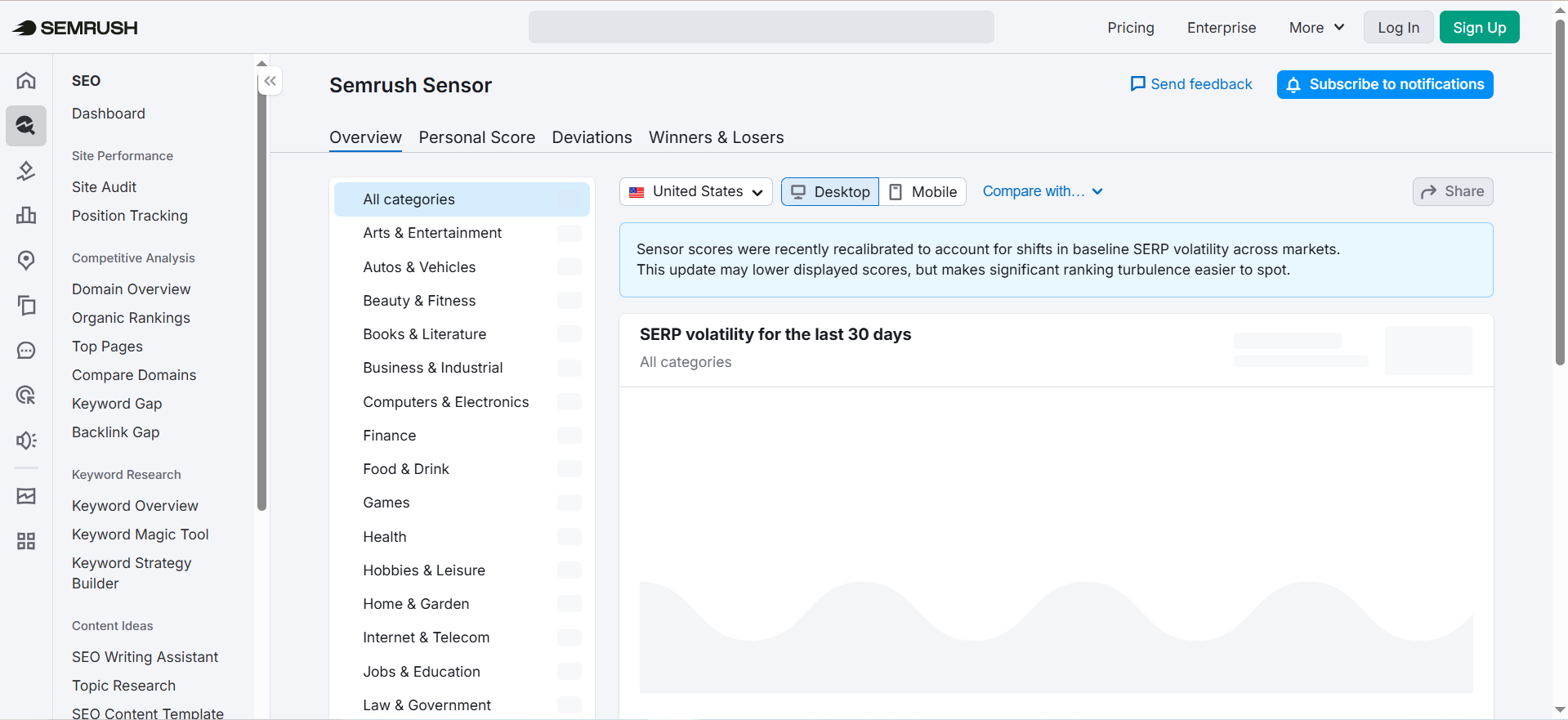
Semrush Sensor is a SERP volatility monitoring tool built into the Semrush platform. It tracks daily fluctuations across Google search results, scores volatility on a 0-to-10 scale, and segments data across 25+ industry categories. In 2025 and 2026, Semrush expanded its tracking to include 38+ SERP features, including AI Overviews, making it possible to see when AI-generated summary boxes appear, disappear, or change composition for your tracked keywords.
Why Teams Use It
SEO teams reach for Semrush Sensor when they need a fast, visual read on whether Google has pushed a core algorithm update or adjusted how often AI Overviews appear across a category. Because Sensor sits inside the broader Semrush suite, there is no extra login or separate billing. Teams that already run Position Tracking campaigns can generate a Personal Score that overlays their own keyword set on top of the global volatility data, giving them a custom view of how their rankings are shifting relative to the market.
What It's Good For
Semrush Sensor excels at answering the question "is something happening in Google right now?" It catches SERP-wide movements before most teams notice them in their own dashboards. The AI Overview tracking layer adds another dimension: you can see whether the share of AI Overviews in a vertical is growing, shrinking, or holding steady, which is critical for forecasting organic traffic trends.
When It's a Good Fit
Semrush Sensor fits best when you are already a Semrush subscriber, when your primary concern is Google's organic search channel, and when you need a single platform for keyword research, rank tracking, backlink audits, and SERP monitoring. Mid-market and enterprise SEO teams running 5,000+ keywords will get the most value because the Personal Score feature becomes more meaningful with scale.
When It's Not a Good Fit
If your primary goal is monitoring brand visibility across multiple AI platforms like ChatGPT, Perplexity, and Copilot, Semrush Sensor falls short. It tracks AI Overviews inside Google but does not extend to third-party LLM platforms. Solo operators or freelancers who only need AI Overview data may find the full Semrush subscription expensive relative to the specific insight they need.
How to Use It
Navigate to Semrush Sensor from the main dashboard. Select your industry category or switch to the "All Categories" view for a global volatility read. Check the SERP Features tab to see the current share of AI Overviews, featured snippets, and other result types. To personalize the data, connect your Position Tracking project and enable the Personal Score. Set up email alerts for volatility spikes above your preferred threshold so you get notified before checking the dashboard manually. The public dashboard is accessible at Semrush Sensor with limited data and no personalization options.
Key Capabilities
Semrush Sensor tracks daily SERP volatility across 25+ categories with desktop and mobile segmentation. It monitors 38+ SERP features including AI Overviews, featured snippets, local packs, knowledge panels, shopping results, video carousels, and Reddit results. The Personal Score feature ties global volatility to your own keyword campaigns. Email alerts notify you of significant fluctuations automatically. The tool integrates natively with Position Tracking, Site Audit, and the rest of the Semrush toolkit.
Pricing
Semrush Sensor is included with all paid Semrush plans. Semrush Pro starts at $139.95/month, Guru at $249.95/month, and Business at $499.95/month. The public Sensor dashboard is accessible for free with limited data and no personalization options.
Free Tier?
Yes. The public Semrush Sensor dashboard is free to use without an account. It shows global volatility scores and category breakdowns but does not include Personal Score, SERP feature drill-downs for your own keywords, or alert functionality. For AI Overview monitoring at the keyword level, you need at least a Pro plan.
Downsides / Limitations
Semrush Sensor does not track brand visibility in ChatGPT, Perplexity, Claude, or any non-Google AI platform. The AI Overview data is aggregated at the category level on the free dashboard, so you cannot see keyword-specific AI Overview appearances without a paid subscription and a Position Tracking project. The tool is designed for volatility detection, not for deep AI citation analysis. If you need to know exactly which URLs are cited inside an AI Overview for a given query, you will need to combine Sensor with Semrush's separate AI Visibility toolkit or a dedicated tool like Profound. For a broader look at tracking brand visibility in AI search results, see our dedicated guide.
2. Algoroo
What It Does
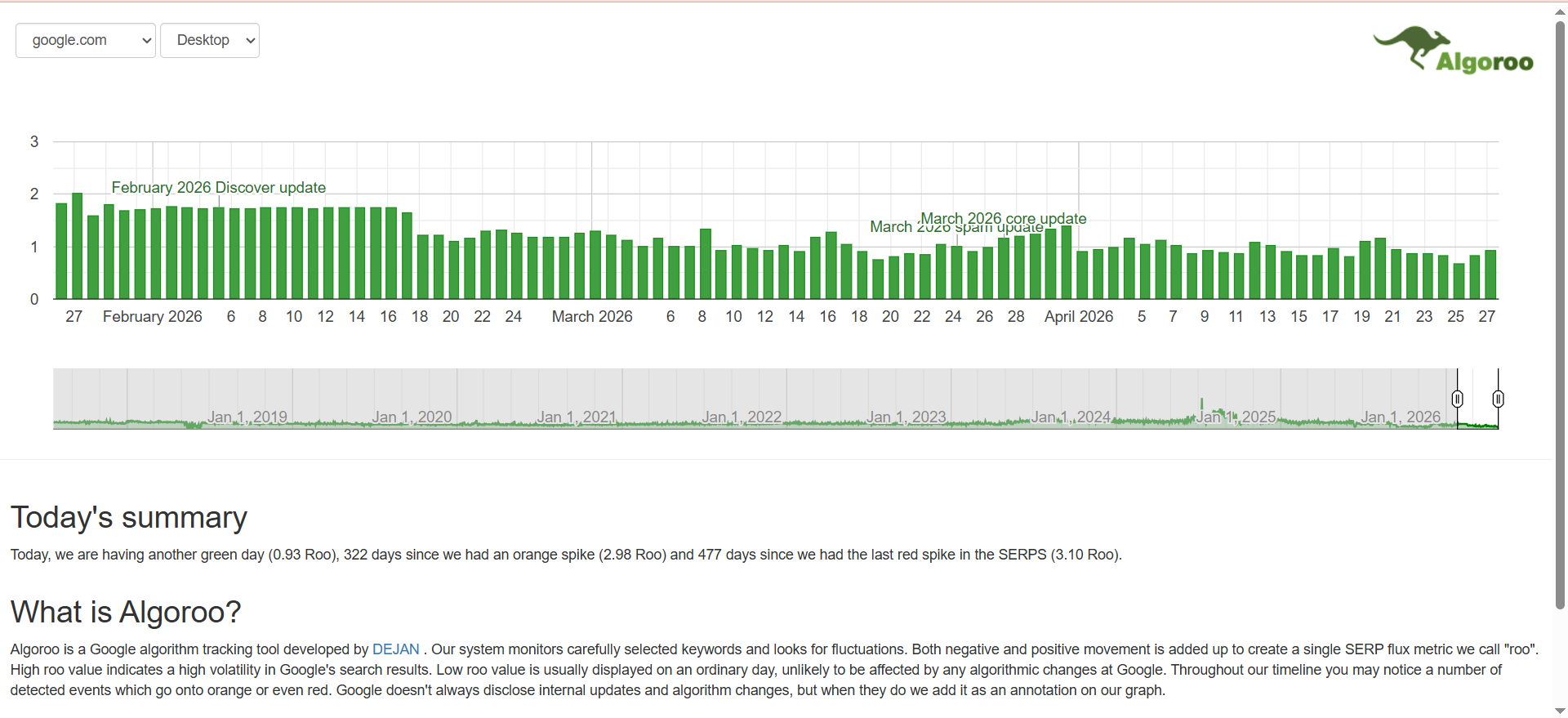
Algoroo is a free Google algorithm tracking tool built by DEJAN, an Australian SEO consultancy. It monitors a curated set of keywords and calculates a proprietary SERP flux metric called "roo" that indicates how volatile Google's search results are on any given day. A high roo value signals major ranking shifts, which often correlate with algorithm updates.
Why Teams Use It
Teams use Algoroo as a quick, no-cost sanity check when rankings drop unexpectedly. Instead of guessing whether a traffic dip is site-specific or algorithm-driven, you open Algoroo, check the roo score, and get an immediate read. Its simplicity is the point. There are no configuration steps, no keyword imports, and no dashboards to set up.
What It's Good For
Algoroo is best at providing a fast, binary signal: "Google changed something" or "Google did not change something." The interactive timeline lets you drag across time periods from 7 days to 2 years, which is useful for correlating historical ranking changes with known algorithm updates. Both desktop and mobile data are available.
When It's a Good Fit
Algoroo fits teams that want a free, zero-setup volatility signal they can check in under 30 seconds. It works well as a secondary validation tool alongside a primary rank tracker. Freelancers, small agencies, and solo SEO practitioners who cannot justify a $100+/month monitoring subscription will find it useful as a first line of defense.
When It's Not a Good Fit
Algoroo does not track AI Overviews directly. It measures overall SERP flux, but it cannot tell you whether AI Overviews are appearing more or less frequently for your keywords, whether your site is being cited, or how your competitors are performing in AI-generated results. If AI Overview monitoring is your primary use case, Algoroo is not the right tool. It also lacks keyword-level granularity, alerting customization, and any integration with broader SEO workflows.
How to Use It
Visit Algoroo. The main dashboard shows the current roo score with a color-coded volatility indicator. Drag the timeline slider to compare today's volatility against historical patterns. Toggle between desktop and mobile views. Subscribe to email alerts to get notified when SERP flux crosses a significant threshold.
Key Capabilities
Algoroo provides a real-time SERP flux metric based on a curated keyword set. It offers an interactive timeline with 7-day to 2-year historical views, desktop and mobile data segmentation, and email alert subscriptions for significant fluctuations.
Pricing
Algoroo is free to use with no paid tiers.
Free Tier?
Yes. Algoroo is entirely free. There are no paid plans, no gated features, and no account registration required to view the volatility data.
Downsides / Limitations
Algoroo does not track AI Overviews, SERP features, or keyword-level ranking data. The "roo" metric is based on DEJAN's own keyword set, not your keywords, so it may not reflect volatility patterns specific to your niche. There is no API, no reporting, and no way to connect it to your SEO stack. The tool has not been updated with AI-era features, so it functions as a legacy volatility signal rather than a modern AI visibility tracker.
3. AccuRanker
What It Does
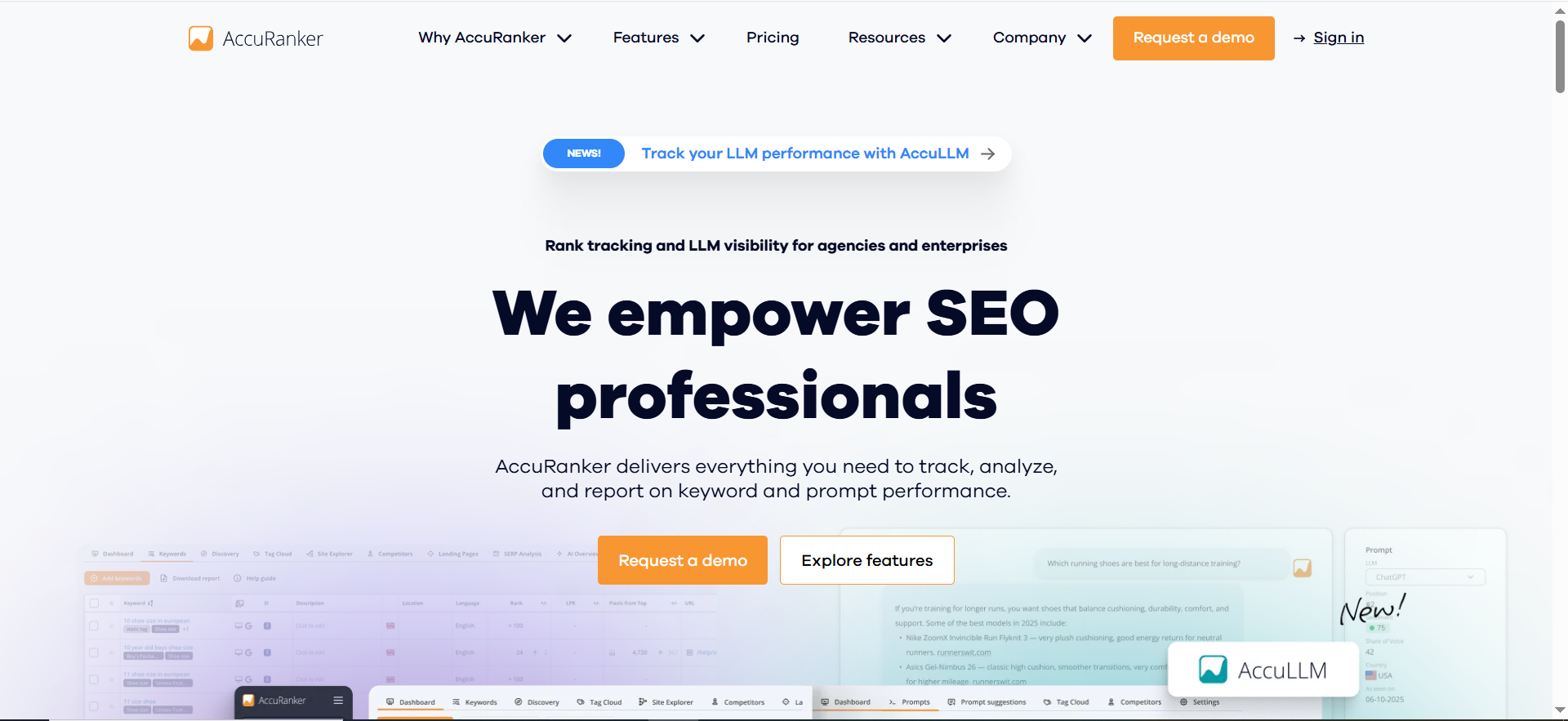
AccuRanker is a high-speed rank tracker built for scale, with on-demand keyword refresh and a 2026 expansion into AI visibility through AccuLLM. It tracks traditional keyword rankings across Google, Bing, YouTube, and local results, and now monitors brand presence across Google AI Overviews, AI Mode, ChatGPT, and Perplexity through its AI Results Tracker feature.
Why Teams Use It
SEO teams and agencies choose AccuRanker when they need fast, accurate rank data they can refresh instantly rather than waiting for daily update cycles. The on-demand refresh is particularly valuable after product launches, pricing updates, or content publishes when you need to see ranking impact within minutes. The AccuLLM addition means teams can now track AI visibility in the same platform where they track organic rankings, reducing tool sprawl.
What It's Good For
AccuRanker is strongest at combining traditional rank tracking with AI visibility monitoring in a single workflow. The data segmentation features let you slice keyword performance by tags, landing pages, SERP features, and now AI citation status. Pixel tracking shows not just position but how much visual real estate your listing occupies, which matters more than ever when AI Overviews push organic results further down the page.
When It's a Good Fit
AccuRanker is a strong fit for mid-market and enterprise SEO teams tracking 5,000 to 50,000+ keywords who want AI visibility data integrated into their existing rank tracking workflow. Agencies managing multiple client domains will benefit from the unlimited users/domains model. Teams that need daily AI Overview monitoring across multiple platforms, combined with instant rank refresh capability, will find AccuRanker more efficient than running separate tools.
When It's Not a Good Fit
AccuRanker's pricing scales with keyword volume, starting at $116/month for 1,000 keywords. While this is accessible for small teams, costs increase as keyword portfolios grow. If you only need AI Overview tracking without traditional rank data, a lighter tool like Profound or even the free Semrush Sensor dashboard would be more cost-efficient.
How to Use It
Add your domains and keyword lists in AccuRanker. Enable AI Results Tracker under the AccuLLM settings to begin monitoring AI Overview citations. Set up keyword tags and segments so you can filter AI visibility data by topic cluster, funnel stage, or content type. Use on-demand refresh to check ranking and AI citation status immediately after content changes. Export data via API or built-in reports for stakeholder reviews.
Key Capabilities
AccuRanker offers on-demand keyword ranking refresh with no waiting period. The AccuLLM AI Results Tracker monitors Google AI Overviews, AI Mode, ChatGPT, Perplexity, and Gemini with daily update cycles. Data segmentation covers tags, landing pages, SERP features, and AI citation status. Pixel tracking measures visual SERP real estate. The platform supports unlimited users and domains, white-label reports, and API access at higher tiers.
Pricing
AccuRanker uses keyword-count-based pricing where all features are included in every plan. Pricing starts at $116/month for 1,000 keywords and scales based on the number of keywords tracked. Plans tracking 5,000 keywords run approximately $269/month, while higher-volume plans for 10,000-25,000 keywords include API access and white-label reports at correspondingly higher price points. A 10% discount is available for annual billing. Custom enterprise pricing is available for larger keyword volumes.
Free Tier?
No. AccuRanker does not offer a free tier. A 14-day free trial is available with full feature access.
Downsides / Limitations
AccuRanker's keyword-based pricing means costs scale with tracking volume, starting at $116/month for 1,000 keywords. While all features including AccuLLM are available on every plan, the per-keyword cost can add up for teams tracking large portfolios. AccuRanker's AI tracking launched in 2026, so the feature set is still maturing compared to AI-native platforms. If your team's only need is AI visibility and you do not require traditional rank tracking, the price-to-value ratio may not work.
4. Sistrix
What It Does
Sistrix is a European-origin SEO suite built around its proprietary Visibility Index, a metric that quantifies a domain's organic search visibility based on ranking positions and search volumes. In 2025-2026, Sistrix added AI Overview tracking filters, prompt monitoring across ChatGPT, Perplexity, Google AI Overviews, and Google AI Mode, and an in-box AIO analysis feature that lets users drill into which queries trigger AI Overviews and which sources are cited.
Why Teams Use It
SEO teams across Europe and increasingly in North America use Sistrix for its 13+ years of historical visibility data, which provides a longer trend line than most competitors. The Visibility Index makes it easy to benchmark domain performance at a glance. With the AI Overview tracking additions, teams can now see how AI-generated results are affecting their visibility score and which competitors are gaining or losing citations in the AI summary boxes.
What It's Good For
Sistrix is strongest at providing a macro-level view of SEO performance over time, combined with granular AI Overview analysis for specific queries. The country-level AI Overview tracking is available across all countries where Google shows AI Overviews, which makes it especially valuable for international SEO teams. The prompt monitoring feature covers ChatGPT, Perplexity, Google AI Overviews, and Google AI Mode, giving a multi-platform view of how your brand appears in AI contexts.
When It's a Good Fit
Sistrix fits best for teams that value historical visibility trends and need AI Overview tracking integrated into a broader SEO intelligence platform. International companies operating across multiple markets will benefit from country-level AIO tracking. Mid-market and enterprise teams that need to report on visibility trends to leadership will appreciate the Visibility Index as a single metric that captures both organic and AI search performance shifts.
When It's Not a Good Fit
North American teams may find the Visibility Index less intuitive than metrics they are used to in tools like Semrush or Ahrefs. Sistrix does not include traditional rank tracking at the keyword level in the same way AccuRanker or Semrush Position Tracking does. The pricing in euros may create budgeting friction for USD-denominated teams. If you need real-time or on-demand rank checks, Sistrix's daily update cycle may feel slow.
How to Use It
Enter your domain in Sistrix to see your Visibility Index score and trend. Navigate to the AI Overviews section to see which of your tracked keywords trigger AI Overviews and whether your domain is cited. Use the prompt monitoring feature to set up brand monitoring across ChatGPT, Perplexity, and Google AI Mode. Compare your AI visibility against competitors using the domain comparison view. Export data for reporting or connect via API.
Key Capabilities
Sistrix offers the Visibility Index with 13+ years of historical data across multiple countries. AI Overview tracking is available with filter options and in-box AIO analysis. Prompt monitoring covers ChatGPT, Perplexity, Google AI Overviews, and Google AI Mode. The platform includes keyword research, backlink analysis, competitor benchmarking, and domain comparison tools. API access is available on Professional plans and above.
Pricing
Sistrix Starter costs €119/month (~$130/month), Plus costs €239/month (~$260/month), Professional costs €419/month (~$457/month) with API access and 6 user seats, and Premium costs €799/month (~$870/month). Custom enterprise pricing is also available.
Free Tier?
No. Sistrix does not offer a permanent free tier. A 14-day free trial is available.
Downsides / Limitations
The Visibility Index is proprietary and may not align with the metrics your team already tracks. Keyword-level rank tracking is less granular than dedicated rank trackers like AccuRanker. Pricing in euros means costs fluctuate for non-EU teams. The prompt monitoring feature, while multi-platform, has prompt volume limits on lower tiers. North American keyword databases are strong but historically not as deep as European coverage.
5. Profound
What It Does
Profound is an AI-first search visibility platform designed specifically for monitoring and optimizing brand presence across AI search engines. It tracks ChatGPT, Perplexity, Google AI Overviews, Google AI Mode, Google Gemini, Microsoft Copilot, Claude, and Grok, with Amazon Rufus coverage coming soon. Unlike traditional SEO tools that added AI tracking as an extension, Profound was built from the ground up for the AI search era.
Why Teams Use It
Teams turn to Profound when their primary concern is AI search visibility rather than traditional organic rankings. The platform does not just monitor whether your brand is mentioned. It analyzes the full response context, tracks which competitors are cited alongside you, and identifies optimization opportunities through its AI-powered Opportunities panel. The content generation agents can automatically produce content optimized for AI search engines, making it an active optimization tool rather than a passive monitor.
What It's Good For
Profound is strongest at deep, multi-platform AI visibility analysis. It covers more AI platforms than any other tool in this comparison, including niche platforms like Claude and Grok that most competitors ignore. The Opportunities panel identifies specific content gaps where your brand is missing from AI responses, and the content agents can draft optimized content to fill those gaps. For teams where AI search is a primary traffic or brand visibility channel, Profound provides the most complete picture.
When It's a Good Fit
Profound fits teams that are specifically investing in AI search optimization, whether that is ensuring their SaaS product gets mentioned in ChatGPT comparisons, their ecommerce brand appears in Perplexity shopping queries, or their content gets cited in Google AI Overviews. Growth-stage SaaS companies, DTC brands with AI-savvy audiences, and agencies offering AI visibility services will get the highest ROI. Teams already running a traditional SEO tool and looking for a dedicated AI visibility layer will find Profound a natural complement.
When It's Not a Good Fit
Profound does not replace a traditional rank tracker or SEO suite. If you need keyword-level Google rank data, backlink analysis, or site audits, you will still need Semrush, Ahrefs, or a similar platform. The $99/month Starter plan is limited to ChatGPT tracking with 50 prompts, which is too narrow for most teams. The meaningful feature set starts at $399/month, which may be hard to justify for teams where AI search is still a small share of traffic. Enterprise pricing at $2,000+ puts full-scale deployment out of reach for small businesses.
How to Use It
Sign up at Profound and connect your brand profile. Set up prompt tracking by defining the queries and topics that matter to your business. Profound will begin monitoring how AI platforms respond to those prompts, tracking your brand's presence, competitor citations, and response sentiment. Review the Opportunities panel to identify gaps. Use the content agents to generate optimized content for underperforming topics. Track progress through the analytics dashboard and export reports for stakeholders.
Key Capabilities
Profound tracks 8+ AI platforms including ChatGPT, Perplexity, Google AI Overviews, Google AI Mode, Gemini, Copilot, Claude, and Grok. Multi-LLM response analysis shows not just mentions but citation context, competitor presence, and sentiment. The Opportunities panel identifies content gaps across AI platforms. AI content generation agents produce optimized content for AI search. Google Analytics integration connects AI visibility to site traffic and conversions. Enterprise plans include SSO/SAML, SOC2 compliance, dedicated Slack support, and unlimited view-only seats.
Pricing
Profound Starter costs $99/month for 50 prompts on ChatGPT only. The Lite plan costs $499/month and adds Perplexity, Copilot, and AI Overviews with expanded prompt volume. The Growth plan costs $399/month for 100 prompts across ChatGPT, Perplexity, and Google AI Overviews, including AI content generation and the Opportunities panel. Enterprise pricing starts at $2,000/month for full platform coverage including Google AI Mode, Gemini, Claude, Meta AI, and Grok, with unlimited prompts, API access, and unlimited seats.
Free Tier?
No. Profound does not offer a free tier or free trial at present.
Downsides / Limitations
The Starter plan at $99/month only covers ChatGPT with 50 prompts, which is too restrictive for meaningful monitoring. The Lite plan at $499/month adds more platforms but remains limited. The features that make Profound valuable, including multi-platform tracking, content agents, and the Opportunities panel, require the $399/month Growth plan. Enterprise pricing is steep. Platforms like Google AI Mode, Gemini, Claude, and Grok require Enterprise access. Profound does not include traditional SEO features like rank tracking, backlink analysis, or technical audits, so it always needs to be paired with another tool. The platform is relatively new compared to established SEO suites, so the historical data depth is limited.
What Is an AI Overviews Checker and Why Does It Matter for SEO?
An AI overviews checker is a software tool that monitors whether your website, brand, or content appears inside Google's AI-generated search summaries. These summaries, called AI Overviews, appear at the top of search results for an increasing share of queries and pull information from web sources that Google's AI deems most relevant. The tool tracks which queries trigger AI Overviews, whether your pages are cited as sources, how frequently you appear compared to competitors, and how those appearances change over time.
This matters for SEO because AI Overviews are restructuring how organic traffic flows. Teams evaluating their options should also review the best solutions for Google AI Overviews tracking for a broader comparison. When Google answers a query directly inside an AI Overview, users may never scroll down to the traditional organic listings. Research from Sistrix found that AI Overviews cost Germany alone 265 million organic clicks per month. If your content is cited inside the AI Overview, you retain visibility and potentially earn clicks through the source links. If your competitor is cited instead, you lose a position you might have won through traditional ranking. An AI overviews checker gives you the data to see where you stand and where to focus your optimization efforts.
How Do AI Overviews Affect Organic Click-Through Rates?
AI Overviews compress the organic results further down the page, which reduces click-through rates for positions that previously sat above the fold. When a user's query is fully answered by the AI Overview, the incentive to click any organic result drops significantly. This effect is most pronounced for informational queries where the AI Overview provides a complete, self-contained answer.
However, the impact is not uniformly negative. Sites that are cited as sources within the AI Overview can see higher click-through rates on those specific listings because the citation functions as an endorsement from Google's AI. The challenge is that citation spots are limited, typically three to five sources per AI Overview, and the selection criteria are opaque. Monitoring tools like Semrush Sensor and AccuRanker help you track whether your CTR is rising or falling in the context of AI Overview appearances, so you can adjust your AI search optimization strategy accordingly rather than guessing.
Can You Track AI Overviews for Free?
Yes, but with significant limitations. The free options include the public Semrush Sensor dashboard, which shows aggregate SERP volatility and AI Overview prevalence by category but does not let you monitor your own keywords. Algoroo provides free SERP volatility data but does not track AI Overviews at all. You can also manually search Google for your target queries and visually check whether an AI Overview appears and whether your site is cited, but this approach is inconsistent, time-consuming, and does not scale.
For meaningful, keyword-level AI Overview tracking, you will need a paid tool. The lowest-cost entry point for dedicated AI search monitoring is Profound at $99/month, though that tier only tracks ChatGPT and does not include AI Overview tracking. Semrush's Pro plan at $139.95/month gives you AI Overview data within the broader Position Tracking tool. If budget is the primary constraint, the free Semrush Sensor dashboard combined with periodic manual checks is the most practical zero-cost approach.
What Is the Difference Between SERP Volatility Tracking and AI Overview Monitoring?
SERP volatility tracking, offered by tools like Semrush Sensor and Algoroo, measures how much Google's search result rankings are changing on any given day. A high volatility score indicates that many keywords are shifting positions, which often correlates with an algorithm update. This is a market-level signal that tells you "something changed" but does not explain what changed or how it specifically affects AI-generated results.
AI Overview monitoring is a more targeted capability. It tracks whether specific queries trigger an AI Overview, which sources are cited inside the summary, how your brand compares to competitors in citation frequency, and how these patterns change over time. Tools like AccuRanker, Sistrix, and Profound provide this level of detail. The two capabilities complement each other: SERP volatility tracking tells you when to investigate, and AI Overview monitoring tells you what happened to your AI visibility specifically. Most teams benefit from having both.
How Do You Get Your Site Cited in Google AI Overviews?
Getting cited in Google AI Overviews requires a combination of strong traditional SEO fundamentals and content structured for AI extraction. Google's AI pulls from sources that already rank well organically for the target query, so the foundation is still strong keyword targeting, authoritative backlinks, and technically sound site infrastructure. Beyond that, several content practices increase your chances of citation.
First, provide clear, direct answers to the query within the first few paragraphs of your page. AI systems favor content that answers the question concisely before expanding into detail. Second, use structured data markup including FAQ schema, HowTo schema, and product schema where relevant, so Google can parse your content programmatically. Third, include comparison tables, numbered lists, and definition blocks that are easy for AI systems to extract and summarize. Fourth, maintain factual accuracy and cite credible sources, since Google's AI is more likely to reference content that demonstrates expertise and trustworthiness. For a deeper dive, see our guide on best practices for optimizing content for Google AI Overviews. Fifth, keep your content updated regularly, because AI Overviews tend to favor recent, current information over dated pages.
Monitoring tools like AccuRanker and Profound can show you which of your pages are already being cited and which are losing citations, giving you a feedback loop to refine your optimization approach.
Which AI Overviews Checker Works Best for Enterprise SEO Teams?
Enterprise SEO teams need an AI overviews checker that supports large keyword volumes, multi-user access, API integrations, custom reporting, and cross-platform monitoring. For teams managing large content operations, our guide to the best AI content optimization tools for large teams covers complementary tooling. Based on these requirements, AccuRanker and Sistrix are the strongest options.
AccuRanker's unlimited users/domains model, on-demand keyword refresh, and AccuLLM AI Results Tracker provide the scale and speed enterprise teams need. Higher-volume plans include API access and white-label reports, making them suitable for agencies and in-house teams managing large portfolios. Sistrix's Visibility Index provides a unique macro-level metric that makes executive reporting straightforward, and its country-level AI Overview tracking is valuable for global enterprises. The Professional plan at €419/month supports 6 users and includes API access.
For enterprises where AI search visibility is a strategic priority rather than just a monitoring need, Profound's Enterprise plan offers the deepest AI-platform coverage with SSO, SOC2 compliance, and dedicated support, though the $2,000+/month price point reflects that positioning.
How Often Should You Check Your AI Overview Visibility?
The right cadence depends on how fast your competitive landscape moves and how much your traffic depends on queries that trigger AI Overviews. Most teams should check AI Overview data at minimum weekly, reviewing which keywords are triggering AI Overviews, whether their citation count is rising or falling, and whether new competitors have entered the AI Overview results.
Teams in fast-moving verticals like SaaS, fintech, and ecommerce should consider daily monitoring, especially for high-value commercial keywords. AccuRanker's on-demand refresh and daily AI update cycles support this cadence. After publishing new content or making significant site changes, an immediate check is valuable to see if the update has affected your AI citation status. Sistrix and Profound provide daily update cycles that support this workflow without requiring manual intervention. Setting up automated alerts, available in Semrush Sensor and AccuRanker, reduces the need for manual checking while ensuring you catch major shifts quickly. For a full rundown of cadence and tooling, see our AI search monitoring best practices guide.
Do AI Overviews Checkers Also Track ChatGPT and Perplexity Mentions?
Some do, but not all. Semrush Sensor and Algoroo focus exclusively on Google and do not track any third-party AI platforms. AccuRanker, Sistrix, and Profound all extend beyond Google AI Overviews to cover additional AI platforms, but the breadth varies.
AccuRanker's AccuLLM tracks ChatGPT, Perplexity, AI Overviews, and Google AI Mode. Sistrix's prompt monitoring covers ChatGPT, Perplexity, Google AI Overviews, and Google AI Mode. Profound has the broadest coverage, tracking ChatGPT, Perplexity, Google AI Overviews, Google AI Mode, Gemini, Copilot, Claude, and Grok, with Amazon Rufus planned.
If cross-platform AI visibility is important to your strategy, prioritize tools that track the specific platforms your audience uses. For most B2B SaaS companies, ChatGPT and Perplexity are the highest-priority platforms after Google AI Overviews. For ecommerce brands, Perplexity and the upcoming Amazon Rufus integration in Profound may be more relevant.
FAQs
The best free option is the public Semrush Sensor dashboard, which shows aggregate SERP volatility and AI Overview prevalence by industry category. It does not track your specific keywords, but it gives you a useful market-level signal. Algoroo is also free but does not track AI Overviews directly. For keyword-level AI Overview data, you will need a paid tool.
Yes. AccuRanker and Sistrix both combine traditional rank tracking with AI Overview monitoring in a single platform. AccuRanker is the better option if on-demand rank refresh and high-frequency data are priorities. Sistrix is stronger for historical visibility analysis and international coverage.
Accuracy depends on the tool and how it collects data. Tools like AccuRanker and Sistrix check Google's actual search results programmatically and report what they find, so the detection accuracy for whether an AI Overview appears is generally high. The bigger accuracy question is around citation tracking, specifically whether the tool correctly identifies which URLs are cited inside the AI Overview. Established tools with large crawling infrastructure tend to be more reliable here than newer startups.
If you are already using Semrush, the Sensor tool and AI Visibility toolkit give you baseline AI Overview data at no extra cost. However, if AI search visibility is a growing strategic priority, a dedicated tool like Profound or AccuRanker's AccuLLM provides deeper, more actionable data. Ahrefs does not currently offer the same level of AI Overview tracking as Semrush, so Ahrefs users may benefit more from adding a dedicated AI brand visibility checking tool.
AccuRanker and Sistrix both offer robust APIs at their higher-tier plans. AccuRanker's API is available on higher-volume plans and provides access to rank data, SERP features, and AI visibility metrics. Sistrix's API is available on Professional plans (€419/month) and above. Profound offers API access on Enterprise plans ($2,000+/month). For most teams, AccuRanker offers the best balance of API capability and price.