Best AI Mode Rank Tracker (2026)
How B2B companies and SaaS companies can shortlist the best ai mode rank tracker tools for generate pipeline without wasting evaluation cycles.


This playbook helps SEO specialists and content managers compare the best ai mode rank tracker options for SEO and AI search. It breaks down where semrush-sensor, algoroo stand out, when alternatives such as semrush, ahrefs make more sense, and which setup fits B2B companies and SaaS companies and solo operators and small businesses.
If your SEO team still tracks only traditional Google rankings, you are missing the shift. Google AI Mode, ChatGPT, Perplexity, and Gemini now generate answers that cite sources differently from the classic ten blue links. The best AI mode rank tracker tools let you see whether your brand appears in those AI-generated responses, how often you are cited, and where you rank relative to competitors. This guide compares the five strongest options for 2026, explains what each does well (and where each falls short), and helps you pick the right stack for your team, budget, and workflow. The tools covered are Semrush Sensor, AccuRanker, Sistrix, Profound, and Algoroo.
Table of Contents
Best AI Mode Rank Tracker Tools (Quick Comparison)
| Tool | Best For | AI Platforms Tracked | Starting Price | Free Tier? |
|---|---|---|---|---|
| Semrush Sensor | All-in-one SEO + AI visibility | Google AI Mode, ChatGPT, Gemini, Bing | $199/mo (Semrush One Starter) | No (7-day free trial) |
| AccuRanker | Fast, prompt-level AI rank tracking | ChatGPT, Perplexity, AI Overviews, AI Mode | $116/mo (1,000 keywords) | No (14-day free trial) |
| Sistrix | European SEO teams and Visibility Index | ChatGPT, Gemini, DeepSeek, AI Overviews | €119/mo (~$130) Start plan | No |
| Profound | Enterprise AI visibility at scale | 10+ platforms incl. Grok, Meta AI, DeepSeek | $99/mo (Starter) | No |
| Algoroo | Free Google algorithm volatility monitoring | Google SERP volatility only | Free | Yes |
Best AI Mode Rank Tracker Tools (Quick Comparison)
1. Semrush Sensor
What It Does
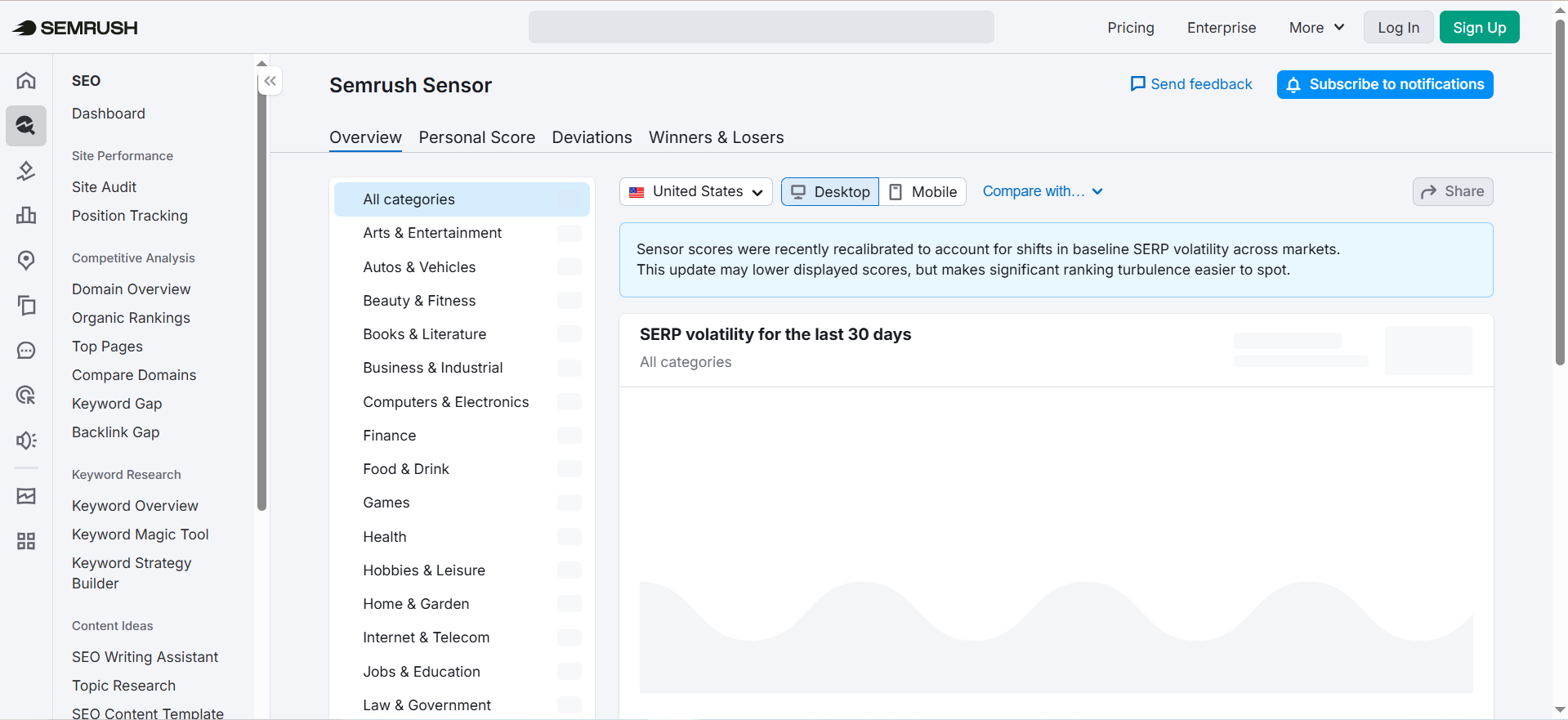
Semrush Sensor is part of the broader Semrush platform, which combines traditional SEO tools with a dedicated AI Visibility Toolkit. The Sensor specifically monitors daily fluctuations in Google search results across 20+ categories on both mobile and desktop. When paired with Semrush's Position Tracking tool, you can select Google AI Mode as a search engine and track your brand's AI visibility, mentions, and average AI Mode position across tracked prompts.
Why Teams Use It
Semrush is already the default SEO platform for many marketing teams. Adding AI Mode tracking to an existing Semrush subscription means there is no new vendor to onboard, no new login to manage, and no new reporting pipeline to build. The AI Visibility Toolkit adds ChatGPT, Gemini, and Google AI Mode tracking on top of the traditional rank tracking, backlink analysis, and site audit tools that teams already rely on.
What It Is Good For
Semrush Sensor is strong when you need a single platform that covers both traditional SEO and AI search visibility. The Sensor dashboard shows SERP volatility by industry, which helps SEO specialists spot algorithm updates early. The Position Tracking tool lets you track AI Mode positions alongside organic positions in the same project, making it easy to compare how a keyword performs in classic search versus AI-generated results.
When It Is a Good Fit
Semrush Sensor fits teams that already use Semrush for SEO and want to add AI visibility without switching platforms. It is a strong choice for mid-market and enterprise B2B companies that need a single reporting layer across organic, AI, and competitive intelligence. If your team tracks hundreds or thousands of keywords and needs AI Mode data in the same dashboard, this is the cleanest path.
When It Is Not a Good Fit
If you only need AI search tracking and do not use traditional SEO tools, the full Semrush subscription is expensive overhead. The AI Visibility Toolkit is a $99/month add-on to plans that start at $139.95/month, so the minimum cost for AI Mode tracking through Semrush is roughly $239/month. Teams that need deep prompt-level tracking across many LLMs may find AccuRanker or Profound more focused.
How to Use It
Sign up for a Semrush Pro, Guru, or Business plan (or Semrush One bundle starting at $199/month). Add the AI Visibility Toolkit for $99/month. In Position Tracking, create a project for your domain, select Google AI Mode as the search engine, and add the prompts or keywords you want to monitor. The dashboard will show your brand's AI visibility score, owned sources, citation positions, and competitor comparisons.
Key Capabilities
Semrush Sensor tracks SERP volatility across 20+ industries. Position Tracking supports Google, Bing, Baidu, ChatGPT, and Google AI Mode. The AI Visibility Toolkit shows brand mentions, citation sources, AI visibility scores, and competitor overlap in AI-generated answers. Reporting integrates with Looker Studio and PDF exports.
Pricing
Semrush One bundles start at $199/month (Starter), $299/month (Pro+), and $549/month (Advanced). Classic SEO plans are $139.95/month (Pro), $249.95/month (Guru), and $499.95/month (Business). The AI Visibility Toolkit is an additional $99/month add-on to any classic plan. Annual billing saves up to 17%.
Free Tier?
No permanent free tier. Semrush offers a 7-day free trial of the platform. The AI Visibility Toolkit does not have a separate free trial.
Downsides and Limitations
The AI Visibility Toolkit is an add-on, not included in base plans, which increases the total cost. AI Mode tracking is limited to Google AI Mode and ChatGPT as search engine options in Position Tracking. The Sensor itself tracks SERP volatility but does not provide prompt-level AI citation analysis on its own. The platform can feel bloated for teams that only need AI tracking.
2. AccuRanker
What It Does
AccuRanker is a dedicated rank tracking platform known for speed and data granularity. Its AccuLLM feature extends tracking into AI search, letting you monitor how your brand performs across ChatGPT, Perplexity, AI Overviews, and Google AI Mode. You can track visibility across custom prompts, monitor brand sentiment in AI answers, see which sources are cited, and analyze competitor positioning in LLM-generated results.
Why Teams Use It
AccuRanker updates rankings on demand, not on a fixed daily schedule. This makes it the fastest rank tracker for teams that need fresh data before a client call, after a content push, or during an algorithm update. The AccuLLM module brings the same speed-first philosophy to AI search tracking, letting you check prompt-level AI visibility without waiting for a daily crawl.
What It Is Good For
AccuRanker excels at high-volume keyword tracking with fast refresh cycles. The platform supports 50+ filters, unlimited users, unlimited domains, and unlimited API calls on every plan. AccuLLM adds prompt tracking across multiple AI platforms, sentiment analysis of AI-generated answers, and source citation monitoring. The combination of traditional rank tracking speed and AI visibility makes it strong for agencies and in-house SEO teams managing multiple domains.
When It Is a Good Fit
AccuRanker fits agencies and mid-to-large SEO teams that manage thousands of keywords across multiple domains and need real-time refresh capability. It is a strong choice when the team needs detailed prompt-level AI tracking alongside traditional rank data. The unlimited users and API access on all plans make it good for teams that feed rank data into custom dashboards or BI tools via Looker Studio or BigQuery.
When It Is Not a Good Fit
Plans start at $116/month for 1,000 keywords (and $224/month for 2,000 keywords on the Professional tier), which can still be expensive for solo practitioners or small teams tracking fewer than 500 keywords. AccuRanker does not include site audit, backlink analysis, or content optimization tools, so teams needing an all-in-one SEO suite will still need a second platform. The AccuLLM feature is relatively new, so platform coverage may lag behind specialists like Profound.
How to Use It
Sign up for a Professional, Expert, or Enterprise plan based on keyword volume. Add your domains and keyword lists. Use the AccuLLM module to create prompt sets for AI tracking. Set up automated reports and connect Looker Studio or BigQuery for custom dashboards. Use on-demand refresh to pull fresh rankings before reporting.
Key Capabilities
On-demand rank refresh (not locked to daily schedule). AccuLLM tracks ChatGPT, Perplexity, AI Overviews, and Google AI Mode. 50+ filters for segmenting keyword data. Unlimited users, domains, and API calls on all plans. Looker Studio and BigQuery integrations. Competitor discovery and SERP feature tracking. Proprietary AI models for keyword insights.
Pricing
Plans start at $116/month for 1,000 keywords. The Professional plan starts at $224/month for 2,000 to 5,000 keywords. Expert plan starts at $764/month for 10,000 to 25,000 keywords. Enterprise plans are custom-priced. Annual billing gives a 10% discount. All plans include unlimited users, domains, and API calls.
Free Tier?
No permanent free tier. AccuRanker offers a 14-day free trial with full access to all features.
Downsides and Limitations
No built-in site audit, backlink analysis, or content tools. The starting price is higher than competitors for low keyword volumes. AccuLLM coverage across AI platforms is growing but not yet as broad as Profound. The interface is data-dense, which can overwhelm new users who are not experienced SEO practitioners.
3. Sistrix
What It Does
Sistrix is a European-origin SEO visibility platform built around the Sistrix Visibility Index, which has been the standard metric for SEO performance in the DACH region (Germany, Austria, Switzerland) for over a decade. In 2026, Sistrix expanded into AI search tracking with its AI/Chatbots Tracker and AI Visibility Index, which measure how brands appear in responses from ChatGPT, Gemini, and DeepSeek across millions of prompts.
Why Teams Use It
For European SEO teams, particularly those focused on German-speaking markets, the Sistrix Visibility Index is the industry-standard benchmark. Clients, stakeholders, and competitors all reference it. Adding AI visibility tracking to the same platform means the team can report on traditional SEO and AI search performance using a single, recognized metric system.
What It Is Good For
Sistrix queries 10 million prompts per language across three major LLMs (ChatGPT, Gemini, DeepSeek) to calculate its AI Visibility Index. This large-scale approach gives a broad view of how a brand is cited across AI answers, not just for the prompts you manually track. The Q1 2026 update added AI Mode tracking, improved brand recognition, and a new Looker Studio Connector for custom reporting.
When It Is a Good Fit
Sistrix is the strongest choice for SEO teams operating in European markets, especially DACH. If your stakeholders already use the Sistrix Visibility Index as their SEO KPI, adding AI tracking to the same platform avoids the reporting fragmentation that comes with a separate AI tool. It also fits teams that want a broad, automated AI visibility measurement rather than manual prompt-by-prompt tracking.
When It Is Not a Good Fit
Sistrix is weaker for US-focused teams where the Visibility Index is not the industry standard. The AI/Chatbots Tracker currently covers three LLMs (ChatGPT, Gemini, DeepSeek), which is narrower than Profound's 10+ platform coverage. Teams that need granular prompt-level control and real-time refresh will find AccuRanker more responsive. The pricing is in Euros, which adds currency conversion complexity for non-European teams.
How to Use It
Choose a plan (Start, Plus, Professional, or Premium) based on user seats and project count. Use the Visibility Index dashboard to monitor traditional SEO performance. Navigate to the AI/Chatbots section to view AI Visibility Index scores across ChatGPT, Gemini, and DeepSeek. Set up custom prompt sets in the AI Tracker for focused monitoring. Connect Looker Studio for automated reporting.
Key Capabilities
Sistrix Visibility Index for traditional SEO benchmarking. AI Visibility Index calculated across 10 million prompts per language. AI/Chatbots Tracker for ChatGPT, Gemini, and DeepSeek. AI Mode tracking added in Q1 2026. Competitor AI visibility comparison. Looker Studio Connector. Onpage Projects for technical SEO. Up to 13 years of historical data on Professional plans.
Pricing
Start plan at €119/month (~$130) for 1 user and 3 projects. Plus plan at €239/month (~$261) for 3 users and 15 projects. Professional plan at €419/month (~$457) for 6 users, 40 projects, and API access. Premium plan at €799/month (~$871) for 12 users and 100 projects. Enterprise pricing is custom. All plans are month-to-month cancelable with annual discounts available.
Free Tier?
No permanent free tier. Sistrix offers limited free lookups for the Visibility Index.
Downsides and Limitations
The AI Visibility Index covers three LLMs, fewer than some competitors. The platform's strength is concentrated in European markets, and US-focused teams may find less community support and fewer benchmarks. Prompt-level customization is less granular than AccuRanker. Pricing is in Euros, which can complicate budgeting for non-European companies. The learning curve for the full platform is moderate.
4. Profound
What It Does
Profound is a dedicated AI visibility platform built for enterprise teams that need to understand how their brand appears across the entire AI discovery ecosystem. It tracks citations, mentions, and visibility across 10+ AI platforms including ChatGPT, Gemini, Perplexity, Grok, Meta AI, DeepSeek, and Google AI Mode. Profound introduced the concept of Share of Synthesis, which measures how much of an AI-generated response is derived from a brand's content.
Why Teams Use It
Profound is purpose-built for AI search visibility, not retrofitted from a traditional SEO tool. This means every feature, metric, and workflow is designed around how AI engines cite, reference, and synthesize brand information. Enterprise teams use it because it offers the broadest platform coverage, proprietary Prompt Volumes data (estimating actual search demand within LLMs), and an Opportunities Panel that gives specific, named actions to improve AI visibility.
What It Is Good For
Profound excels at enterprise-scale AI visibility monitoring. The Share of Synthesis metric goes beyond simple citation counting to measure how deeply a brand's information is woven into AI responses. The Prompt Volumes dataset helps teams prioritize content based on real user conversations inside LLMs, not just traditional search volume. Automated Agents handle content creation and accuracy analysis to prevent hallucinations about the brand.
When It Is a Good Fit
Profound fits Fortune 500 companies and large enterprise marketing teams that need comprehensive AI visibility across every major platform. It is the right choice when the brand is large enough that AI engines actively synthesize information about it, and the team needs to control the narrative across ChatGPT, Gemini, Perplexity, Grok, and others simultaneously. SOC 2 Type II compliance and SSO integration make it viable for security-conscious organizations.
When It Is Not a Good Fit
At $99/month for Starter (ChatGPT only) and $399/month for Growth (and significantly more for enterprise), Profound is expensive for small and mid-market teams that need meaningful multi-platform coverage. It does not include traditional SEO rank tracking, site audit, or backlink tools, so it must be paired with a separate SEO platform. The enterprise focus means the interface and workflows are optimized for large teams with dedicated AI visibility roles, which can feel like overkill for a two-person SEO team.
How to Use It
Sign up for Profound Starter ($99/month) for ChatGPT-only tracking, or the Growth plan ($399/month) for multi-platform coverage. Contact sales for enterprise pricing covering multiple brands and all platforms. Configure your brand profile and competitor set. Use the dashboard to monitor Share of Synthesis, citation sources, and visibility trends across all tracked AI platforms. Review the Opportunities Panel for actionable recommendations. Set up automated Agents for content accuracy monitoring.
Key Capabilities
Share of Synthesis metric for AI response analysis. Prompt Volumes dataset estimating LLM search demand. Opportunities Panel with named, actionable recommendations. 10+ platform coverage including Grok, Meta AI, DeepSeek. Automated Agents for content creation and hallucination prevention. SOC 2 Type II compliance and SSO. Competitor benchmarking across all tracked platforms.
Pricing
Profound Starter costs $99/month for ChatGPT-only tracking with 50 prompts. The Growth plan costs $399/month for 100 prompts across ChatGPT, Perplexity, and Google AI Overviews, including AI content generation and the Opportunities panel. Enterprise plans are custom-priced (typically $2,000+/month) for full platform coverage including Google AI Mode, Gemini, Claude, Meta AI, and Grok, with unlimited prompts and API access.
Free Tier?
No free tier or free trial.
Downsides and Limitations
High entry price excludes small teams and solo practitioners. No traditional SEO tools included, requiring a separate platform for rank tracking, backlinks, and site audits. The Lite plan only covers one company, so agencies monitoring multiple clients need enterprise pricing. The platform is relatively new compared to established SEO tools, so the community, training resources, and third-party integrations are still growing.
5. Algoroo
What It Does
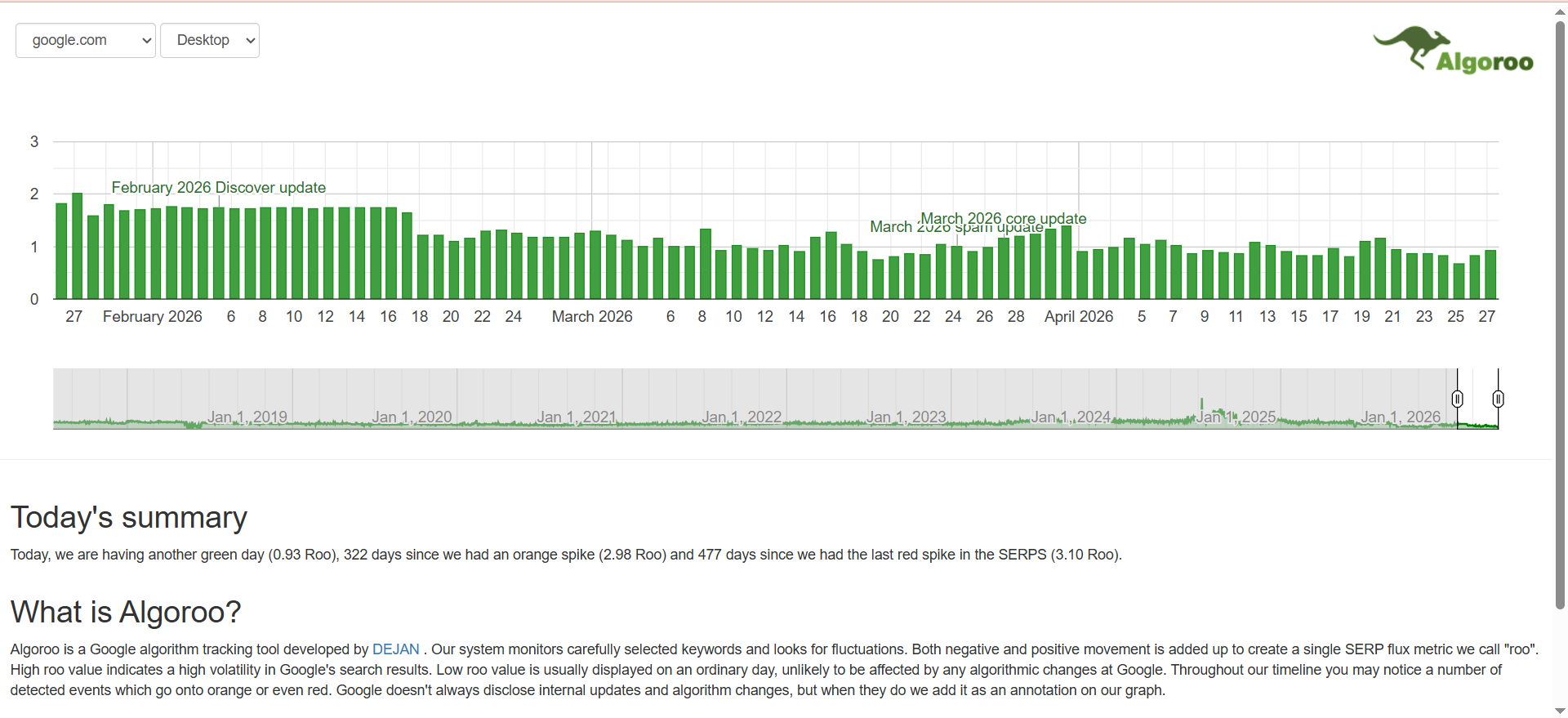
Algoroo is a free Google algorithm tracking tool developed by DEJAN, an Australian SEO consultancy. It monitors a curated set of keywords and calculates a SERP flux metric called the "roo" to indicate the volatility of Google's search results. A high roo value signals that Google may be rolling out an algorithm update, while a low value indicates a stable day.
Why Teams Use It
Algoroo is free and requires no account setup for basic access. SEO specialists use it as a quick check when rankings suddenly shift. Rather than spending time diagnosing whether a ranking drop is caused by an algorithm update or an on-site issue, a quick look at Algoroo's flux chart tells you whether the entire SERP landscape is moving.
What It Is Good For
Algoroo is good for one thing and does it well: showing Google SERP volatility over time. The interactive chart lets you drag across time periods from 7 days to 2 years to spot patterns. It is a lightweight complement to more comprehensive rank trackers, giving you a free, at-a-glance signal that helps contextualize ranking movements.
When It Is a Good Fit
Algoroo fits any SEO practitioner who needs a free, no-setup way to check whether Google is experiencing unusual SERP fluctuations. It is useful as a secondary signal alongside your primary rank tracker. If you are a solo freelancer or a small team with a tight budget, Algoroo provides algorithm volatility data that would otherwise require a paid tool.
When It Is Not a Good Fit
Algoroo does not track AI Mode, ChatGPT, Perplexity, or any AI-generated search results. It does not track individual keyword rankings, domain visibility, or brand citations. It is purely a SERP volatility indicator for traditional Google search. Teams that need AI search visibility tracking will need one of the other tools on this list.
How to Use It
Visit Algoroo. View the SERP flux chart on the homepage. Drag the time selector to zoom into specific date ranges. Use the roo metric to assess whether current SERP volatility is above or below normal. Cross-reference with your primary rank tracker to determine whether ranking changes are algorithm-driven or site-specific.
Key Capabilities
SERP flux metric (roo) calculated from curated keyword monitoring. Interactive time-range chart (7 days to 2 years). Mobile and desktop SERP volatility tracking. Free access with no account required.
Pricing
Free.
Free Tier?
Yes. Algoroo is entirely free to use.
Downsides and Limitations
No AI search tracking of any kind. No individual keyword or domain rank tracking. No brand citation or mention monitoring. No API or data export. The curated keyword set is not customizable. Limited to Google SERP volatility only. No competitor analysis. No reporting or integration features.
What Is an AI Mode Rank Tracker and Why Does It Matter in 2026
An AI mode rank tracker is a tool that monitors how your brand, domain, or content appears in AI-generated search results. Google AI Mode, which rolled out broadly in 2025 and expanded through 2026, generates conversational answers that cite sources instead of (or alongside) traditional organic listings. An AI mode rank tracker tells you whether your site is being cited, how prominently it appears, and how your visibility compares to competitors in these AI-generated responses.
This matters because AI Mode is changing where clicks come from. If your brand is cited in an AI Mode response, you may receive traffic even if your traditional organic ranking is outside the top 10. Conversely, a strong organic ranking may generate fewer clicks if AI Mode provides a complete answer that does not cite your source. Tracking both traditional and AI rankings gives SEO teams the full picture of their search visibility. For a deeper look at the tools available, see our guide to the best tools for tracking brand visibility in AI search results.
How Do AI Mode Rank Trackers Differ From Traditional Rank Trackers
Traditional rank trackers monitor where your domain appears in the ordered list of organic search results for a given keyword. AI mode rank trackers monitor something different: whether your brand or content is mentioned, cited, or synthesized into an AI-generated response. The key differences are in what is measured, how results are structured, and what actions you can take based on the data.
Traditional trackers give you a position number (rank 1, rank 5, rank 23). AI mode trackers give you citation presence (yes or no), citation position within the AI response, source ownership (whether the cited URL is yours), and sometimes sentiment analysis of how the AI describes your brand. The optimization strategies also differ. Traditional SEO focuses on on-page signals, backlinks, and content relevance. AI visibility optimization focuses on being a cited source in training data, knowledge graphs, and high-authority content that LLMs reference when generating answers. Our guide to AI search optimization techniques covers the tactical side of improving this visibility.
Which AI Mode Rank Tracker Is Best for Small Teams and Solo SEO Practitioners
For solo practitioners and small teams with limited budgets, the decision depends on whether you need AI-specific tracking or just algorithm awareness. Algoroo is the only fully free option on this list, but it only covers Google SERP volatility and does not track AI Mode at all. For actual AI mode SEO rank tracking on a budget, the most cost-effective options are Semrush One Starter at $199/month (which includes both traditional SEO and AI visibility) or Sistrix Start at €119/month if you operate primarily in European markets.
AccuRanker's $224/month Professional plan is competitive if you track 2,000+ keywords and need the on-demand refresh speed. Profound's $399/month Growth plan is too expensive for most small teams. The practical recommendation for a solo or small team is to start with Semrush One Starter if you need both traditional SEO and AI tracking in one place, and supplement with Algoroo for free volatility monitoring.
Can You Track Google AI Mode Rankings for Free
There is no fully free tool that tracks Google AI Mode rankings specifically. Algoroo is free but only monitors traditional SERP volatility, not AI Mode citations. Semrush offers a 7-day free trial that includes AI Mode tracking capability if you add the AI Visibility Toolkit. AccuRanker offers a 14-day free trial with full access to AccuLLM.
The closest you can get to free AI Mode monitoring is manually searching your target queries in Google with AI Mode enabled and recording which sources are cited. If your primary interest is tracking AI Overviews rather than AI Mode, see our best AI overviews checker guide for dedicated tools. This is time-intensive and does not scale, but it costs nothing and gives you ground-truth data for a small set of priority keywords. For any kind of systematic, automated tracking, you will need a paid tool.
What Metrics Should You Track in an AI Mode Rank Tracker
The core metrics to track in an AI mode rank tracker — covered in detail in our AI search monitoring best practices guide — are brand mention presence (whether your brand appears in the AI response), citation position (where your source appears relative to other cited sources), source ownership (whether the cited URL belongs to your domain), visibility score (an aggregate measure of how prominently you appear across tracked prompts), and competitor comparison (how your AI visibility compares to direct competitors).
More advanced metrics include Share of Synthesis (how much of the AI response draws from your content, tracked by Profound), sentiment analysis (how positively or negatively the AI describes your brand, available in AccuRanker and Sistrix), prompt volumes (estimated search demand within LLMs, available in Profound), and SERP feature overlap (whether AI Mode responses appear alongside or instead of traditional organic results, tracked by Semrush Sensor).
How Does Google AI Mode Affect Traditional SEO Rankings
Google AI Mode does not directly change your traditional organic ranking position. Your site can still rank number one for a keyword in organic results while AI Mode generates a separate conversational answer above or alongside those results. However, AI Mode affects the practical value of traditional rankings by changing user behavior.
When AI Mode provides a comprehensive answer with cited sources, users may get what they need without scrolling to the organic results. This can reduce click-through rates for traditional rankings, even high-ranking ones. Conversely, being cited as a source in the AI Mode response can drive traffic that you would not have received from your organic position alone. The practical implication is that SEO teams need to track both traditional rankings and AI Mode visibility to understand their actual search traffic potential. For strategies to improve how your content appears in these responses, see our guide on optimizing content for Google AI Overviews.
How to Choose Between Semrush Sensor and AccuRanker for AI Mode Tracking
The choice between Semrush Sensor and AccuRanker comes down to whether you need an all-in-one platform or a specialized rank tracker. Semrush gives you AI Mode tracking inside a platform that also handles site audits, backlink analysis, content optimization, competitive intelligence, and PPC research. AccuRanker gives you faster, more granular rank tracking with on-demand refresh and deeper prompt-level AI analytics, but nothing else.
Choose Semrush if your team uses (or would use) the broader SEO suite and wants AI tracking in the same dashboard. Choose AccuRanker if rank tracking speed and data granularity are your priority, and you already have separate tools for site audits and backlinks. Our guide to the best AI SEO optimization systems for content marketing covers how these tools fit into a broader stack. For agencies managing 10+ client domains with high keyword volumes, AccuRanker's unlimited domains and API calls on all plans often make it the more efficient choice despite the higher per-keyword starting price.
Is Profound Worth the Price for Non-Enterprise Teams
For most non-enterprise teams, Profound is difficult to justify at $399/month for the Growth plan. The platform's strengths, including 10+ platform coverage, Share of Synthesis, Prompt Volumes, and automated Agents, are designed for brands large enough that AI engines actively synthesize information about them across multiple platforms. A five-person startup or a mid-market SaaS company with moderate search volume will get more practical value from Semrush or AccuRanker at a lower price point.
The exception is if your brand is frequently mentioned (or misrepresented) in AI-generated answers and you need to actively monitor and correct that narrative. In that case, Profound's hallucination detection and accuracy analysis features provide value that other tools do not offer. Our guide to the best AI monitoring tools for brand visibility compares additional options in this space. But for straightforward AI Mode rank tracking, the other tools on this list deliver what most non-enterprise teams need.
What Is the Difference Between AI Overviews and Google AI Mode
AI Overviews and Google AI Mode are related but distinct features. AI Overviews (formerly Search Generative Experience) are AI-generated summary boxes that appear at the top of traditional Google search results. They are triggered automatically by Google when it determines an AI summary would be helpful, and they appear within the standard search results page.
Google AI Mode is a separate, opt-in search experience that users access by switching to AI Mode in Google Search. It provides a fully conversational interface where the entire response is AI-generated, with cited sources appearing as references within the conversation. The key difference for rank tracking is that AI Overviews can be tracked alongside traditional SERP features (Semrush Sensor does this), while AI Mode requires dedicated tracking because it operates as a separate search engine interface. Most tools on this list now track both, but coverage depth varies. For a focused comparison of AI Overviews tracking tools, see our best solutions for Google AI Overviews tracking guide.
FAQs
No. Google Search Console does not currently provide data on AI Mode citations or visibility. You need a third-party AI rank tracker for this data.
For most teams, daily monitoring is sufficient. AccuRanker offers on-demand refresh if you need data more frequently. Semrush and Sistrix update on a daily cycle. Profound tracks daily on the Lite plan.
No. AI rank trackers query AI platforms and search engines directly. They do not crawl or interact with your website in any way that affects performance.
Yes. All five tools on this list support some form of competitor tracking. Semrush, AccuRanker, Sistrix, and Profound all let you compare your AI visibility against named competitors. Algoroo shows general SERP volatility but does not track individual competitors.
No. AI Mode rank tracking is the measurement side, telling you where you appear. GEO is the optimization side — the strategies and tactics you use to improve your visibility in AI-generated answers. Our guide to the best GEO software for AI search optimization covers the leading platforms. You need tracking to measure whether your GEO efforts are working.