Best AI SEO Optimization Systems For Content Marketing (2026)
What SEO specialists and content managers should compare before choosing a ai seo optimization systems solution for content marketing.


This playbook helps SEO specialists and content managers compare the best ai seo optimization systems options for content marketing. It breaks down where ahrefs, semrush stand out, when alternatives such as screaming-frog, se-ranking make more sense, and which setup fits B2B companies and SaaS companies and solo operators and small businesses.
If you manage content marketing for a B2B, SaaS, or ecommerce company, the right AI SEO optimization system is the difference between content that ranks and content that sits on page five collecting dust. After testing the leading platforms, the short answer is this: Ahrefs and Semrush are the strongest all-in-one options for teams that need keyword research, competitor analysis, and content optimization under one roof. Surfer SEO and Clearscope win on pure content optimization with real-time scoring. MarketMuse is the best fit for teams that need topical authority planning at scale before they write a single word. The right pick depends on whether you need a full SEO suite or a focused content optimization layer. This guide breaks down all five tools by features, pricing, workflow fit, and the specific scenarios where each one earns its price tag.
Table of Contents
Best AI SEO Optimization Systems For Content Marketing (Quick Comparison)
| Tool | Best For | Starting Price | AI Content Optimization | Keyword Research | Technical SEO Audit |
|---|---|---|---|---|---|
| Ahrefs | Full-stack SEO with backlink intelligence | $29/mo (Starter) | Yes | Advanced | Yes |
| Semrush | All-in-one SEO and marketing suite | $117.33/mo (annual) | Yes | Advanced | Yes |
| Surfer SEO | Real-time content scoring and NLP optimization | $79/mo (annual) | Yes | Basic | No |
| Clearscope | Enterprise content grading and editorial workflow | $129/mo | Yes | Moderate | No |
| MarketMuse | Topical authority planning and content gap analysis | Free / $149/mo | Yes | Moderate | No |
Best AI SEO Optimization Systems For Content Marketing (Quick Comparison)
1. Ahrefs
What It Does
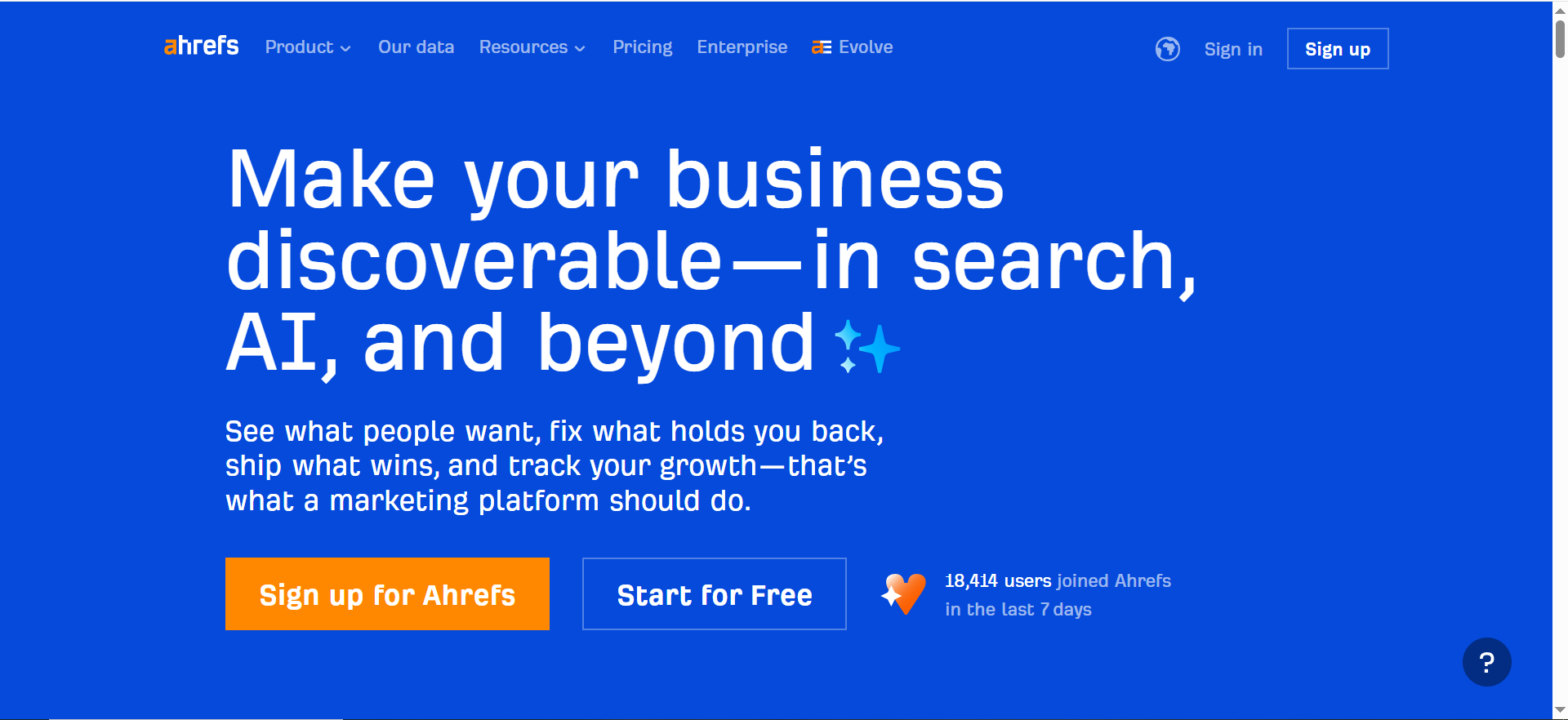
Ahrefs is a full-stack SEO platform built around the largest third-party backlink index on the web. It combines Site Explorer for competitive analysis, Keywords Explorer for keyword research across 10+ search engines, Content Explorer for content discovery and link prospecting, Site Audit for technical SEO, and Rank Tracker for daily position monitoring. In 2026, Ahrefs added Brand Radar for tracking AI search mentions and upgraded its AI URL detection for monitoring how AI engines crawl your content.
Why Teams Use It
Content marketing teams use Ahrefs because it connects keyword research directly to competitive intelligence. You can see which pages drive traffic for competitors, which keywords have the most realistic ranking opportunity based on your current domain authority, and which content gaps exist in your category. The backlink data is consistently the most comprehensive available, which matters for any content strategy that relies on link-building or digital PR to amplify organic performance.
What It Is Good For
Ahrefs excels at competitive content gap analysis, backlink auditing and link prospecting, keyword difficulty assessment grounded in real SERP data, content ideation based on what already works in your niche, and tracking the performance of content across both traditional and AI search. The 2026 addition of AI search tracking through Brand Radar makes it relevant for teams that need visibility into how their content appears in AI Overviews, ChatGPT, and Perplexity results.
When It Is a Good Fit
Ahrefs is the right choice for SEO specialists and content managers at B2B, SaaS, and ecommerce companies who need a single platform for keyword research, competitor analysis, and backlink monitoring. It is particularly strong for teams that publish link-worthy content and need to track the downstream SEO impact of that content. If your workflow is research-heavy before drafting and you want one tool to handle keyword selection, SERP analysis, and content performance tracking, Ahrefs covers that loop well.
When It Is Not a Good Fit
Ahrefs is not the strongest choice if your primary need is real-time content optimization during the writing process. It does not offer a content editor that scores your draft against NLP-based recommendations the way Surfer SEO or Clearscope do. If your team's bottleneck is optimizing drafts rather than finding what to write about, Ahrefs alone will leave a gap.
How to Use It
Start with Keywords Explorer to build a keyword map organized by topic clusters. Use Content Explorer to find high-performing content in your niche and identify link-building targets. Run Site Audit monthly to catch technical issues. Use Site Explorer on competitors to discover content gaps where they rank and you do not. Feed the resulting keyword and topic list into your editorial calendar.
Key Capabilities
Ahrefs capabilities include Site Explorer for backlink and organic traffic analysis, Keywords Explorer covering Google, YouTube, Amazon, Bing, and more, Content Explorer with filtering by traffic, referring domains, and publish date, Site Audit with 170+ technical checks, Rank Tracker with desktop and mobile tracking, Brand Radar for AI search monitoring, Web Analytics, Looker Studio connectors, WordPress SEO plugin, and enterprise API access.
Pricing
Ahrefs offers a $29/month Starter plan for entry-level access. The Lite plan costs $129/month or approximately $108/month billed annually with 1,000 credits, 5 projects, and 750 tracked keywords. Standard costs $249/month or approximately $199/month billed annually with 6,000 credits and 20 projects. Advanced is $449/month or approximately $374/month billed annually with 50 projects and 5 user seats. Enterprise starts at $1,499/month.
Free Tier?
Yes. Ahrefs offers free Webmaster Tools with limited Site Explorer and Site Audit for verified sites, plus the $29 Starter plan as a low-risk entry point. The free tier is useful for basic audits but insufficient for content marketing workflows.
Downsides and Limitations
The content optimization features are not as granular as dedicated tools like Surfer SEO or Clearscope. The learning curve is moderate due to the breadth of features. Pricing scales quickly once you need multiple user seats or higher keyword tracking limits. The Starter and Lite plans restrict credits which can feel limiting for active content teams.
2. Semrush
What It Does
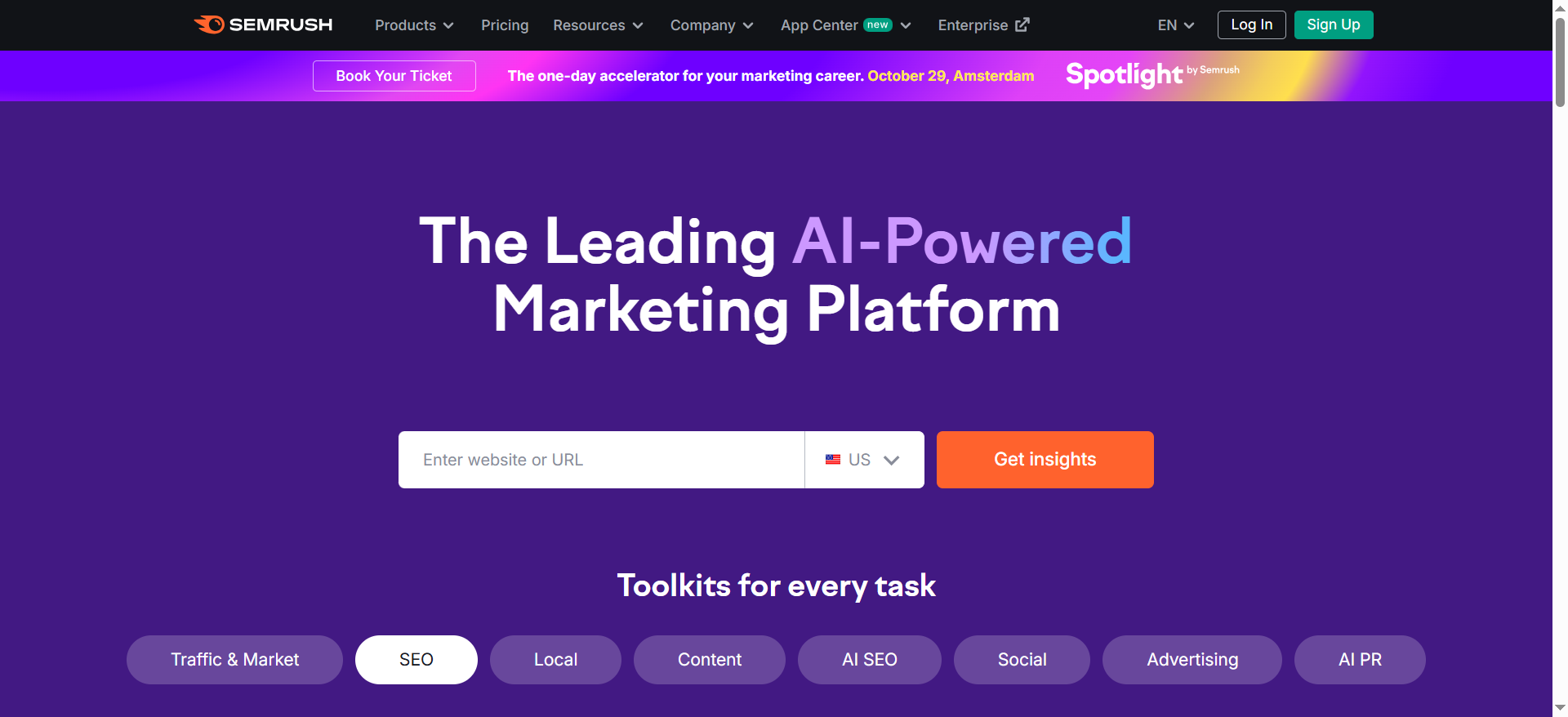
Semrush is an all-in-one digital marketing platform that covers SEO, content marketing, competitor research, paid advertising, and social media management. For content marketing specifically, it offers the SEO Toolkit with keyword research, position tracking, site audit, and backlink analytics, plus a dedicated Content Marketing Toolkit that includes topic research, an SEO content template, the SEO Writing Assistant, and post tracking. In 2026, Semrush introduced Semrush One, bundling the traditional SEO Toolkit with AI Visibility tracking across Google AI Overviews, ChatGPT, Gemini, and Perplexity.
Why Teams Use It
Teams choose Semrush because it consolidates SEO research, content planning, and performance tracking into a single dashboard. The Content Marketing Toolkit bridges the gap between keyword research and content production by generating content briefs, providing real-time optimization scores in Google Docs, and tracking how published content performs against target keywords. Copilot, the AI assistant, surfaces prioritized recommendations based on your specific site data, reducing the time spent identifying what to fix or write next.
What It Is Good For
Semrush is strong in competitive keyword gap analysis, content brief generation, real-time content optimization through the SEO Writing Assistant, AI search visibility tracking with the new Semrush One bundle, technical SEO auditing, backlink gap analysis, and PPC competitor intelligence. It is one of the few platforms where a content manager can go from keyword research to content brief to optimization score to rank tracking without leaving the tool.
When It Is a Good Fit
Semrush fits teams that want one subscription to handle SEO research, content optimization, and performance reporting. It is a good match for agencies managing multiple client accounts, mid-market and enterprise marketing teams with cross-functional workflows spanning SEO, content, and paid, and SaaS companies that need both content marketing and competitive intelligence in a single stack. Teams focused on AI search visibility may also want to review best practices for optimizing content for Google AI Overviews.
When It Is Not a Good Fit
Semrush is not ideal if you only need a content optimization editor and nothing else. The platform is broad, and the pricing reflects that. If your team has a strong keyword research process already and just needs a tool to score and optimize drafts, Semrush is overkill and more expensive than focused alternatives like Surfer SEO or Clearscope.
How to Use It
Use Topic Research to generate content ideas around a seed keyword. Build an SEO Content Template for each target keyword to get recommended word count, semantically related terms, and readability targets. Draft your content in Google Docs with the SEO Writing Assistant plugin active for real-time scoring. After publishing, use Position Tracking to monitor keyword movement and Post Tracking to see organic traffic to each URL.
Key Capabilities
Semrush key capabilities include Keyword Magic Tool with 26+ billion keywords, Site Audit with 140+ technical checks, Content Marketing Toolkit with topic research, SEO content templates, and the Writing Assistant, Copilot AI assistant for prioritized recommendations, Position Tracking with daily updates, Backlink Analytics and Link Building Tool, Semrush One for AI visibility tracking, On-Page SEO Checker, Traffic Analytics, and Market Explorer.
Pricing
Pro plan costs $139.95/month or $117.33/month billed annually with 5 projects and 500 tracked keywords. Guru plan is $249.95/month or $208.33/month annually with 15 projects, 1,500 keywords, and Content Marketing Toolkit. Business plan runs $499.95/month or $416.66/month annually with 40 projects and 5,000 keywords. Add-ons include Content Toolkit at $60/month, AI Visibility at $99/month, and additional user seats at $45 to $100/month depending on plan.
Free Tier?
Yes. Semrush offers a free account with 10 searches per day, 1 project, and 10 tracked keywords. It is useful for exploratory research but too restricted for ongoing content marketing workflows.
Downsides and Limitations
The platform can feel overwhelming for teams that only need content optimization. Each plan includes just one user seat, and adding team members is expensive. The Content Marketing Toolkit requires at least the Guru plan. The AI Visibility tracking is an additional $99/month add-on. Total cost for a team of three on Guru with content and AI add-ons can exceed $500/month.
3. Surfer SEO
What It Does
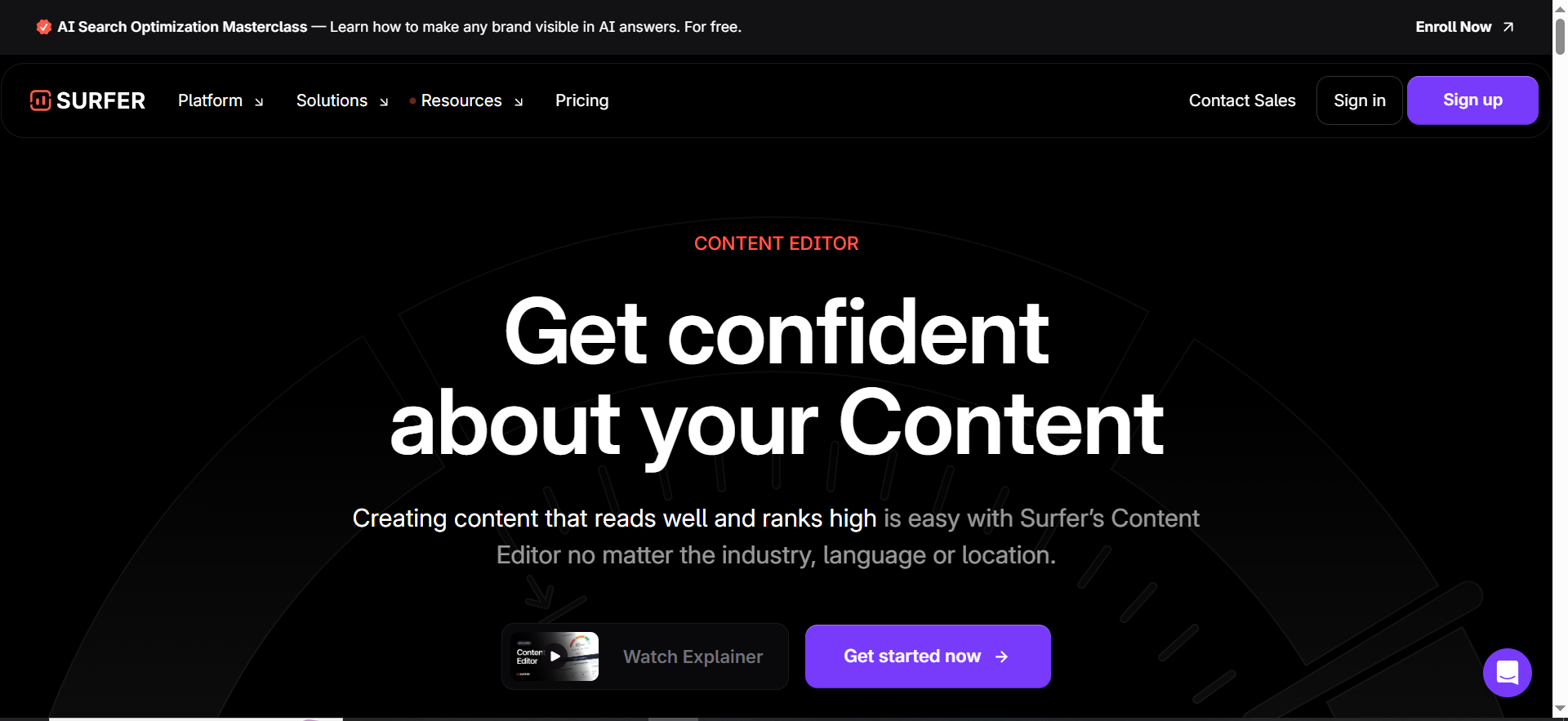
Surfer SEO is a content optimization platform that analyzes the top-ranking pages for a target keyword and gives you a real-time content score based on how well your draft matches the ranking signals found across those competitors. It examines over 500 ranking factors including keyword density, NLP terms, heading structure, word count, image usage, and internal link patterns. The Content Editor is the core product, supplemented by SERP Analyzer, Keyword Research, Audit, and the newer AI Tracker for monitoring AI search visibility.
Why Teams Use It
Content teams use Surfer SEO because it turns the subjective question of whether content is optimized into a measurable score. Writers and editors can see in real time whether they are covering the right topics, using the right terms, and matching the structural patterns that correlate with top rankings. The workflow integration with Google Docs, WordPress, and Jasper makes it easy to embed Surfer into existing editorial processes.
What It Is Good For
Surfer SEO excels at real-time content optimization scoring, NLP-based keyword and topic recommendations, content structure analysis including heading depth, paragraph length, and image density, content auditing for existing pages that need refreshing, brief generation for writers and freelancers, and AI visibility tracking through its AI Tracker feature.
When It Is a Good Fit
Surfer is the right choice for content marketing teams that already have a keyword research workflow through Ahrefs, Semrush, or another tool and need a dedicated optimization layer for their writing process. It works well for agencies producing high volumes of SEO content, in-house teams that use freelance writers and need a scoring system to ensure quality, and any team where the bottleneck is optimizing drafts rather than finding keywords.
When It Is Not a Good Fit
Surfer SEO does not include backlink analysis, competitive intelligence, or technical site auditing. If you need an all-in-one SEO platform, Surfer cannot replace Ahrefs or Semrush. Teams that need deep keyword research with search volume, difficulty scores, and SERP feature analysis will still need a separate tool alongside Surfer.
How to Use It
Create a Content Editor for your target keyword. Surfer analyzes the top-ranking pages and generates a recommended structure with target terms, NLP entities, heading suggestions, and word count range. Write or paste your draft into the editor and adjust until your Content Score reaches 70 or above. Use the Audit feature on existing published content to identify pages where a refresh could improve rankings.
Key Capabilities
Surfer SEO key capabilities include Content Editor with real-time scoring from 0 to 100, NLP-powered keyword and entity recommendations, SERP Analyzer for competitive content analysis, Content Audit for existing page optimization, Keyword Research tool, AI Tracker for AI search visibility monitoring, integrations with Google Docs, WordPress, Jasper, and ChatGPT, multi-language support, and a 7-day money-back guarantee.
Pricing
Essential plan costs $99/month or $79/month billed annually with 30 content editor credits. Scale plan is $219/month or $175/month annually with 100 content editor credits. Enterprise pricing is custom. Annual billing saves approximately 20%.
Free Tier?
No. Surfer SEO does not offer a free tier. The 7-day money-back guarantee is the closest risk-reduction option available.
Downsides and Limitations
No backlink analysis or technical SEO features. The keyword research tool is basic compared to Ahrefs or Semrush. Content editor credits are consumed per article, and the Essential plan's 30 credits can run out quickly for active content teams. The recommendations can occasionally over-optimize for keyword density if followed too literally.
4. Clearscope
What It Does
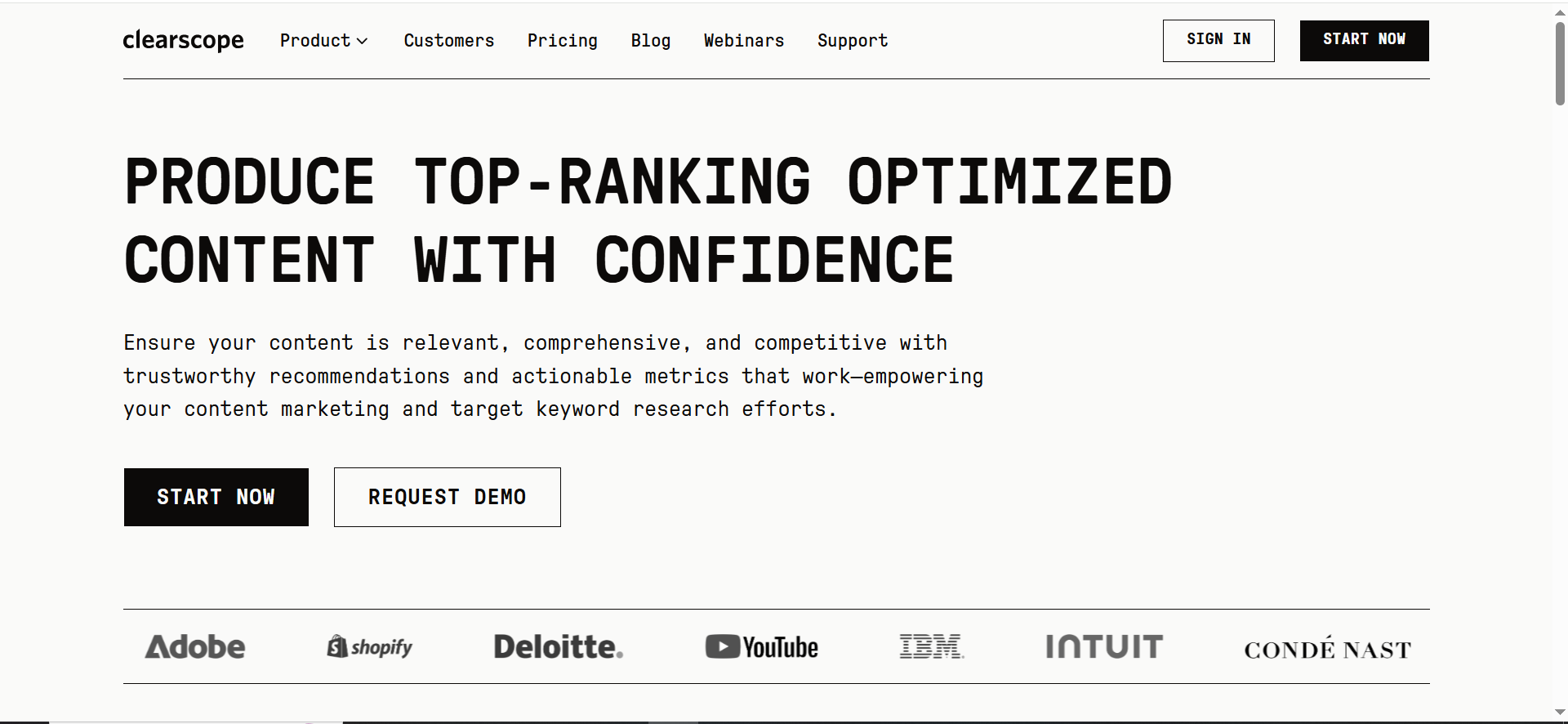
Clearscope is a content optimization platform that grades your content on an A++ to F scale based on how thoroughly it covers the topics and terms that top-ranking pages address for a given keyword. It uses semantic analysis to evaluate meaning and context rather than simple keyword counting. The platform includes the Content Editor for optimization, Topic Explorations for keyword research, and Content Inventory for monitoring published page performance over time.
Why Teams Use It
Enterprise content teams and agencies choose Clearscope because the grading system is intuitive enough for writers who are not SEO specialists to understand and act on. The interface is clean, the recommendations are focused, and the integration with Google Docs and WordPress means writers can optimize in their native environment. Content Inventory gives SEO managers visibility into which published pages are losing relevance and need updating.
What It Is Good For
Clearscope is strong in content grading with a clear A++ to F scale, semantic keyword recommendations based on top-ranking page analysis, editorial workflow integration through Google Docs and WordPress plugins, content inventory tracking for identifying decay and refresh opportunities, and team collaboration where non-technical writers need clear optimization guidance.
When It Is a Good Fit
Clearscope fits content teams at mid-market and enterprise companies that produce a steady volume of SEO content and need a quality control layer. It is particularly effective for organizations where writers are not SEO experts and need a simple grading system to guide their optimization. If your workflow involves handing content briefs to freelance writers and you need a standardized way to evaluate whether the output is optimized, Clearscope's grading system solves that cleanly.
When It Is Not a Good Fit
Clearscope lacks keyword research depth, backlink analysis, and technical SEO auditing. The pricing is higher per credit than Surfer SEO, which makes it less attractive for smaller teams or solo operators on a tight budget. If you need competitive intelligence or an all-in-one SEO suite, Clearscope does not cover those use cases.
How to Use It
Enter your target keyword into Clearscope to generate a report. The report shows the terms and topics you should cover, along with the competitive content landscape. Paste your draft into the Content Editor and revise until you reach an A or A+ grade. Use Content Inventory to monitor your published content library and flag pages where the grade has dropped, signaling a need for a refresh.
Key Capabilities
Clearscope key capabilities include Content Editor with A++ to F grading system, semantic analysis of top-ranking content, Topic Explorations for keyword and topic research, Content Inventory for published page monitoring, Google Docs integration, WordPress plugin, Microsoft Word support, multi-language support for English, French, German, Italian, and Spanish, and unlimited user seats on all plans.
Pricing
Essentials plan starts at $129/month with core content analytics and scoring. Business plan is $399/month with expanded features. Enterprise pricing is custom and typically includes SSO and advanced controls. No minimum contract on monthly plans.
Free Tier?
No. Clearscope does not offer a free tier. Contact their team for a demo or pilot.
Downsides and Limitations
No backlink analysis, technical SEO, or competitive intelligence features. Pricing starts higher than Surfer SEO for comparable content optimization. The keyword research through Topic Explorations is narrower than Ahrefs or Semrush. Content credits can be limiting depending on publishing volume.
5. MarketMuse
What It Does
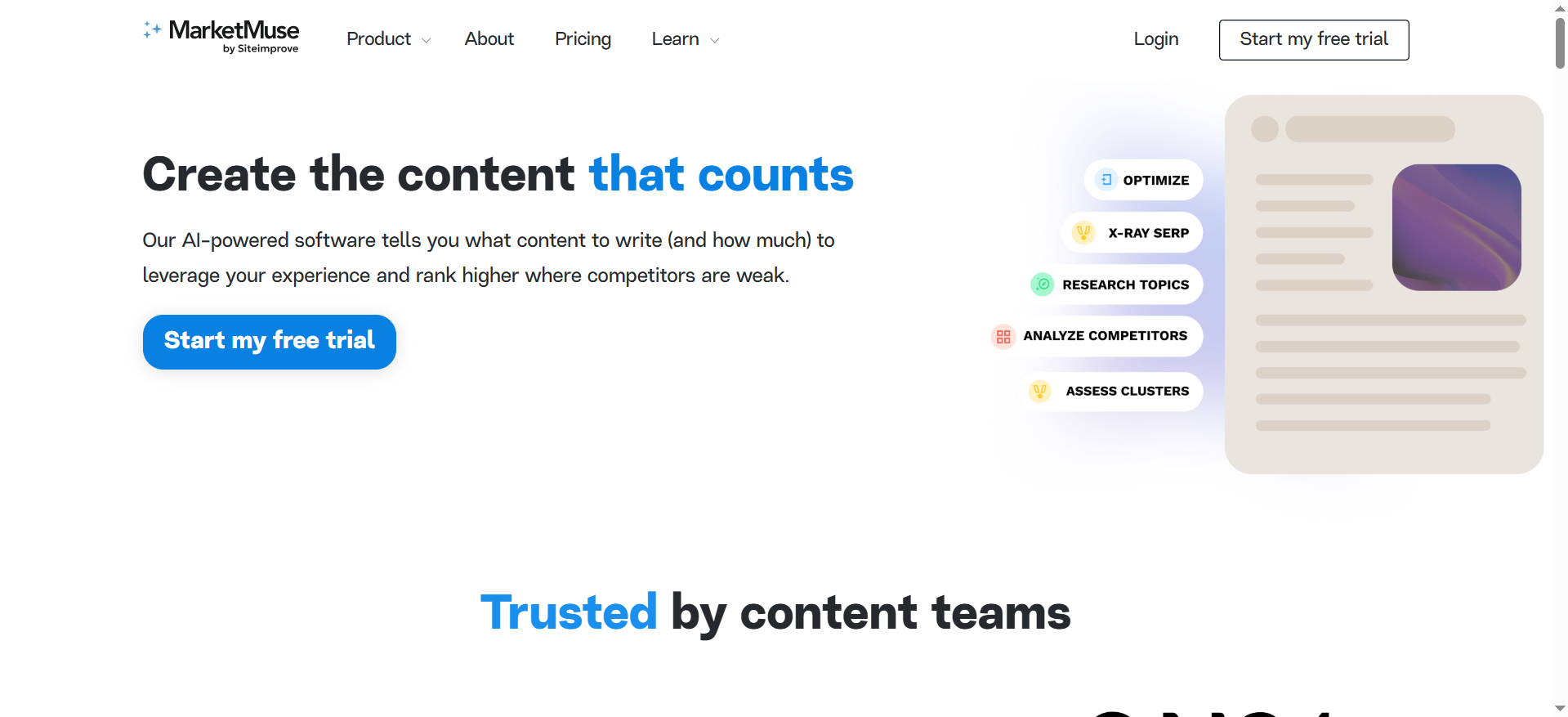
MarketMuse is an AI-powered content strategy and optimization platform that uses natural language processing to analyze your existing content, identify topical gaps, and generate content briefs with recommended topics, subtopics, and questions to cover. It provides both industry benchmarks and personalized metrics based on your site's existing authority, which helps prioritize which topics you are most likely to rank for. MarketMuse also offers AI-powered first-draft generation and content optimization scoring.
Why Teams Use It
Teams choose MarketMuse when their primary challenge is not optimizing individual pages but planning a comprehensive content strategy that builds topical authority. The platform's personalized difficulty scores show you where your site already has enough authority to compete and where you would need significant investment to rank. This strategic lens makes MarketMuse more of a content planning tool than a pure writing optimizer.
What It Is Good For
MarketMuse excels at topical authority analysis and content gap identification, personalized difficulty scoring based on your existing content footprint, AI-generated content briefs with recommended structure, topics, and questions, content inventory auditing to find underperforming or missing content, and first-draft generation for scaling content production.
When It Is a Good Fit
MarketMuse fits content marketing teams at SaaS and B2B companies that are building or expanding a content library and need to prioritize which topics to tackle first based on competitive feasibility. It is particularly valuable for teams transitioning from ad-hoc content production to a structured topical authority strategy. Teams scaling their content output may also benefit from exploring the best AI writing tools for content creators.
When It Is Not a Good Fit
MarketMuse is not the right choice if you need real-time content scoring during the writing process. Its optimization features exist but are less granular than Surfer SEO or Clearscope. The platform also lacks backlink analysis, technical SEO, and the competitive intelligence features found in Ahrefs or Semrush. For teams that already know what to write and just need to optimize drafts, MarketMuse adds unnecessary overhead.
How to Use It
Start with a content inventory audit to see where your existing content stands. Use the Research feature to identify topical gaps and prioritize by personalized difficulty. Generate content briefs for your highest-opportunity topics. Hand briefs to writers with the recommended structure, topics, and questions. Use the Optimize feature to score completed drafts against the brief recommendations.
Key Capabilities
MarketMuse key capabilities include content inventory auditing with authority scoring, personalized keyword difficulty based on your domain's topical coverage, AI-generated content briefs with recommended topics, subtopics, and questions, first-draft generation using AI, content optimization scoring, competitive content analysis, topic cluster planning, and SERP analysis with content gap identification.
Pricing
Free tier includes 10 queries per month with access to content briefs and basic optimization. Standard plan costs $149/month. Team plan is $399/month with unlimited queries and full feature access.
Free Tier?
Yes. MarketMuse offers a free tier with 10 queries per month. This is generous enough to evaluate the platform, though serious use requires a paid plan.
Downsides and Limitations
The real-time content optimization is less refined than Surfer SEO or Clearscope. No backlink analysis or technical SEO features. The interface has a steeper learning curve. The free tier's 10-query limit is quickly exhausted for active content teams. First-draft generation quality varies and requires significant editing.
How Do AI SEO Tools Improve Content Marketing ROI?
AI SEO tools improve content marketing ROI by reducing the guesswork in keyword selection, content structure, and optimization. Instead of publishing content and hoping it ranks, teams can validate that each piece targets a realistic keyword, covers the topics search engines expect, and matches the structural patterns of pages already ranking in the top positions. This means fewer wasted articles, faster time-to-rank for new content, and better performance from content refreshes. Tools like Semrush and Ahrefs add competitive intelligence that helps teams avoid keywords where they cannot realistically compete, while Surfer SEO and Clearscope ensure each draft meets a quality threshold before publishing. Over time, this reduces the cost per ranking page and increases the percentage of published content that generates organic traffic. For teams managing optimization at scale, our guide to the best AI content optimization tools for large teams covers additional workflow considerations.
What Is the Difference Between Ahrefs and Semrush for Content Optimization?
Ahrefs and Semrush both cover keyword research, backlink analysis, and technical SEO, but they differ in how they handle content optimization workflows. Semrush includes a dedicated Content Marketing Toolkit with topic research, SEO content templates, and the SEO Writing Assistant that provides real-time scoring in Google Docs. Ahrefs focuses more on the research side with Content Explorer for finding what performs in your niche and Site Explorer for competitive gap analysis, but does not offer an in-editor content scoring tool. If your team needs a tool that guides the actual writing process, Semrush has the edge. If your team needs stronger backlink data and competitive research to inform a content strategy, Ahrefs is typically more detailed.
Which AI SEO Tool Is Best for Small Business Content Marketing?
For small businesses with limited budgets, MarketMuse's free tier with 10 queries per month is the lowest-cost entry point for content optimization. Ahrefs' $29/month Starter plan offers the most affordable access to a full-stack SEO platform. Surfer SEO at $79/month on annual billing provides the best value for teams focused specifically on optimizing content during the writing process. Small businesses should avoid over-investing in enterprise platforms like Semrush Business or Clearscope Enterprise until their content volume and revenue justify the cost. A practical starting stack for a small business is Ahrefs Starter for research plus Surfer SEO Essential for content optimization, totaling around $108/month.
How Does AI Content Optimization Affect Search Rankings?
AI content optimization tools analyze the top-ranking pages for a given keyword and identify the patterns that correlate with higher positions. These include which topics and subtopics are covered, which NLP entities appear, how content is structured with headings and paragraphs, and what the typical word count and reading level look like. When you optimize your content to match or exceed these patterns, you increase the likelihood that search engines view your page as comprehensive and relevant. This does not guarantee a top ranking since backlinks, domain authority, and technical SEO still matter, but it removes content quality as a barrier. Studies consistently show that pages scoring above 70 in Surfer SEO or achieving an A grade in Clearscope rank faster and maintain positions longer than unoptimized content.
Can AI SEO Tools Replace Manual Keyword Research?
AI SEO tools can automate much of the mechanical work in keyword research, such as generating keyword lists, estimating search volume, calculating difficulty, and identifying related queries. However, they cannot replace the strategic judgment needed to decide which keywords align with your business goals, which topics serve your target audience, and how to sequence content for topical authority. The best approach is to use tools like Ahrefs Keywords Explorer or Semrush Keyword Magic Tool to generate and filter the raw data, then apply human judgment to select the keywords that match your ICP, funnel stage, and competitive position. MarketMuse adds a useful layer here by showing personalized difficulty scores that factor in your existing authority, which helps prioritize more intelligently than raw keyword difficulty alone.
What Features Should I Look for in an AI SEO Optimization Platform?
The most important features depend on where your content workflow breaks down. If the bottleneck is finding what to write about, prioritize keyword research depth, competitive gap analysis, and topic clustering (Ahrefs and Semrush). If the bottleneck is optimizing drafts, prioritize real-time content scoring, NLP-based recommendations, and editor integrations with Google Docs or WordPress (Surfer SEO and Clearscope). If the bottleneck is planning a content strategy, prioritize topical authority analysis and content inventory auditing (MarketMuse). Every team should look for AI search visibility tracking, as the rise of AI Overviews and LLM-powered search means traditional rankings alone no longer capture the full picture of organic visibility. Our guide to the best AI content optimization tools for search engine visibility digs deeper into this area.
How Do AI SEO Tools Track Visibility in AI Search Results?
In 2026, the leading AI SEO tools have added features specifically for tracking visibility in AI-generated search results. Ahrefs Brand Radar monitors how AI engines crawl and reference your content. Semrush One bundles AI Visibility tracking across Google AI Overviews, ChatGPT, Gemini, and Perplexity. Surfer SEO's AI Tracker measures your Visibility Score, mention gaps, competitor share of voice, and citation frequency in AI responses. These features are critical because a growing percentage of search queries now surface AI-generated answers that may or may not cite your content. Tracking AI visibility helps content teams understand whether their pages are being referenced by AI systems and identify gaps where competitors are getting cited instead. For a detailed comparison of monitoring platforms, see our guide to the best AI search monitoring tools for SEO professionals.
Is Surfer SEO or Clearscope Better for Content Teams?
Surfer SEO and Clearscope both solve the same core problem, which is scoring and optimizing content against what currently ranks. Surfer SEO offers a 0-to-100 Content Score and more granular structural recommendations including heading count, paragraph length, image density, and word count targets. Clearscope uses an A++ to F grading system and focuses more on semantic topic coverage. Surfer is more affordable, starting at $79/month versus Clearscope at $129/month, and includes more credits at the entry level. Clearscope includes unlimited user seats on all plans, which makes it more cost-effective for large teams. For agencies and freelance-heavy teams, Surfer's lower per-seat cost and Jasper integration give it an edge. For enterprise teams where simplicity and unlimited seats matter, Clearscope is often the better fit.
Frequently Asked Questions
MarketMuse offers a free tier with 10 queries per month, making it the most affordable starting point. For a paid tool, Ahrefs Starter at $29/month provides access to a full SEO platform at the lowest cost. Surfer SEO at $79/month annually is the most affordable dedicated content optimization tool.
Yes, but support varies. Surfer SEO supports multiple languages for content optimization. Clearscope supports English, French, German, Italian, and Spanish. Ahrefs and Semrush support keyword research across most major languages and markets. MarketMuse is primarily English-focused. Always verify language support for your specific market before committing.
Yes, and many content teams do. A common stack is Ahrefs or Semrush for keyword research and competitive analysis, paired with Surfer SEO or Clearscope for content optimization during the writing process. This combination covers the full workflow from research to optimization without relying on any single tool to do everything.
At minimum, audit your top-performing content quarterly to catch ranking decay and refresh opportunities. Clearscope Content Inventory and MarketMuse content audits can automate ongoing monitoring. For competitive niches, monthly audits of your top 20 to 50 pages help you respond quickly to SERP changes and algorithm updates.
Surfer SEO and Clearscope have the simplest learning curves because they focus on a single workflow: paste your draft, optimize against the score. Ahrefs and Semrush have steeper learning curves due to their breadth of features, but both offer extensive tutorials and certifications. MarketMuse requires the most onboarding time to understand its authority metrics and content planning framework.