Best AI Tools For Improving CSI Scores Automated Customer Service (2026)
How B2B companies and B2C brands can shortlist the best ai tools tools for improving csi scores automated customer service without wasting evaluation cycles.

This playbook helps product managers and growth marketers compare the best ai tools options for improving csi scores automated customer service. It breaks down where intercom-fin, zendesk-ai stand out, when alternatives such as intercom, zendesk make more sense, and which setup fits B2B companies and B2C brands and small businesses and mid-market companies.
TL;DR
If you're serious about raising CSI scores without hiring 10 new support agents, AI automation is now the fastest lever. The 5 best tools in 2026 are Intercom Fin (fastest setup, SMBs), Zendesk AI (mid-market power), Ada (enterprise complexity), Forethought (intelligent routing + QA), and Gorgias (ecommerce only). Intercom Fin resolves ~60% of tickets at $0.99 each. Ada handles up to 83% for enterprises. Gorgias is purpose-built for Shopify. If you're spending 3+ hours daily on ticket triage, any of these will cut response times by 50% within 30 days.
Table of Contents
Best AI Tools for Improving CSI Scores (Quick Comparison)
| Tool | Best For | AI Resolution Rate | Pricing Model | Standout Feature |
|---|---|---|---|---|
| Intercom Fin | SMBs on Intercom | ~60% | $0.99/resolution (min 50/mo) | Sub-1-hour setup, multi-channel |
| Zendesk AI | Mid-market/enterprise | Variable | $50/agent/mo add-on + per-resolution | Copilot saves 45sec/ticket |
| Ada | Enterprises 300K+/year conversations | Up to 83% | $30K–$300K+/year | Multi-LLM reasoning, HIPAA/SOC2 |
| Forethought | Mid-market + QA-first teams | Variable | $40K–$160K/year | Triage + 100% interaction scoring |
| Gorgias | Ecommerce/Shopify | ~60% | $10/mo + ~$1.00/AI resolution | Order editing, unified inbox |
Best AI Tools for Improving CSI Scores (Quick Comparison)
Tool #1: Intercom Fin
What it does
Intercom Fin is a conversational AI agent that handles customer inquiries across chat, email, and social channels. It learns from your help center and past conversations to resolve common issues without human intervention. When it can't solve a problem, it hands off to a human agent with full context.
Why teams use it
Intercom Fin plugs directly into Intercom's existing platform. If your team already uses Intercom for customer messaging, enabling Fin takes under an hour and requires zero new integrations. It starts learning from day one and improves as more conversations flow through.
What it's good for
Handling repetitive questions: order status, password resets, billing inquiries, onboarding questions. Fin excels when your support queue is 60% the same questions asked different ways. It's also good for 24/7 coverage without hiring night shift staff.
When it's a good fit
You're on Intercom, your support volume is 50–500 tickets/day, and your team is tired of answering "where's my order?" for the hundredth time. Also a fit if you want to test AI without a massive budget or setup.
When it's not a good fit
You're using Zendesk, Freshdesk, or another platform—Fin won't integrate. You have highly specialized workflows (legal consultation, complex B2B negotiations). Your resolution rate expectation is 90%+; Fin averages 60%, and that's reasonable for an AI agent.
How to use it
- Connect Fin to your help center or knowledge base.
- Set escalation rules (when to hand off to humans).
- Monitor performance daily for the first week; Fin learns rapidly.
- Review hand-offs to spot patterns and improve your knowledge base.
Key capabilities
- Multi-channel support (chat, email, social).
- Knowledge base integration and continuous learning.
- Copilot feature for agents (paid add-on) to suggest responses.
- Real-time performance dashboards.
- Salesforce integration for CRM sync.
Pricing
$0.99 per successful resolution, with a minimum of 50 resolutions per month (~$50/month baseline). This is on top of Intercom's seat-based pricing, which starts at $29/seat/month (billed annually) or $39/seat/month (billed monthly) on the Essential plan. You only pay for what the AI actually resolves.
Free tier?
Yes. 14-day free trial available; no credit card required.
Downsides / limitations
Locked to Intercom ecosystem. 60% resolution rate means 40% of tickets still need humans—that's by design, not a flaw, but if you need higher automation, you'll need a different tool. Fin's $0.99/resolution cost is in addition to Intercom's per-seat fees, so factor in total platform cost. Can take 1–2 weeks to reach optimal performance as Fin learns your knowledge base.
Tool #2: Zendesk AI
What it does
Zendesk AI is an integrated suite of AI capabilities built into Zendesk's customer support platform. The core offer includes an AI agent that resolves tickets autonomously, a Copilot feature that assists human agents in real-time, and an AI agent builder for custom workflows.
Why teams use it
If you're already paying for Zendesk Suite, Zendesk AI is the natural next step. No new platform to learn, no additional integrations to manage. Everything lives in one control panel. The Copilot feature is particularly popular—it reads the customer issue, searches your knowledge base, and suggests a response to your agent in real-time, saving ~45 seconds per ticket.
What it's good for
Fast-growing teams that need both automation (for volume reduction) and agent assist (to speed up remaining tickets). Zendesk AI scales well from 10 agents to 1,000. Also good for teams managing support across multiple channels (email, chat, phone, social).
When it's a good fit
You're already on Zendesk Suite ($55–$209+/agent/month). Your support team is 10+ people. You want a vendor you can grow with—Zendesk has the infrastructure for enterprise. You care about deep integrations (Salesforce, Slack, HubSpot).
When it's not a good fit
You're a 2-person startup. The total cost (Suite + AI add-on at $50/agent/month) quickly adds up. You need industry-specific compliance (HIPAA/SOC2 out-of-box); Zendesk supports it but Ada is more built for it. You want a simple, flat-fee model; Zendesk's per-agent pricing gets complicated fast.
How to use it
- Enable Zendesk AI in your Suite settings.
- Upload your knowledge base and training data.
- Set automation rules (escalation triggers, handoff conditions).
- Deploy Copilot to agents via Zendesk dashboard.
- Monitor resolution rates and agent feedback; adjust rules weekly.
Key capabilities
- AI agent for autonomous ticket resolution.
- Copilot for real-time agent assist (~45 sec/ticket savings).
- AI agent builder for custom workflows.
- Omnichannel support (email, chat, phone, social).
- Deep integrations with 500+ third-party apps.
- Real-time analytics and dashboards.
Pricing
Zendesk Suite plans start at $55/agent/month. AI add-on is $50/agent/month. You also pay per automated resolution (rates vary; Zendesk doesn't publicly disclose per-ticket costs). Budget $100–$200/agent/month for a mid-market team.
Free tier?
No free tier, but Zendesk offers a 14-day trial of the full Suite.
Downsides / limitations
Expensive if you have a large team (10+ agents can quickly hit $2K+/month). Per-agent pricing means you're paying even for agents who don't use AI features. The agent builder has a learning curve; you'll need internal expertise or a consultant. Note: Zendesk announced an acquisition of Forethought in March 2026, which may consolidate these capabilities over the next 12–18 months.
Tool #3: Ada
What it does
Ada is an enterprise-grade AI platform purpose-built for customer service at scale. It uses a Multi-LLM Reasoning Engine to understand complex customer needs and resolve them across chat, email, voice, and SMS. Ada's backbone is its ability to chain multiple reasoning steps and connect to your internal systems (CRM, helpdesk, knowledge base, fulfillment).
Why teams use it
Enterprise teams with high stakes (financial services, healthcare, ecommerce at $10M+ revenue) choose Ada for its reasoning depth and compliance. Ada doesn't just pattern-match—it can understand nuanced requests, ask clarifying questions, and make decisions based on business logic you define.
What it's good for
Handling complex, multi-step issues: "I want to return this item, but I also have a billing question and need to update my account." Ada can resolve all three in one conversation. Also excellent for teams requiring HIPAA, SOC2, or GDPR compliance out-of-the-box.
When it's a good fit
You're an enterprise with 300K+ annual conversations and a $50K+ CX budget. Your customers ask complex, multi-part questions. You need compliance certifications. You're willing to invest 2–3 weeks in setup and training for superior long-term performance. Your average resolution rate expectation is 75%+.
When it's not a good fit
You're a small business or startup. Ada's minimum is ~$30K/year, and realistic pricing is $50K–$300K+ depending on volume. You need quick deployment (Ada takes weeks to set up properly). You have simple, straightforward FAQs; Ada is overkill and you're better off with Intercom Fin.
How to use it
- Work with Ada's onboarding team to map your customer journeys.
- Connect Ada to your CRM, helpdesk, and knowledge base.
- Define business logic and escalation rules.
- Train Ada on past conversations (typically 1K–5K examples).
- Deploy in phases: test on one channel first, then expand.
Key capabilities
- Multi-LLM Reasoning Engine (can use GPT-4, Claude, or Ada's proprietary models).
- Ada Playbooks for complex SOP workflows.
- Voice support (native, not just chat).
- HIPAA, SOC2, and GDPR compliance built-in.
- Deep CRM and ERP integrations.
- Real-time quality analytics.
- Custom training on your data.
Pricing
Starts at ~$30K/year for SMB licensing. Mid-market typically $50K–$100K/year. Enterprise can range $150K–$300K+/year depending on conversation volume and feature requests. Per-resolution costs are typically $1.00–$3.50 depending on complexity.
Free tier?
No. Ada is enterprise-only; they don't offer trials or freemium versions.
Downsides / limitations
Expensive. High setup cost and 3–6 week onboarding cycle. Requires dedicated internal resources (CX ops or an admin) to manage and improve. If your support volume is low, you're overpaying. Less transparent pricing—you'll need to negotiate with their sales team.
Tool #4: Forethought
What it does
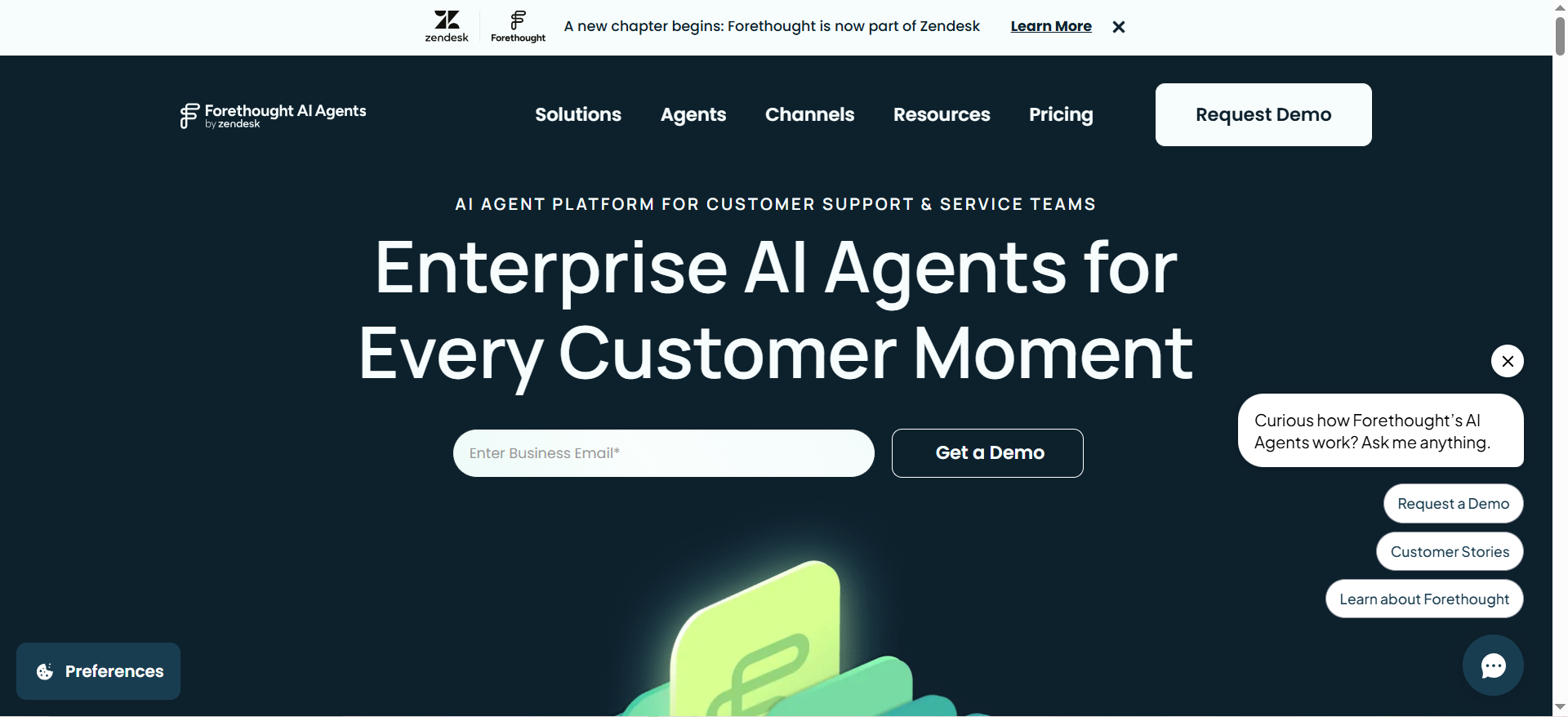
Forethought is a suite of five AI agents designed to handle different parts of the support workflow: Solve (resolve tickets), Triage (auto-route and prioritize), Assist (agent copilot), Discover (identify gaps in your knowledge base), and Agent QA (score 100% of interactions). All agents work across chat, email, voice, and SMS.
Why teams use it
Forethought is the only platform that offers intelligent routing + QA together. Most teams can't afford to QA every single ticket, so they sample—Forethought QA scores 100% of interactions for quality consistency. Triage saves hours of manual work by auto-routing complex cases and prioritizing urgent tickets.
What it's good for
Growing support teams (20–200 agents) that are tired of manual triage and quality spot-checks. If your team spends 20% of time just assigning tickets to the right person, Triage will save you 6+ hours daily. If QA is your bottleneck, Agent QA scoring 100% of tickets is game-changing.
When it's a good fit
You're mid-market to enterprise, you have 10K–100K tickets/month, and you care about consistency and quality as much as volume. You're willing to invest $40K–$160K/year. You have enough ticket volume to justify the cost. You're on Zendesk, Freshdesk, or another platform (Forethought integrates with all of them).
When it's not a good fit
You're small (under 100 tickets/day). You don't have a QA function today—adding 100% scoring overnight will be overwhelming. You need a simple, plug-and-play solution; Forethought requires 2–4 weeks of setup and training.
How to use it
- Map your current ticket flow and triage rules.
- Connect Forethought to your helpdesk (Zendesk, Freshdesk, etc.).
- Train Triage on your routing logic.
- Deploy Solve for high-confidence automation (typically 20–30% of tickets first).
- Enable Agent QA dashboard; review scores weekly and coach agents.
Key capabilities
- Solve: AI agent for autonomous resolution (~40–70% depending on use case).
- Triage: Auto-routes and prioritizes based on urgency, sentiment, and topic.
- Assist: Real-time suggestions for agents (similar to Zendesk Copilot).
- Discover: Identifies common unresolved issues and suggests knowledge base articles.
- Agent QA: Scores 100% of interactions on tone, accuracy, and adherence to brand guidelines.
- Omnichannel support.
Pricing
$40K–$160K/year depending on ticket volume (10K–100K/month) and which agents you activate. Per-resolution pricing also applies but isn't publicly disclosed. Contact sales for a custom quote.
Free tier?
No. Forethought is enterprise-focused; you'll need to request a demo to discuss pricing.
Downsides / limitations
Expensive for small teams. Long sales cycle (expect 2–4 weeks before you're live). Requires internal coordination to map workflows. Agent QA requires cultural buy-in from your team—they need to view it as coaching, not surveillance. Note: Zendesk announced an acquisition of Forethought in March 2026; the long-term roadmap is unclear, though Zendesk has committed to maintaining Forethought as a separate product for the near term.
Tool #5: Gorgias
What it does
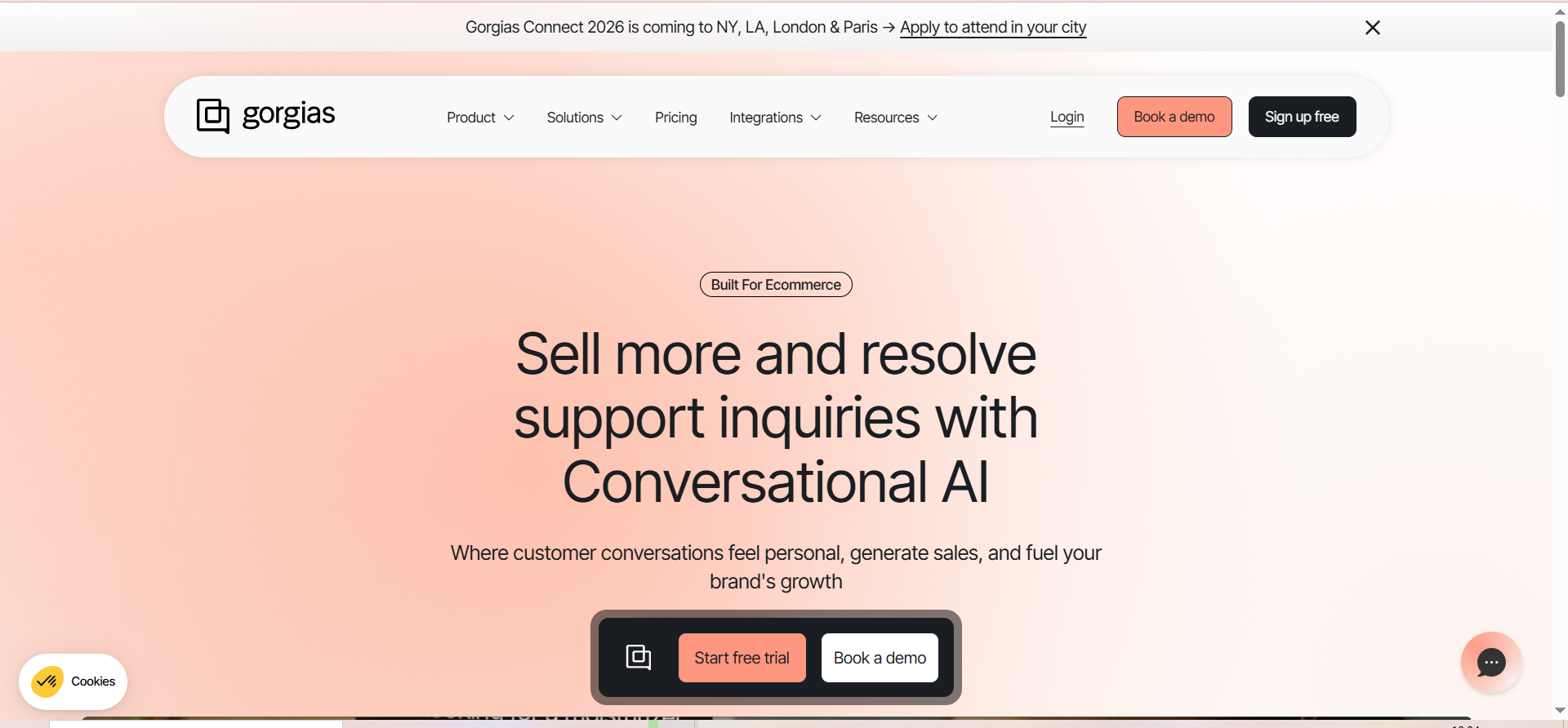
Gorgias is a unified inbox and AI customer service platform built specifically for ecommerce brands. It consolidates email, chat, SMS, and social messages into one workspace. The AI agent includes a Shopping Assistant (for pre-purchase questions) and a Support Agent (for post-purchase issues). You can also edit Shopify orders directly from within Gorgias without switching tabs.
Why teams use it
Ecommerce teams love Gorgias because it's built to answer the questions ecommerce customers actually ask: "Can you change my shipping address?" "Will this fit my body type?" "Do you have this in blue?" The AI understands product context and order history, so responses are instantly personalized.
What it's good for
Handling seasonal spikes without hiring temps. Processing bulk order issues (especially returns and exchanges). Shopify stores that need a unified inbox. SMB ecommerce brands ($100K–$5M/year revenue) that want AI without enterprise pricing.
When it's a good fit
You're on Shopify. Your support volume is 50–1K tickets/day. Your team is 2–10 people. You want to keep everything in one tool (messaging, billing, order management). You don't need advanced routing or QA; you just want to handle more tickets with the same team size. For a broader view, see our best AI customer service agents for ecommerce comparison.
When it's not a good fit
You're not on Shopify (Gorgias has limited integrations outside Shopify). You need advanced workflow automation or industry-specific compliance. You sell B2B or SaaS (Gorgias is ecommerce-only). You need voice support (Gorgias doesn't have it yet).
How to use it
- Connect your Shopify store (one-click).
- Connect email, chat, SMS, and social accounts.
- Upload your product catalog and help center articles.
- Deploy the AI agent to your chat widget and email.
- Monitor resolution rate daily and refine prompts based on hand-offs.
Key capabilities
- Unified inbox (email, chat, SMS, social in one interface).
- Shopify order editing from within the platform.
- Shopping Assistant (pre-purchase) and Support Agent (post-purchase).
- Help center integration and AI learning.
- Automation for bulk actions (e.g., bulk refunds, shipping label generation).
- Real-time analytics and reporting.
Pricing
Starter plan is $10/month for up to 3 users and 50 tickets. AI resolution is ~$0.90 per ticket on annual plans or $1.00 on monthly plans (auto-billed based on usage). Basic plan is $60/month for 300 tickets. Pro plan is $360/month for 2,000 tickets. Advanced plan is $900/month for 5,000 tickets. Enterprise pricing is custom. Total cost depends on your ticket volume; a brand doing 500 tickets/month on the Basic plan might pay $60 + ~$450 in AI costs = ~$510/month.
Free tier?
No free tier. Gorgias offers a 7-day free trial with access to all features and no credit card required. Paid plans start at $10/month (Starter).
Downsides / limitations
Shopify-only (unless you have very specific integrations). Limited voice support. The AI can feel generic if your product catalog is complex or niche (e.g., enterprise software). Resolution rate is ~60%, similar to Intercom Fin. Overage charges of $0.36–$0.40 per ticket apply once you exceed your plan's monthly ticket limit. No built-in QA or advanced analytics compared to enterprise tools.
How AI Tools Actually Improve CSI Scores
CSI (Customer Satisfaction Index) scores go up when three things happen: faster first response, faster resolution, and consistent quality.
Faster first response: AI agents respond immediately, 24/7. Humans sleep. Average first response time drops from 2–4 hours to under 30 seconds. That alone moves the needle on CSI.
Faster resolution: AI resolves 60–83% of tickets without human touch. Your team's average resolution time (currently, say, 8 minutes per ticket) stays the same, but AI-resolved tickets take zero human time. Your average resolution time across all tickets plummets.
Consistent quality: AI doesn't have bad days. It doesn't get tired, angry, or defensive. Every response is on-brand, follows your guidelines, and includes relevant information. Customers notice this consistency and rate it higher on satisfaction surveys.
Agent assist: AI-backed agents (via tools like Zendesk Copilot or Forethought Assist) resolve tickets 30–45 seconds faster because the AI pre-writes responses. Faster human resolution = higher satisfaction.
Feedback loops: Most AI tools today (especially Ada and Forethought) include analytics that show which questions are unresolved, which categories have low satisfaction, and which agents are struggling. You use this to improve your knowledge base, training, or processes—which drives CSI up over time. For deeper analysis, see the best AI tools for analyzing customer feedback.
Real example: A Shopify brand had a 72% CSI before deploying Gorgias. Three months later, CSI was 81%. Why? 65% of "where's my order?" and "update my address" questions were now handled by AI in under 1 minute instead of waiting for a human reply. Customers got immediate answers and CSI went up 9 points.
What to Look for When Choosing an AI Tool for CSI Improvement
Resolution quality: Does the tool actually resolve issues, or just gather information for hand-off? Ask for case studies. Ask for third-party benchmarks. Don't trust a vendor who claims 95% resolution; 60–70% is honest and realistic.
Channel coverage: Do you need email only, or chat + email + social + voice? Make sure your tool covers all channels your customers use. A tool that's amazing on chat but doesn't handle email won't move the dial. If voice is key, see our best AI voice assistants for customer support automation guide.
Integration depth: Does it connect to your CRM, helpdesk, knowledge base, and fulfillment system? The more integrations, the more context the AI has, and the better it performs. If it requires custom APIs, budget 2–4 weeks of engineering time.
Pricing model: Is it per-resolution (you pay only for AI work), per-agent (you pay regardless of volume), or per-month flat fee? Per-resolution is most transparent. Per-agent is cost-predictable. Flat-fee is best if you know your volume. Match the model to your predictability.
QA and analytics: Does the tool give you visibility into what the AI is resolving, failing on, and handing off? Can you track CSI improvements over time? If not, you can't prove ROI.
Setup time: Can you be live in 1 day (Intercom Fin) or do you need 6 weeks (Ada)? Align this with your timeline and internal resources.
How to Measure CSI Score Improvements After Deploying AI
Track these KPIs from day 1. You should see movement within 2–4 weeks.
CSAT (Customer Satisfaction Score): Before AI, measure your baseline CSAT (usually 6.5–7.5 out of 10). After 30 days of AI, re-survey the same customer segment. Expect a 0.5–2.0 point increase.
First Response Time (FRT): This will drop from hours to minutes/seconds if your AI is live 24/7. Measure the median time from ticket open to first response. Expect 80%+ improvement.
Resolution Time: Measure time from ticket open to closure. Because AI resolves 60%+ of tickets instantly, your overall average resolution time should drop 30–50%.
Containment Rate: What % of tickets were resolved without human touch? Ada and Forethought will push this to 70–80%. Intercom Fin and Gorgias typically land at 60–65%.
Escalation Rate: The flip side of containment. What % of tickets were handed off to humans? Lower is better, but don't go below 30% (some customers will always need a human).
NPS (Net Promoter Score): This is harder to isolate to AI, but compare NPS scores before and after AI deployment. Research shows AI-assisted support (e.g., Copilot) increases NPS by 3–5 points.
Agent Satisfaction / Burnout Metrics: Ask your team. If AI is removing drudgery (repetitive questions, triage) from their day, they'll report higher job satisfaction. This indirectly increases CSI because happy agents provide better service.
Can AI Fully Replace Human Agents for CSI Improvement?
Not yet, and likely not for years. Here's why:
AI excels at repeatable, well-defined problems: "Where's my order?" "Reset my password." "What's your refund policy?" It's terrible at edge cases, emotional support, and complex negotiations. A customer who's furious about a $500 billing error needs a human who can empathize and think creatively about solutions.
The realistic model is hybrid: AI handles 60–70% of tickets autonomously. For the remaining 30–40%, AI assists humans by pre-writing responses, summarizing context, and suggesting next steps. This combo is where CSI gains are biggest.
Also, customers still value talking to a human when they're upset or confused. You can't replace that with AI. But you can make sure humans are available faster by removing the queue of routine questions.
What Is the Fastest Way to Improve CSI Scores With AI?
In 30 days: Deploy Intercom Fin or Gorgias (fastest setup, 1–2 hours to live). Enable 24/7 coverage on your most common questions. CSI should move 1–2 points.
In 90 days: Add AI Copilot for human agents (Zendesk Copilot or Forethought Assist). Humans are now 30–45 seconds faster per ticket. CSI should move another 1–3 points.
In 6 months: Invest in knowledge base improvement and AI retraining. Use your tool's analytics to identify the top 20% of unresolved tickets and create content around them. CSI should stabilize 3–5 points higher than baseline.
The fastest wins are availability (AI is always there) and first response time. Quality improvements take longer because they require teaching your AI (and your team) what "good" looks like.
How Much Do AI Customer Service Tools Typically Cost?
SMB (under 100 tickets/day):
- Intercom Fin: ~$29–$139/seat/month + $0.99/resolution (minimum $50/month in AI costs).
- Gorgias: ~$10–$60/month + ~$0.90–$1.00/AI resolution.
- Budget: $100–$500/month to start.
Mid-market (100–1K tickets/day):
- Zendesk AI: ~$1K–$3K/month (Suite + AI add-on + per-resolution costs).
- Forethought: ~$40K–$80K/year.
- Budget: $3K–$7K/month.
Enterprise (1K+ tickets/day):
- Ada: $50K–$300K/year.
- Forethought: $80K–$160K+/year.
- Zendesk AI: $5K–$20K+/month.
- Budget: $5K–$25K/month.
Most teams see ROI within 6 months by calculating (cost of AI tool) vs. (cost of hiring new agents to handle the same volume). If one agent costs $40K/year and AI costs $5K/year, you break even by replacing 0.125 full-time employees.
Which AI Tool Is Best for Small Ecommerce Brands?
Gorgias, no question. It's the only tool purpose-built for ecommerce, it integrates directly with Shopify (one-click setup), and the pricing is transparent and affordable ($10 + per-resolution costs). You'll be live in under 2 hours.
If your brand is on a different platform (WooCommerce, BigCommerce, Magento), Intercom Fin is your second choice—it's also quick to deploy and affordable on a pay-per-resolution model.
Avoid Ada, Zendesk, and Forethought for small ecommerce brands. They're built for larger organizations and you'll be paying for features you don't need.
How Long Does It Take to See CSI Score Improvements With AI?
Week 1: Deployment and initial AI training. You'll see dramatic improvements in first response time and availability, but CSI surveys haven't been sent yet.
Week 2–4: First CSAT surveys come back post-deployment. CSI should move 0.5–1.5 points upward due to faster response. This is when you'll know if the tool is working.
Month 2–3: Sustained improvements. CSI has moved 1–3 points. Your team is comfortable with the AI. Handoff rate is stable.
Month 4–6: Knowledge base optimization kicks in. You've refined the AI's knowledge based on hand-offs and customer feedback. CSI continues upward, now 2–5 points above baseline.
Most realistic: visible CSI improvement within 30 days, sustained improvement by 90 days.
FAQs
Yes, but with caveats. AI is better at routine, repeatable questions. If your product is complex software, customers will have nuanced questions that AI struggles with. However, AI-assisted agents (Copilot) can still help—they pre-write responses and summarize documentation. For B2B, Zendesk AI or Ada are better bets than Intercom Fin because they handle complexity better. Ada, specifically, is built for this. See also our best AI chatbots for enterprise customer support comparison.
Yes, but you'll get lower resolution rates. AI learns from your help center, past tickets, and product docs. If you don't have a knowledge base, you'll need to build one first (1–2 weeks of work) or accept that the AI will hand off 50%+ of tickets to humans. Recommend investing in a knowledge base before deploying AI; it's a force multiplier.
Statistically, they care less than you think. Most customers don't realize they're talking to AI if the response is fast, accurate, and resolves their problem. That said, always have a clear "Talk to a human" button and route to a human immediately if the customer asks for one. Transparency builds trust—some brands even mention AI in their chat widget and customers don't mind.
Use per-resolution if your ticket volume is unpredictable (spiky ecommerce, seasonal demand). Use per-agent if your volume is stable and you have a clear headcount. Per-resolution is cheaper if AI resolution is high (60%+) and per-agent is cheaper if you have large team and low AI usage. Calculate both scenarios for your volume and pick the model that's 20%+ cheaper.
No, if you deploy thoughtfully. Start with AI handling only your most common, lowest-risk questions (e.g., "What's your return policy?"). Monitor for 2 weeks, then expand to higher-risk questions. Don't flip a switch and route 100% of traffic to AI on day one. A phased rollout (week 1: 10% of chat, week 2: 30%, week 3: 60%) reduces surprises and lets your team adjust.