Best AI Voice Assistants For Customer Support Automation (2026)
How B2B companies and B2C brands can shortlist the best ai voice assistants tools for customer support automation without wasting evaluation cycles.


This playbook helps product managers and growth marketers compare the best ai voice assistants options for customer support automation. It breaks down where vapi, retell-ai stand out, when alternatives such as intercom, intercom-fin make more sense, and which setup fits B2B companies and B2C brands and small businesses and mid-market companies.
If you are looking for the best AI voice assistants for customer support automation, the short answer is that Vapi and Retell AI lead for developer-driven teams that need low-latency, customizable voice pipelines, while PolyAI is the strongest pick for enterprise contact centers that want a fully managed deployment. Bland handles high-volume outbound calling with realistic voice cloning, and ElevenLabs Conversational AI stands out when multilingual coverage and voice quality are the top priorities. The right choice depends on your call volume, technical resources, and whether you need a self-service platform or a managed solution. This guide breaks down what each tool does, who it fits, and where it falls short so you can make a confident decision.
Table of Contents
Best AI Voice Assistants For Customer Support Automation (Quick Comparison)
| Tool | Best For | Starting Price | Latency | Languages |
|---|---|---|---|---|
| Vapi | Developer teams building custom voice pipelines | $0.05/min base (true cost ~$0.30/min with providers) | <500ms | 100+ countries |
| Retell AI | Mid-market teams wanting an all-in-one builder | $0.07/min base (true cost ~$0.11–$0.19/min with LLM and telephony) | ~600ms | 31+ |
| Bland | High-volume outbound call automation | $0.11–$0.14/min (plan-dependent; Start $0.14, Build $0.12, Scale $0.11) | Low | English-focused |
| ElevenLabs Conversational AI | Multilingual support with premium voice quality | $0.10/min | Real-time | 70+ |
| PolyAI | Enterprise contact centers needing managed service | Custom (six-figure annual contracts) | Real-time | 20+ |
Best AI Voice Assistants For Customer Support Automation (Quick Comparison)
Tool #1: Vapi
What It Does
Vapi is a developer-focused platform that provides APIs to build, test, and deploy voice AI assistants. It sits between your phone system and your AI models, handling call management, speech-to-text conversion, model processing, and text-to-speech output. Think of it as the middleware layer that connects your telephony infrastructure to whichever LLM and voice providers you choose.
Why Teams Use It
Teams choose Vapi because it offers granular control over every component of the voice pipeline. You pick your own STT provider, your own LLM, your own TTS engine, and your own telephony carrier. This model-agnostic approach means you are never locked into a single vendor, and you can swap components as better options emerge. For engineering teams that already have infrastructure expertise, Vapi provides the flexibility to build exactly what they need without compromises.
What It Is Good For
Vapi excels at high-volume inbound and outbound calling scenarios where customization matters more than convenience. Its ultra-low-latency voice pipeline delivers sub-500ms end-to-end response times, which makes conversations feel natural. Phone number provisioning spans the US, UK, Canada, Australia, and over 100 other countries. The platform supports flexible conversational structures through its Assistants and Squads primitives, letting you build anything from simple FAQ bots to complex multi-agent workflows.
When It Is a Good Fit
Vapi is a good fit when your team has developers who can manage integrations with multiple third-party providers, when you need maximum control over latency and model selection, and when your call volumes justify the engineering investment. It works particularly well for B2B SaaS companies and startups that already have technical teams comfortable with API-first tools.
When It Is Not a Good Fit
Vapi is not a good fit when your team lacks engineering resources to manage the multi-provider stack. The advertised $0.05/minute rate is misleading because true production costs reach $0.30–$0.33/minute once you factor in the required STT, LLM, TTS, and telephony providers. Most deployments require contracts with four to six different vendors, which adds billing complexity and operational overhead. If you want a plug-and-play solution, look elsewhere.
How To Use It
Start by signing up for the free plan, which includes 10 minutes of call time per month. Configure your voice pipeline by selecting your preferred STT, LLM, and TTS providers. Build your assistant using the API or the dashboard, define your conversational logic, and provision a phone number. Test with the built-in simulator before routing live calls.
Key Capabilities
Vapi provides an ultra-low-latency voice pipeline with sub-500ms response times, custom audio-text endpointing that detects when users stop speaking, real-time interruption handling so the assistant pauses and listens when callers speak over it, phone number provisioning in 100+ countries, flexible Assistants and Squads primitives for conversational logic, model-agnostic design supporting any STT/LLM/TTS combination, and webhook-based integrations for CRM and ticketing systems.
Pricing
Vapi offers a free plan with 10 minutes per month, pay-as-you-go at $0.05 per minute (platform fee only), a Team plan at $99 per month, and custom Enterprise pricing. The critical caveat is that the $0.05 rate covers only the Vapi platform fee. You still pay separately for your STT provider, LLM provider, TTS provider, and telephony carrier. Realistic all-in costs run $0.30–$0.33 per minute.
Free Tier?
Yes. The free plan includes 10 minutes of call time per month with full platform access. It is enough to prototype and test, but not enough for production use.
Downsides and Limitations
The biggest downside is cost opacity. The headline pricing does not reflect what you actually pay in production. Managing four to six vendor relationships adds administrative burden. Documentation can be inconsistent, and community support is still maturing. The platform assumes a level of technical sophistication that many support teams do not have.
Tool #2: Retell AI
What It Does
Retell AI is an all-in-one voice agent platform that bundles the core real-time voice pipeline into a single framework. Retell handles the core voice engine in one integrated system, though LLM and telephony costs are billed separately. The result is faster setup and fewer moving parts compared to fully unbundled platforms like Vapi.
Why Teams Use It
Teams choose Retell AI because it dramatically reduces the complexity of building and deploying voice agents. The drag-and-drop builder supports IVR trees, dynamic transfers, real-time webhooks, and CRM integration without requiring deep engineering expertise. The platform also includes built-in testing and QA tools where you can simulate conversations, A/B test call flows, and monitor live call data through detailed dashboards.
What It Is Good For
Retell AI is particularly strong for mid-market companies that need production-ready voice agents without assembling a multi-vendor stack. The platform delivers voice agents that respond within 600 milliseconds with support for 31+ languages and native-quality speech. Its pricing model is simpler than fully unbundled platforms, though the $0.07/min base rate covers only the voice engine. LLM costs ($0.003–$0.08/min) and telephony ($0.015/min) are additional, bringing true all-in costs to approximately $0.11–$0.19/min depending on configuration.
When It Is a Good Fit
Retell AI is a good fit when you want a single vendor for your entire voice pipeline, when your team includes product managers or growth marketers (not just engineers) who need to build and iterate on call flows, and when billing simplicity relative to fully unbundled platforms matters. It works well for B2B and B2C companies in the small to enterprise range that want to move from prototype to production quickly.
When It Is Not a Good Fit
Retell AI is not ideal when you need absolute maximum control over every component of the pipeline or when you want to use highly specialized STT or TTS providers that Retell does not support natively. Teams with very high call volumes may find that the per-minute cost, while transparent, adds up faster than a custom-assembled stack at scale.
How To Use It
Sign up and receive $10 in free credits (approximately 60 minutes of calls). Use the drag-and-drop builder to design your call flow, configure your agent's personality and instructions, connect your CRM via webhooks, and test with the built-in simulator. Deploy to a phone number and monitor performance through the analytics dashboard.
Key Capabilities
Retell AI provides sub-600ms response latency, 31+ language support with native-quality speech, an intuitive drag-and-drop call flow builder, built-in A/B testing and QA simulation tools, real-time webhooks and CRM integration, detailed call analytics dashboards, 20 free concurrent calls with additional capacity at $8 per concurrent call per month, and a single billing relationship that covers the full pipeline.
Pricing
Retell AI charges $0.07 per minute for the voice engine on a usage-based model with no mandatory base subscription. LLM costs ($0.003–$0.08/min) and telephony ($0.015/min via Retell's Twilio, or free with your own SIP) are billed separately, bringing realistic all-in costs to $0.11–$0.19 per minute depending on configuration. Every account includes 20 concurrent calls for free. Additional concurrent call capacity costs $8 per call per month. Volume discounts are available, with enterprise pricing dropping to $0.05 per minute or lower for the base rate.
Free Tier?
Yes. Every new account receives $10 in free credits, which covers approximately 70–90 minutes of calls depending on your LLM and telephony configuration. Full platform access is included with no commitments.
Downsides and Limitations
Language support, while growing at 31+ languages, is narrower than ElevenLabs' 70+ languages. The platform is newer than some competitors, so the ecosystem of third-party integrations is still expanding. Customization depth is limited compared to fully open platforms like Vapi for teams that want to control every model and provider choice. The $0.07/min base rate can be misleading since LLM and telephony costs add 60–170% on top.
Tool #3: Bland
What It Does
Bland is a programmable voice platform built for automating high-volume phone calls using realistic AI voices. It gives developers control over call flows, including voice cloning, real-time scripting, and webhook-based responses. The platform handles both inbound and outbound calls, with a particular strength in outbound automation at scale.
Why Teams Use It
Teams use Bland because it makes it straightforward to automate thousands of outbound calls with customizable scripts and realistic voice clones. The API-first approach integrates directly into CRMs, marketing tools, and data pipelines. For teams running appointment confirmations, lead qualification calls, or proactive customer outreach, Bland offers the automation backbone.
What It Is Good For
Bland excels at high-volume outbound call automation where consistency and scale matter more than conversational depth. Its custom voice cloning feature creates branded AI voices that maintain a consistent identity across every call. The platform supports high concurrency, handling dozens of simultaneous calls, and its flexible workflow automation spans calls, SMS, and integrations.
When It Is a Good Fit
Bland is a good fit for teams that need to automate repetitive outbound calls at scale, such as appointment reminders, payment follow-ups, survey collection, or lead qualification. It works well when you have a defined script or call flow and need the AI to execute it consistently across thousands of calls. B2B companies and ecommerce brands with high call volumes benefit most.
When It Is Not a Good Fit
Bland is not the best fit for complex inbound customer support scenarios that require deep conversational understanding, context switching, or nuanced problem resolution. Its strength is scripted, predictable interactions rather than open-ended customer conversations. If your primary use case is handling escalations, troubleshooting, or empathetic support interactions, you should consider Retell AI or PolyAI instead.
How To Use It
Start with the API documentation and build your first call flow using Bland's scripting system. Configure your voice (or clone a custom voice), set up webhook-based responses for dynamic data lookup, connect your CRM, and launch your first campaign. Test with small batches before scaling to production volumes.
Key Capabilities
Bland provides custom voice cloning for branded AI voices, high-concurrency call handling for dozens of simultaneous calls, flexible workflow automation across calls and SMS, an API-first architecture for direct CRM and pipeline integration, real-time scripting with webhook-based responses, outbound campaign management tools, and per-second billing with tiered plan-based rates ($0.11–$0.14/min) and a minimum of $0.015 per call.
Pricing
Bland uses tiered plan-based pricing, billed by the second, with a minimum of $0.015 per call for outbound or failed calls. The Start plan (free) charges $0.14 per connected minute, the Build plan ($299/month) charges $0.12 per minute, and the Scale plan ($499/month) charges $0.11 per minute. Add-ons like custom voices, knowledge base lookup, and call recording increase the per-minute cost further. Enterprise pricing is custom and quote-based.
Free Tier?
Bland offers a free Start plan with a per-minute rate of $0.14/min, limited to 100 calls per day, 100 calls per hour, and 10 concurrent calls. Production use at higher volumes benefits from the paid Build or Scale plans, which offer lower per-minute rates.
Downsides and Limitations
The tiered pricing structure means your per-minute rate depends on your plan level, and add-ons increase costs further. Language support is more limited than multilingual-first platforms like ElevenLabs or PolyAI. The platform is optimized for outbound automation, so inbound support capabilities are less mature. Documentation and onboarding can be challenging for non-technical teams.
Tool #4: ElevenLabs Conversational AI
What It Does
ElevenLabs Conversational AI (also called ElevenAgents) is a voice and chat agent platform from ElevenLabs, the company best known for its industry-leading text-to-speech technology. The platform lets you build AI agents that handle voice calls, web chat, and phone interactions with the same natural-sounding voice quality that made ElevenLabs famous. It supports seamless continuity across voice, chat, phone, and web with one conversation and one context regardless of channel.
Why Teams Use It
Teams choose ElevenLabs Conversational AI primarily for voice quality and multilingual coverage. With access to over 10,000 expressive voices (or the ability to clone your own), you can match every product, region, and use case. Real-time language detection and switching across 70+ languages means you can support a global customer base without deploying separate agents for each language. The platform also supports multiple LLM backends including GPT-4, Claude, Gemini, or your own custom model.
What It Is Good For
ElevenLabs Conversational AI is strongest when voice quality and multilingual support are non-negotiable requirements. It handles customer interactions in 70+ languages with native-sounding speech and consistent tone across every channel. The platform scales instantly to handle millions of conversations, making it suitable for companies with global customer bases that need support in multiple languages without sacrificing voice naturalness.
When It Is a Good Fit
ElevenLabs Conversational AI is a good fit when your customers span multiple geographies and languages, when voice quality directly impacts your brand perception, and when you need omnichannel continuity between voice and chat. SaaS companies, ecommerce brands, and healthcare organizations with international customers benefit most. It also works well when you want to connect your own LLM rather than being locked into a single model.
When It Is Not a Good Fit
ElevenLabs Conversational AI is not the best fit for teams that need deep telephony integrations, complex IVR routing, or enterprise-grade contact center features out of the box. The platform comes from a voice-first AI company rather than a contact center vendor, so its call routing and agent handoff capabilities are less mature than purpose-built contact center solutions like PolyAI. If your primary need is replacing a traditional IVR with full contact center functionality, consider PolyAI or Retell AI.
How To Use It
Create your agent in the ElevenLabs dashboard by selecting a voice, configuring your LLM backend, and defining your conversational instructions. Connect your phone number or embed the agent on your website. There is no cost to create an agent. You pay only for conversation minutes consumed.
Key Capabilities
ElevenLabs Conversational AI provides access to 10,000+ expressive voices plus custom voice cloning, real-time language detection and switching across 70+ languages, omnichannel support spanning voice calls, web chat, and phone, multi-LLM support for GPT-4, Claude, Gemini, and custom models, instant scaling to handle millions of conversations, a 95% discount on silence periods longer than 10 seconds, and seamless context continuity across channels.
Pricing
ElevenLabs Conversational AI charges $0.10 per minute of conversation for voice calls. Silence periods longer than 10 seconds receive a 95% discount. Conversational AI agents consume credits at approximately 10,000 credits per 10 minutes of high-quality conversation. You need purchased Pay As You Go credits or enabled usage-based billing to exceed your plan's credit quota. There is no cost to create an agent.
Free Tier?
ElevenLabs offers a free plan with limited credits that you can use to test Conversational AI agents. The free tier is enough to prototype and evaluate voice quality, but production use requires a paid plan.
Downsides and Limitations
The credit-based pricing system can be confusing, and costs can escalate quickly for high-volume deployments. Telephony and contact center features are less mature than platforms like Retell AI or PolyAI that were built specifically for phone-based customer support. The platform is newer to the conversational AI space (coming from a TTS background), so enterprise support features and compliance certifications are still catching up.
Tool #5: PolyAI
What It Does
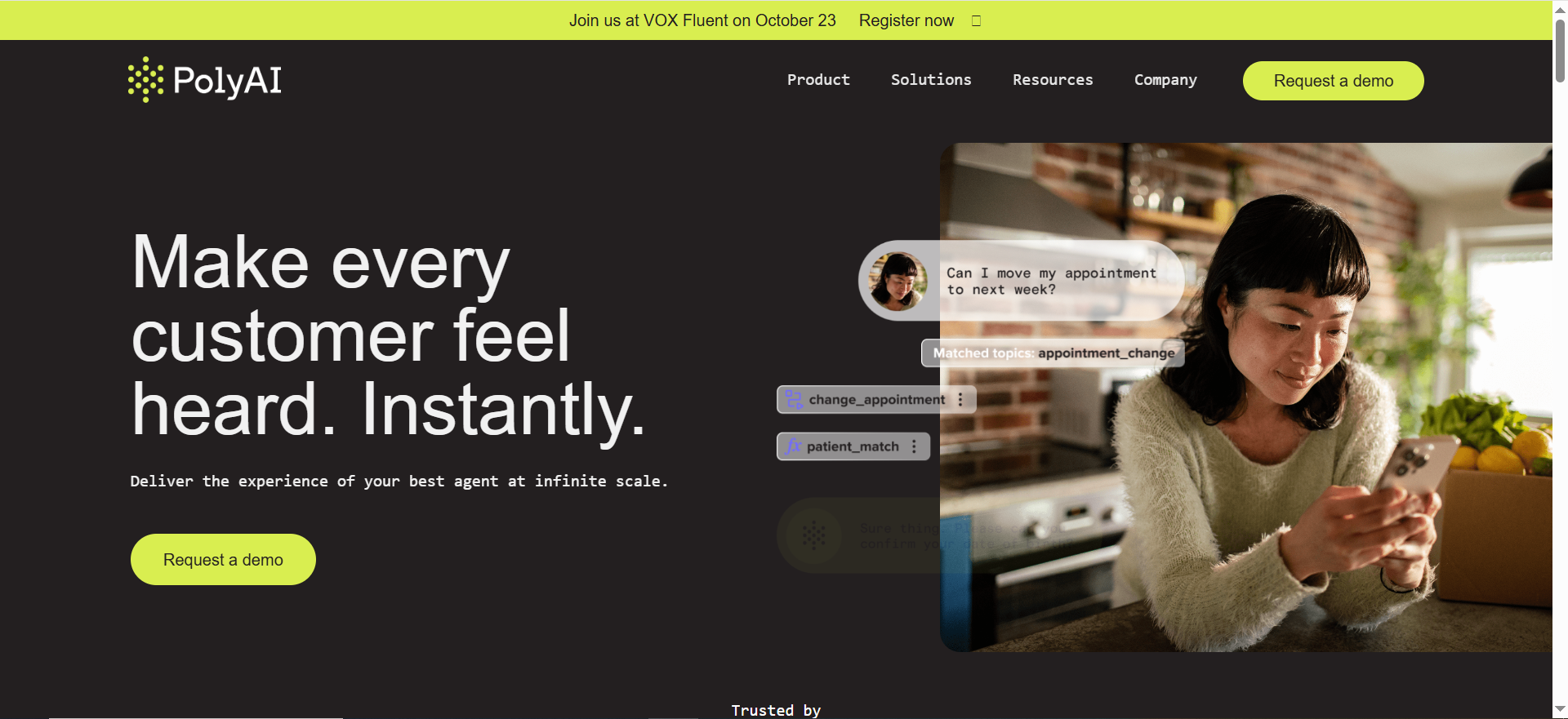
PolyAI is an enterprise conversational voice AI platform designed to automate high-volume customer interactions across phone channels using natural language conversations instead of traditional IVR menus. The platform combines automatic speech recognition, natural language understanding, dialogue management, and text-to-speech synthesis into a managed service that handles complex customer support scenarios.
Why Teams Use It
Teams choose PolyAI because it delivers the most production-ready, enterprise-grade voice AI experience on this list. PolyAI operates as a managed service, meaning you are not just licensing software. You are working with a team that builds, deploys, and maintains your voice agent on your behalf. Their voice assistants handle over 50% of customer inquiries, including authentication, order management, billing, and reservations. Deployment typically takes six weeks or less.
What It Is Good For
PolyAI is strongest in high-volume enterprise contact centers where call quality, compliance, and reliability are critical. The platform handles millions of calls for banks, hotels, and healthcare systems with lifelike voice agents. Its managed service model means PolyAI's team handles ongoing performance improvements, maintenance, and 24/7 support, which is ideal for organizations that want results without building an internal voice AI team.
When It Is a Good Fit
PolyAI is a good fit for mid-market to enterprise companies with high call volumes that want a turnkey solution with enterprise-grade SLAs. It works particularly well in industries with complex compliance requirements like financial services, healthcare, and hospitality. If your organization does not have (or does not want to build) an internal voice AI engineering team, PolyAI's managed service model removes that burden.
When It Is Not a Good Fit
PolyAI is not a good fit for startups, small businesses, or teams with limited budgets. The six-figure annual contracts put it out of reach for most smaller organizations. The managed service model also means less direct control over the technology stack compared to developer-first platforms like Vapi or Retell AI. If you need to iterate rapidly on call flows without going through a vendor's professional services team, a self-service platform will be faster.
How To Use It
Engage PolyAI's sales team for a consultation. Their team works with you to define the use case, design the conversational flows, integrate with your existing systems, and deploy the voice agent. The typical deployment timeline is six weeks. After launch, PolyAI provides ongoing optimization, maintenance, and 24/7 support.
Key Capabilities
PolyAI provides enterprise-grade ASR, NLU, dialogue management, and TTS in a single managed platform, the ability to handle over 50% of customer inquiries autonomously, deployment within six weeks, 24/7/365 emergency support with a web ticket portal, 99.9% SLA for uptime on phone lines, compliance certifications and regular security audits, proactive performance improvements included in the service, and integration with existing contact center infrastructure.
Pricing
PolyAI uses custom enterprise pricing with contracts that typically start at six figures annually. Ongoing usage is priced on a per-minute basis, which includes proactive performance improvements, maintenance, and 24/7 support. Pricing varies based on voice minutes processed, integrations, compliance requirements, and deployment scope. Contact PolyAI's sales team for a custom quote.
Free Tier?
No. PolyAI does not offer a free tier or self-service trial. Engagement begins with a sales consultation and custom proposal.
Downsides and Limitations
The high price point and annual contract requirements make PolyAI inaccessible for smaller organizations. The managed service model means slower iteration cycles compared to self-service platforms. Customization is handled by PolyAI's team rather than your own, which can create bottlenecks when you need rapid changes. Language support, while strong, covers fewer languages than ElevenLabs' 70+ language offering.
How Do AI Voice Assistants Handle Customer Support Calls Differently Than Traditional IVR
Traditional IVR systems force callers through rigid menu trees using keypad inputs or limited voice commands. AI voice assistants replace this with natural language conversations where callers speak in their own words and the system understands intent, context, and nuance. The difference is that a traditional IVR asks "Press 1 for billing, press 2 for support," while an AI voice assistant lets the caller say "I need to update my payment method and check my last invoice" and handles both requests in a single interaction. This reduces call handling time, eliminates menu navigation frustration, and increases first-call resolution rates. For teams exploring this shift, see our guide to the best AI agent platforms for self-service and case resolution.
What Is the Average Cost Per Minute for AI Voice Assistants in Customer Support
The cost per minute for AI voice assistants in customer support ranges from $0.05 to $0.33 depending on the platform and configuration. Developer platforms like Vapi advertise rates as low as $0.05 per minute, but the true all-in cost reaches $0.30+ when you include required third-party STT, LLM, TTS, and telephony providers. Retell AI charges $0.07 per minute for the voice engine, with LLM and telephony costs adding $0.04–$0.12/min on top, bringing true all-in costs to approximately $0.11–$0.19 per minute. ElevenLabs charges $0.10 per minute. Bland runs $0.11–$0.14 per minute depending on plan tier, with add-ons increasing costs further. Enterprise solutions like PolyAI use custom per-minute pricing bundled into annual contracts. The right comparison is total cost of ownership, not headline rates.
Can AI Voice Assistants Handle Complex Customer Support Scenarios Like Refunds and Account Changes
Yes, but the depth of handling varies by platform. PolyAI's managed voice agents handle over 50% of customer inquiries autonomously, including authentication, order management, and billing changes. Retell AI supports dynamic transfers and CRM integration that enable agents to look up account information and process changes in real time. Vapi provides the infrastructure to build custom workflows for any scenario, but requires engineering effort. The key factor is integration depth with your existing systems. An AI voice assistant can process a refund only if it has API access to your payment system, CRM, and order management platform. Without those integrations, the assistant can only collect information and transfer to a human agent.
How Long Does It Take to Deploy an AI Voice Assistant for Customer Support
Deployment timelines range from hours to six weeks depending on the platform and complexity. Self-service platforms like Retell AI and Vapi allow you to build and deploy a basic voice agent in hours or days if you have clear call flows and existing integrations. Bland supports rapid deployment for outbound campaigns with defined scripts. ElevenLabs Conversational AI lets you create and deploy agents quickly through its dashboard. PolyAI's managed service model typically takes six weeks for full deployment, but this includes custom design, integration, testing, and optimization by their professional services team. The tradeoff is speed versus polish: faster deployments handle simpler use cases, while longer deployments handle complex enterprise scenarios. For a broader view, see our comparison of the best AI chatbots for enterprise customer support.
Which AI Voice Assistant Is Best for Multilingual Customer Support
ElevenLabs Conversational AI leads for multilingual support with real-time language detection and switching across 70+ languages. The platform automatically detects which language a caller is speaking and responds in that language with native-sounding speech quality. Retell AI supports 31+ languages, which covers most major markets. PolyAI supports 20+ languages with enterprise-grade quality. Vapi's multilingual capability depends on which STT and TTS providers you connect. Bland is primarily English-focused. If your customer base spans multiple regions and languages, ElevenLabs provides the broadest coverage with the most natural-sounding output.
What Metrics Should You Track After Deploying an AI Voice Assistant for Support
The core metrics to track after deploying an AI voice assistant are containment rate (percentage of calls fully handled without human transfer), first-call resolution rate, average handle time, customer satisfaction score (CSAT), cost per call compared to human agents, escalation rate and reasons, and caller drop-off points. Containment rate is the most important because it directly measures how much call volume the AI handles autonomously. PolyAI reports that their voice assistants achieve over 50% containment rates. Retell AI provides built-in dashboards for monitoring these metrics. For Vapi and Bland, you need to build your own analytics pipeline or connect third-party monitoring tools.
How Do AI Voice Assistants Integrate with Existing Contact Center Software
Most AI voice assistants integrate with existing contact center software through APIs, webhooks, and SIP trunking. Retell AI offers native CRM integration through its drag-and-drop builder with real-time webhooks. Vapi connects to existing telephony infrastructure and provides webhook-based integrations for CRM and ticketing systems. Bland's API-first architecture integrates directly into CRMs, marketing tools, and data pipelines. PolyAI integrates with existing contact center infrastructure as part of its managed service deployment. ElevenLabs supports embedding on websites and connecting phone numbers. The critical question is not whether a platform can integrate, but how much engineering effort the integration requires and whether it supports real-time data lookup during calls.
FAQs
An AI voice assistant for customer support is a software system that uses speech recognition, natural language understanding, and text-to-speech technology to handle customer phone calls automatically. Instead of routing callers through traditional IVR menus, it holds natural conversations, understands caller intent, and resolves issues or routes calls to the right department. Modern platforms like Vapi, Retell AI, Bland, ElevenLabs, and PolyAI can handle tasks like account lookups, appointment scheduling, billing inquiries, and order status checks without human intervention.
Costs range from $0.05 to $0.33 per minute depending on the platform and your configuration. Retell AI charges $0.07 per minute for the voice engine, with LLM and telephony adding $0.04–$0.12/min on top (true all-in cost: $0.11–$0.19/min). Vapi charges $0.05 per minute for platform fees but true costs reach $0.30+ with required third-party services. Bland charges $0.09–$0.14 per minute with add-ons. ElevenLabs charges $0.10 per minute. PolyAI uses custom enterprise pricing with six-figure annual contracts. Compare total cost of ownership rather than headline per-minute rates.
Not entirely, but they can handle a significant portion of call volume. PolyAI reports handling over 50% of customer inquiries autonomously. The best approach is using AI voice assistants for routine, predictable interactions like account lookups, appointment scheduling, FAQs, and basic troubleshooting, while routing complex, emotionally sensitive, or escalated calls to human agents. This hybrid model reduces costs and wait times while maintaining quality for difficult cases.
Retell AI is the most accessible for non-technical teams, with its drag-and-drop builder, built-in testing tools, and all-in-one pricing. ElevenLabs Conversational AI is also relatively straightforward, letting you create agents through a dashboard without writing code. Vapi and Bland are developer-focused platforms that require API integration and technical configuration. PolyAI handles setup for you through its managed service, but requires a sales engagement and six-figure commitment. If you run a smaller team, see our guide to choosing an AI voice agent for small businesses.
Language support varies significantly across platforms. ElevenLabs leads with 70+ languages and real-time language detection. Retell AI supports 31+ languages. PolyAI supports 20+ languages with enterprise-grade quality. Vapi's language support depends on the third-party STT and TTS providers you connect. Bland is primarily focused on English. For global customer support, ElevenLabs offers the broadest coverage, while PolyAI offers the deepest enterprise-grade support in fewer languages.
Modern AI voice assistants use sentiment analysis and intent detection to recognize when a caller is frustrated, confused, or requesting a human agent. Most platforms support configurable escalation triggers that transfer the call to a human agent when the AI detects these signals. Retell AI supports dynamic transfers within its call flow builder. PolyAI includes sophisticated escalation logic as part of its managed service. Vapi and Bland support webhook-based escalation that you configure programmatically. The key is setting clear escalation rules and testing them with realistic scenarios before going live.