Who Has The Best AI Agent For Security Questionnaires (2026)
A practical buyer's guide to picking the right ai agent stack for security questionnaires across content and SEO.


This playbook helps data analysts and product managers compare the best ai agent options for security questionnaires. It breaks down where conveyor, hypercomply stand out, when alternatives such as langsmith, helicone make more sense, and which setup fits B2B companies and SaaS companies and mid-market companies and enterprise teams.
If your team’s main problem is answering inbound security questionnaires quickly and accurately, Conveyor is the strongest pure-play pick right now. It is the clearest “AI agent for security questionnaires” product in this shortlist, with a browser extension, portal autofill, trust center workflow, and a public claim of 95%+ first-pass answer accuracy. SafeBase is the best fit if you want to reduce the number of questionnaires you receive in the first place through a trust-center-first motion. HyperComply is the best option for lean security and compliance teams that want fast rollout and a security-review-specific workflow. Responsive is the best fit for larger cross-functional response operations, and Loopio is the best fit for teams that treat security questionnaires as part of a broader RFP and DDQ response program.
📋 Get Listed / Advertise
We update this guide monthly. Want your tool featured? Contact: aigrowthhacksofficial@gmail.com.
Table of Contents
Best Tools for Security Questionnaires
| Tool | Best for | Why it stands out | Main tradeoff |
|---|---|---|---|
| Conveyor | Teams that want the most agent-like questionnaire automation | Strong AI-first positioning, portal autofill, trust center, RFP + questionnaire coverage | Pricing is usage-credit based, so volume planning matters |
| HyperComply | Lean security/compliance teams | Built specifically for security reviews, fast response workflow, trust page, Salesforce + Slack workflow | Less of a broad proposal-management platform than Loopio or Responsive |
| SafeBase | Trust-center-led GTM teams | Helps reduce inbound questionnaires through self-serve trust content and AI assistance | Best value appears when trust center adoption is part of your sales motion |
| Responsive | Enterprise response operations | Mature response platform, AI agents, TRACE Score, plan depth, broad integrations | Can be more platform than a small security team needs |
| Loopio | Proposal teams handling SQs alongside RFPs/DDQs | Strong content library, collaboration, integrations, governance, public starting price | Not as specialized around security-review workflows as Conveyor or HyperComply |
Best Tools for Security Questionnaires
What Actually Makes an AI Agent “Best” for Security Questionnaires?
The winning product is usually not the one with the flashiest AI copy. It is the one that can do four things reliably: pull from approved sources, handle messy input formats, preserve governance, and reduce review time without increasing risk. HyperComply’s buyer guidance stresses centralized repositories, AI-powered suggestions, and integrations. Responsive emphasizes approved content, agent-based intake, and accuracy scoring. Loopio focuses on trusted content, permissions, and governance controls.
In practice, buyers should judge these tools on five criteria:
Accuracy grounded in approved content
A useful agent should answer from trusted internal sources, not from general web text. Conveyor says teams can connect AI to source material such as documents, websites, and Drive content. Responsive says its AI drafts from approved security questionnaire content and adds TRACE Score for confidence. Loopio says answers come from trusted content sources with permission-aware retrieval. SafeBase says its AI uses approved sources and does not train on customer data.
Workflow fit
Some teams need a narrow tool for security reviews. Others need a broader response platform. HyperComply is squarely built around security and compliance workflows, while Responsive and Loopio are broader response-management platforms spanning RFPs, DDQs, and security questionnaires.
Trust center leverage
If you can answer fewer questionnaires by proactively sharing evidence, that is often better than automating every form. SafeBase says its trust-center-first approach reduces inbound questionnaires by 74% or more, and one Crossbeam case study cites a 98% reduction. Conveyor and HyperComply also combine questionnaire handling with trust-center or trust-page functionality.
Portal and file handling
A real-world agent needs to work with Word, Excel, PDF, and browser-based portals. Conveyor highlights browser-based autofill. Responsive says its agents intake Word, Excel, and PDF questionnaires. Loopio supports Slack, Salesforce, and broader connected content workflows.
Commercial model
Pricing affects fit more than most vendors admit. Loopio publicly starts at $20,000 per year for 10 seats. Conveyor uses a credit-based model and has a free tier for light trust-center use. HyperComply says it is priced by questionnaire, and its startup package advertises unlimited questionnaire responses at a discounted rate for eligible startups. Responsive offers four editions with pricing by quote, including Lite through Enterprise.
📋 Get Listed / Advertise
We update this guide monthly. Want your tool featured? Contact: aigrowthhacksofficial@gmail.com.
Tool #1: Conveyor
What it does
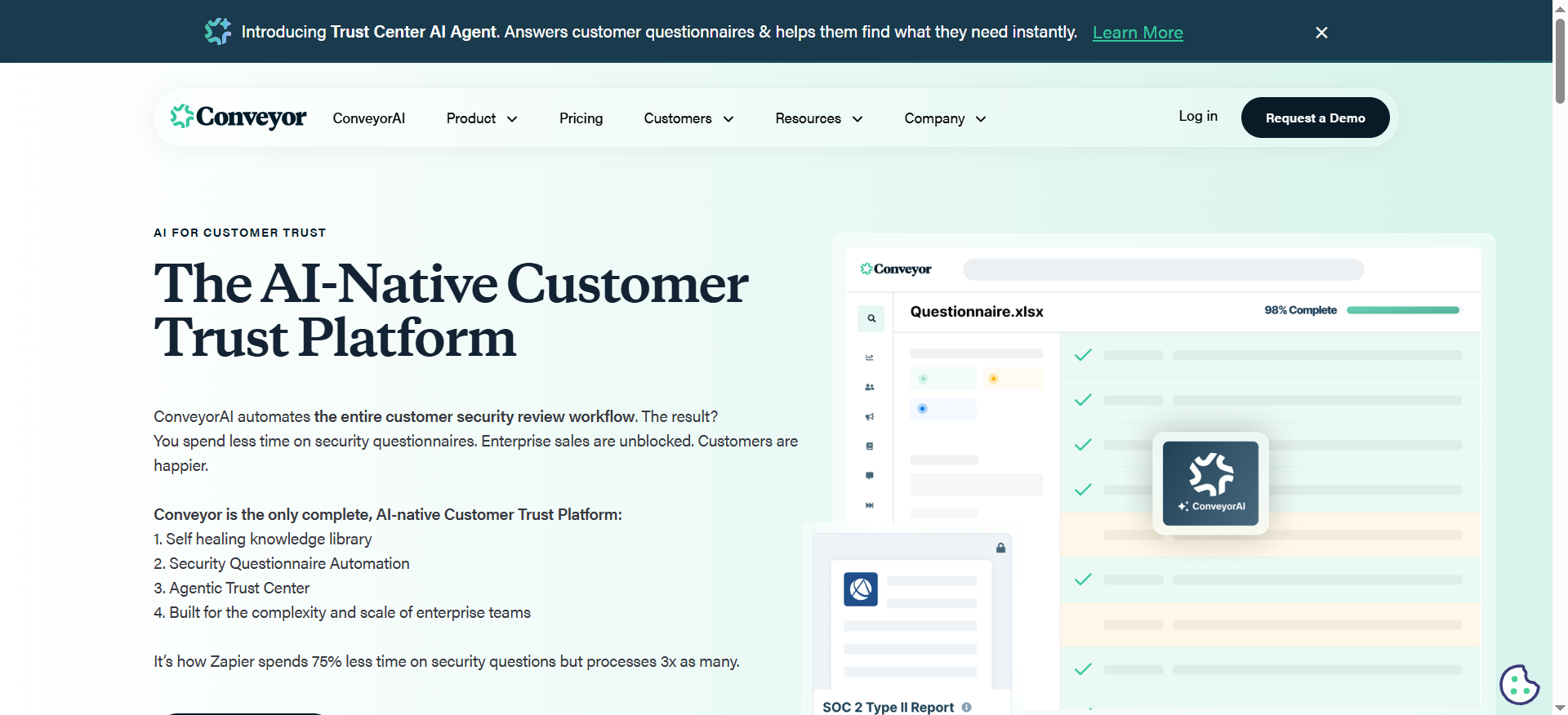
Conveyor is an AI customer trust platform built to automate security questionnaires, trust-center workflows, and RFP responses from a shared source of truth. Its positioning is unusually direct for this category: it explicitly markets an AI Agent for Security Questionnaires rather than only “AI assistance.”
Why teams use it
Teams use Conveyor when security reviews are blocking deals and the goal is to remove as much manual work as possible. Conveyor says customers choose it for 95%+ accurate first-pass AI answers, trust-center self-service, browser-based questionnaire completion, and more seamless automation of complex workflows.
What it’s good for
It is strongest for B2B SaaS teams that handle frequent inbound security reviews, want a strong browser/portal workflow, and prefer a platform purpose-built around customer trust operations rather than generic proposal management. It is especially strong when the same team also owns trust-center publishing.
When it’s a good fit
Choose Conveyor when your highest-priority metric is reducing questionnaire turnaround time while keeping answers grounded in approved materials. It is also a good fit when buyers often send forms through portals rather than clean spreadsheets. Conveyor’s own docs say teams typically see a two-to-three-fold reduction in turnaround time.
When it’s not a good fit
It is less ideal if your security questionnaire workflow is only a small piece of a much larger enterprise proposal operation with complex cross-department authoring requirements. In those cases, Responsive or Loopio may be a better operational hub.
How to use it
The usual model is to connect documents and knowledge sources, generate draft answers, use the browser extension or platform workflow to complete the questionnaire, then publish reusable trust materials so future buyers can self-serve more of the review.
Key capabilities
Conveyor’s standout capabilities are its source-connected answering, trust-center integration, questionnaire autofill in portals, and explicit agent framing for security questionnaires and RFPs.
Pricing
Conveyor has a free plan and a credit-based pricing model for trust-center and questionnaire usage. Its pricing page shows free trust-center credits and usage metering, while a Conveyor comparison page states security questionnaire automation on the Professional plan starts at $4,800.
Free tier?
Yes, for light trust-center usage. The free plan is not the same as full production-scale questionnaire automation.
Downsides / limitations
The main tradeoff is that its economics are tied to usage and credits, so high-volume teams need to model forecasted volume carefully. And while it is excellent for security-review workflows, some organizations may still prefer a broader strategic response platform if RFP governance is the bigger internal requirement.
Tool #2: HyperComply
What it does
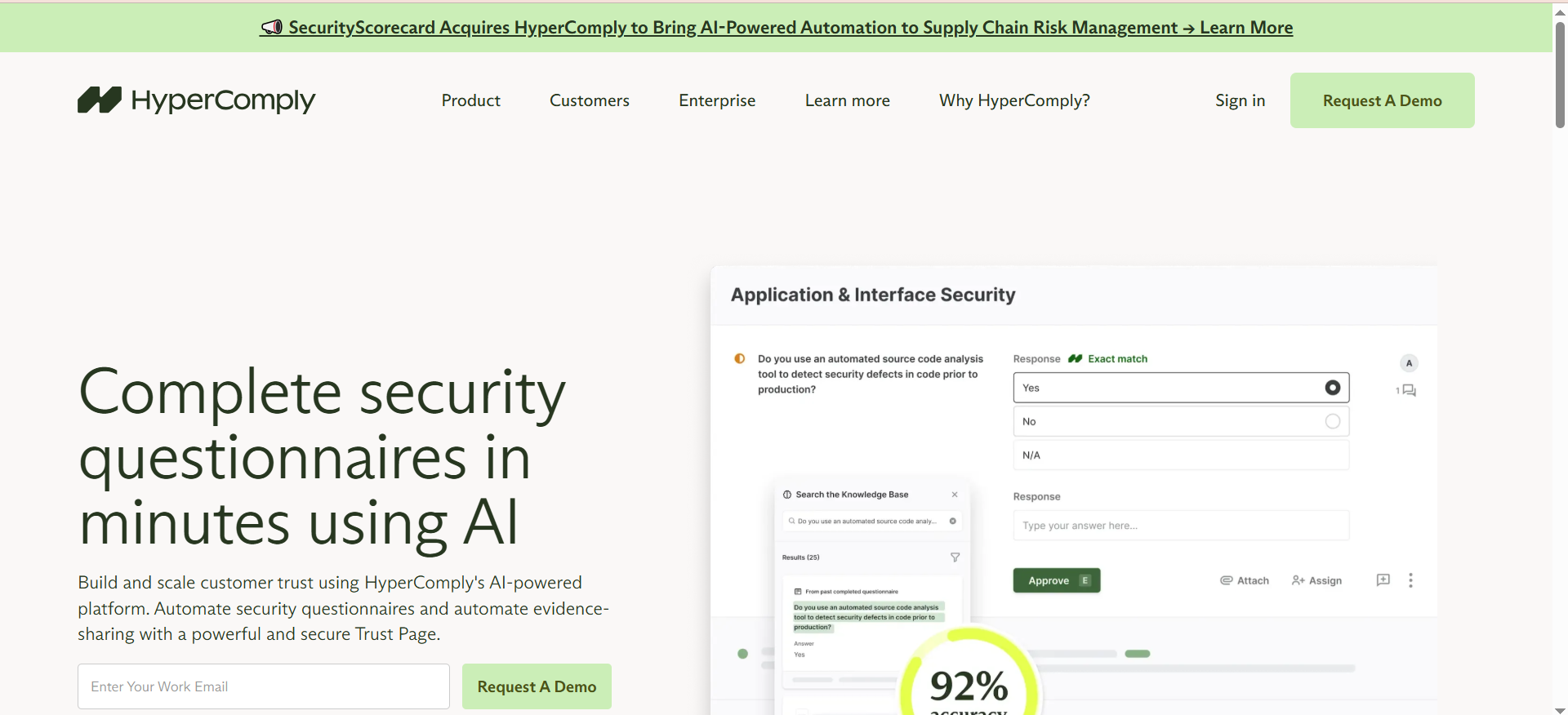
HyperComply automates security questionnaires and evidence sharing for security and compliance teams, paired with a Trust Page to streamline reviews. Its product is positioned around speed and operational simplicity.
Why teams use it
Buyers choose HyperComply when they want a more security-review-specific workflow than a broad proposal platform. HyperComply says teams can respond in as little as one day, supports Salesforce and Slack workflows, and syncs security controls so responses stay current.
What it’s good for
It is a strong fit for lean security, GRC, or compliance teams that need to move fast without building a giant response-management process. It also looks attractive for startups and growth-stage companies that want predictable questionnaire handling without buying a much broader enterprise response suite.
When it’s a good fit
Choose HyperComply when your core job is speeding security reviews, not managing every kind of sales-content workflow. It is also a good fit when you want Slack and Salesforce to be part of the review loop.
When it’s not a good fit
It is less ideal when your proposal team needs a deeply featured cross-functional content operation spanning many response types and advanced content workflows. That is where Loopio or Responsive often feel more complete.
How to use it
Most teams use HyperComply by importing questionnaires, letting AI draft responses from the security knowledge base, routing exceptions to SMEs, and using the Trust Page to cut repeat requests. HyperComply also says its Respond AI saves roughly 2 to 5 hours per questionnaire and reduces manual effort by at least 75%.
Key capabilities
The core strengths are questionnaire-specific automation, security-knowledge grounding, Slack and Salesforce workflow connections, and a trust-page layer to reduce repetitive back-and-forth.
Pricing
HyperComply does not publish standard list pricing on its main pages, but its help center says it is priced by questionnaire. Its startup package advertises unlimited questionnaire responses at 60% off for eligible startups.
Free tier?
No public free self-serve tier was visible in the sources reviewed.
Downsides / limitations
The tradeoff is breadth. HyperComply looks very strong if your world revolves around security reviews, but less obviously superior if your team needs one platform for RFPs, DDQs, security questionnaires, internal content ops, and enterprise reporting across many departments.
Tool #3: Loopio
What it does
Loopio is a response-management platform used for RFPs, RFIs, DDQs, and security questionnaires. It combines a collaborative content library with AI features that help draft, summarize, route, and improve responses.
Why teams use it
Teams use Loopio when security questionnaires are one recurring workflow inside a broader proposal and due-diligence operation. Loopio’s AI emphasizes trusted content, content provenance, permissions, and reusable knowledge workflows rather than only security-questionnaire automation.
What it’s good for
Loopio is strongest for proposal, sales engineering, and response teams that need consistency, collaboration, and content governance across many request types. It is especially useful when multiple departments contribute and when the content library is the real operating system behind the work.
When it’s a good fit
Choose Loopio when your security questionnaire process lives inside a broader RFP/DDQ motion, and when content governance and internal collaboration matter more than having the most specialized security-review agent. Its case studies show strong scale benefits, including Netskope handling 90+ security questionnaires a year and using Loopio to complete much of each response from the library.
When it’s not a good fit
It is not the best pick if you want the most security-review-specific product or the strongest trust-center-led deflection strategy. Conveyor, HyperComply, and SafeBase are all more specialized there.
How to use it
Teams typically centralize approved answers in the library, connect knowledge sources like Google Drive, SharePoint, and Slack, generate draft answers, assign exceptions to SMEs, and continuously improve reusable content after each project.
Key capabilities
Loopio’s strongest capabilities are response intelligence, content governance, summarization, expert identification, integration with connected knowledge sources, and permission-aware controls.
Pricing
Loopio publicly says pricing starts at $20,000 per year for 10 seats, with higher packages for more mature teams.
Free tier?
No public free tier was visible in the reviewed sources.
Downsides / limitations
Its biggest limitation in this specific category is specialization. Loopio is very good at response management, but it is not positioned as aggressively as Conveyor around autonomous security questionnaire completion, and it is not as trust-center-first as SafeBase.
Tool #4: Responsive
What it does
Responsive is a strategic response management platform for RFPs, DDQs, security questionnaires, and related information requests. Its AI agents automate intake, drafting, and review workflows across formats and teams.
Why teams use it
Responsive is attractive to organizations that want a broad, enterprise-ready response platform rather than a narrow SQ tool. It says teams can respond 80% faster, automate Word/Excel/PDF intake, use conversational AI for outlier questions, and score answers with TRACE Score.
What it’s good for
It is best for larger response operations where InfoSec, sales, legal, product, and proposal teams all need to work from one system. Its pricing packages, AI Agent Studio, API connector, and enterprise options show more platform depth than most point tools.
When it’s a good fit
Choose Responsive when your organization already thinks in terms of strategic response management, not just questionnaire automation. It is also a good fit if you want structured scoring, more configurable platform tiers, and broad enterprise packaging.
When it’s not a good fit
Responsive can be too much platform for a small security team that mainly wants to answer questionnaires faster. In those situations, HyperComply or Conveyor may be easier to justify and deploy.
How to use it
Teams typically upload questionnaires, let AI agents create the draft, use TRACE Score and review workflows to validate quality, and manage collaboration through the central content library and response platform.
Key capabilities
Its strongest features for this use case are multi-format intake, approved-content grounding, AI agents, TRACE Score, conversational AI for outlier answers, and strong packaging across company sizes.
Pricing
Responsive offers Lite, Emerging, Growth, and Enterprise editions with quote-based pricing. Public plan pages show feature differences but not list prices.
Free tier?
No public free tier was visible in the reviewed sources.
Downsides / limitations
Responsive’s tradeoff is complexity and scope. It is powerful, but if your need is narrow and security-review-specific, the broader SRM framing may add overhead you do not need.
Tool #5: SafeBase
What it does
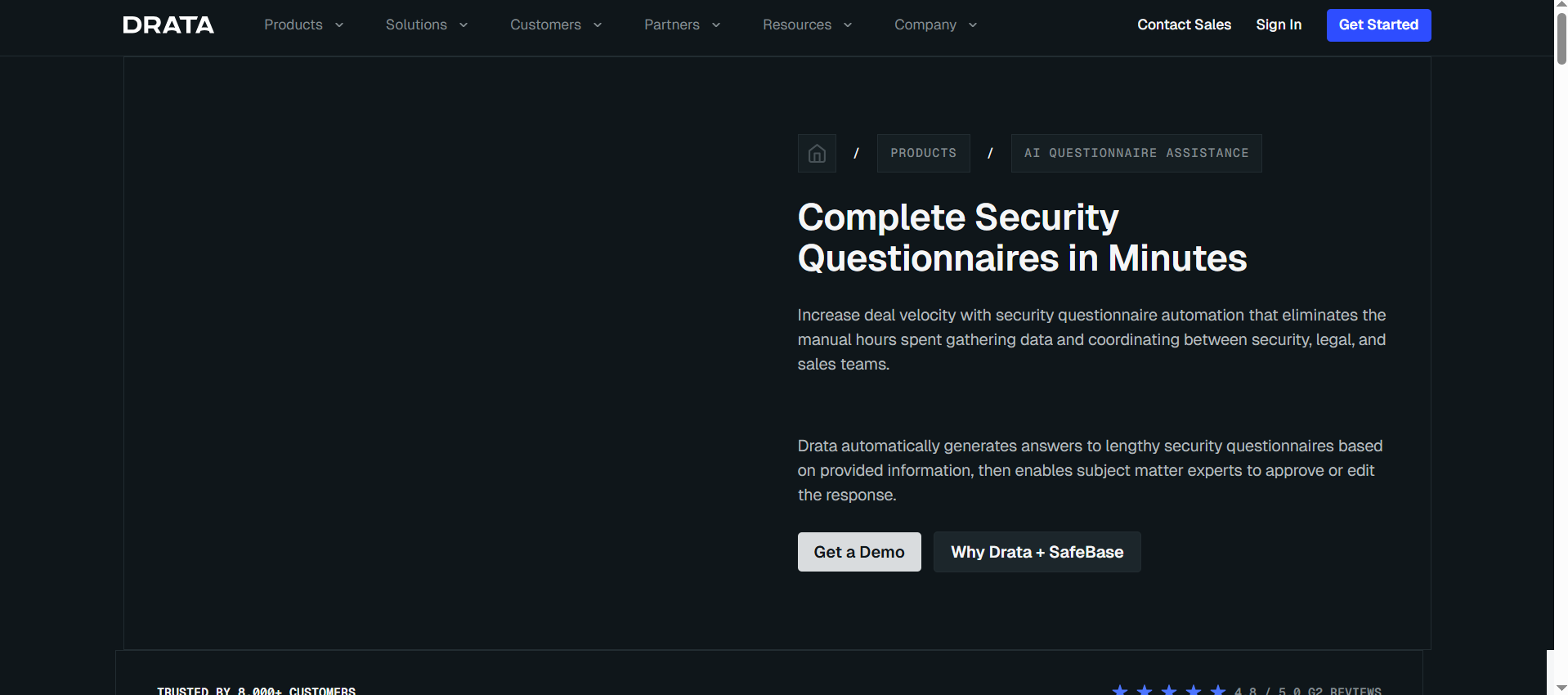
SafeBase, now part of Drata, combines trust-center infrastructure with AI questionnaire assistance. Its main thesis is that the best security questionnaire workflow is the one you can partially eliminate through proactive self-service.
Why teams use it
Teams use SafeBase when security reviews are slowing sales and too much knowledge is trapped in manual back-and-forth. SafeBase says its trust-center-first approach reduces inbound questionnaires by 74% or more, and its AI products generate answers from approved sources while keeping humans in the loop.
What it’s good for
It is strongest for B2B SaaS companies that want to operationalize trust as part of the sales process, not just automate forms. If your goal is fewer repetitive reviews, more self-serve document access, and a modern buyer experience, SafeBase is one of the strongest options here.
When it’s a good fit
Choose SafeBase when you can influence the buyer journey early with a trust center and when your revenue team is aligned around proactive security sharing. Its Crossbeam case study reports a 98% reduction in inbound security questionnaires and a seven-day reduction in sales cycle.
When it’s not a good fit
If your team receives many questionnaires but cannot realistically drive trust-center adoption in the sales process, its biggest advantage is muted. In that case, a more questionnaire-centric workflow like Conveyor or HyperComply may feel more directly aligned.
How to use it
The best implementation pattern is to publish high-value trust materials first, route buyers into the trust center early, then use AI questionnaire assistance only for what still requires bespoke response. That reduces both workload and review friction.
Key capabilities
Its standout strengths are trust-center UX, NDA/document workflow, approved-source AI assistance, and the broader Drata connection around agentic trust management.
Pricing
SafeBase does not show a standard public price on the reviewed pages. Comparison content on its site references custom pricing plans.
Free tier?
No public free tier was visible in the reviewed sources.
Downsides / limitations
SafeBase is less of a pure “answer every incoming form” story than Conveyor. Its real advantage shows up when your company is ready to push a trust-center-led workflow, which is strategic but requires GTM alignment.
So, Who Actually Has the Best AI Agent?
Best overall for this title: Conveyor
Conveyor wins this article’s title because it is the clearest direct answer to “best AI agent for security questionnaires.” Its product positioning, feature set, portal handling, trust-center link, and first-pass accuracy claim all align directly with that buying intent.
Best for lean security teams: HyperComply
HyperComply is the better pick if you want a security/compliance-specific workflow that feels lighter-weight and more focused than a full response-management platform.
Best for reducing questionnaire volume: SafeBase
SafeBase is the best option if your real strategic goal is to prevent repetitive questionnaires through trust-center deflection rather than only automate them faster.
Best for enterprise response ops: Responsive
Responsive is strongest when the work spans multiple departments and response types, and when platform depth matters more than narrow specialization.
Best for broader proposal teams: Loopio
Loopio is strongest when your security questionnaire process sits inside a larger proposal and DDQ engine powered by a governed content library.
Common Mistakes Buyers Make
Mistaking “AI drafting” for true workflow automation
A vendor can have decent drafting and still fail on file ingestion, portal completion, approvals, or trust-center reuse. The best tools here differ most in workflow design, not just generation quality.
Ignoring trust-center economics
If a trust center can remove a meaningful chunk of inbound questionnaires, that may be worth more than a slightly better draft engine. SafeBase’s and HyperComply’s trust-led motion makes this especially relevant.
Buying a broad platform for a narrow problem
If your actual pain is a small security team buried in questionnaires, a broader response suite can be unnecessary. HyperComply and Conveyor may be easier to justify than Responsive or Loopio in that case.
Not testing permissions and source quality
Loopio and Responsive both emphasize approved content, permissions, and governed sources. That matters because security questionnaires can create real risk if teams answer from stale or overexposed content.
Final Verdict
Conveyor has the best AI agent for security questionnaires if your goal is the strongest pure-play automation for inbound security reviews. It is the most direct match for the title and the clearest current market positioning around an actual questionnaire agent. HyperComply is the best challenger for lean security teams, SafeBase is the smartest choice for trust-center-led deflection, Responsive is best for broad enterprise response management, and Loopio is best when security questionnaires live inside a wider proposal operation. For a closely related comparison, see best AI agent platforms for self-service and case resolution.
📋 Get Listed / Advertise
We update this guide monthly. Want your tool featured? Contact: aigrowthhacksofficial@gmail.com.
FAQs
It is software that ingests a security questionnaire, retrieves approved company information, drafts responses, routes exceptions for review, and often helps manage evidence sharing or trust-center workflows. The best tools do more than write text. They also reduce manual coordination and improve consistency.
For startups, HyperComply is especially worth a look because it advertises a startup package with discounted access and unlimited questionnaire responses for eligible startups. Conveyor is also worth considering for lighter usage because it has a free tier on the trust-center side.
Responsive is the strongest enterprise-wide response platform in this list based on its packaging depth, AI Agent Studio, enterprise hosting options, and broad SRM scope. SafeBase also becomes very compelling for enterprise trust-center programs, especially within the broader Drata ecosystem.
Yes. Responsive explicitly references support for formats such as SIG, VSAQ, CAIQ, VSA, NIST 800-171, CIS Controls, ISO, and DORA-related workflows. Other vendors in this category also position themselves around standardized security assessments and reusable knowledge.
Only partially. Loopio publicly lists pricing starting at $20,000 per year for 10 seats. Conveyor publicly shows a free tier and credit-based model, while Responsive, HyperComply, and SafeBase mainly push quote-based or custom pricing in the sources reviewed.
The biggest risk is poor source quality. Even strong AI agents can produce risky answers if your approved content is stale, incomplete, or weakly governed. The best outcomes come from clean source documents, permissions, clear review ownership, and a realistic pilot questionnaire for evaluation.