Best Companies For AI Sales Automation Tools (2026)
What marketing ops leaders and product managers should compare before choosing a companies solution for ai sales automation tools.

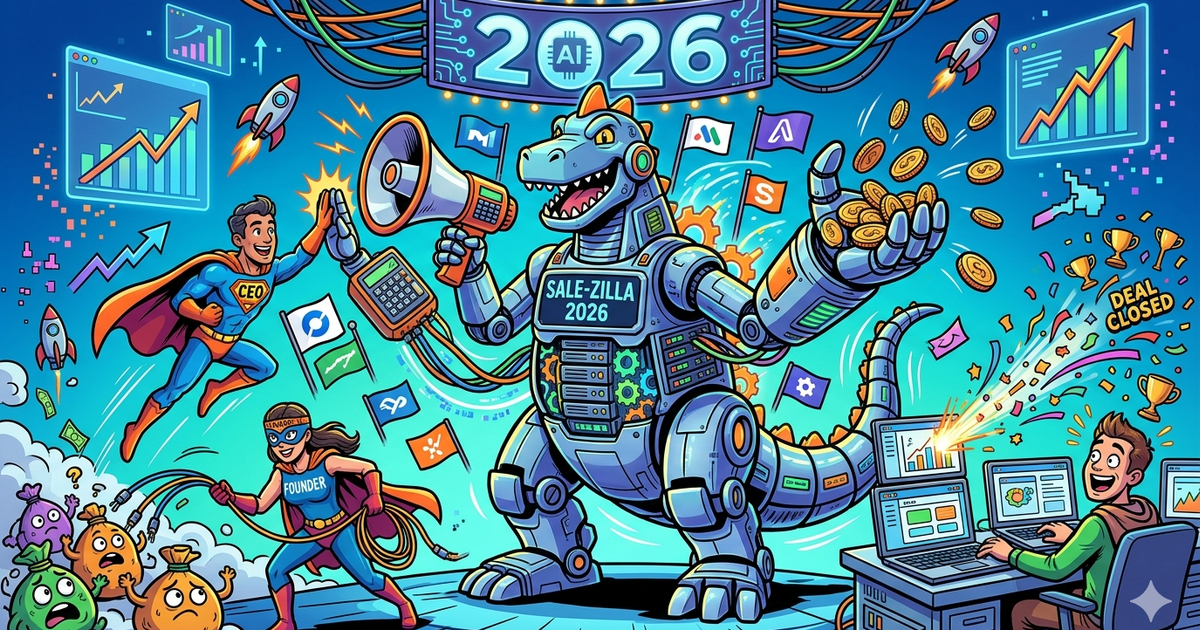
This playbook helps marketing ops leaders and product managers compare the best companies options for ai sales automation tools. It breaks down where zapier, make stand out, when alternatives such as relay-app, relevance-ai make more sense, and which setup fits B2B companies and B2C brands and small businesses and mid-market companies.
Sales automation has shifted from a nice-to-have to essential infrastructure. AI-powered tools now handle lead qualification, email sequences, meeting scheduling, and deal tracking with minimal human intervention. If you're looking for the most capable platforms to automate sales workflows, your choice depends on team size, technical expertise, and integration depth. Zapier excels for non-technical teams needing broad app coverage, Make offers affordable visual workflow building, n8n delivers self-hosted control for developers, Workato provides enterprise-grade orchestration, and UiPath brings RPA-backed automation at scale. This guide compares the top five options and answers the critical questions sales teams ask when evaluating automation platforms.
Table of Contents
Best Companies For AI Sales Automation Tools (Quick Comparison)
| Tool | Best For | Starting Price | Key Strength |
|---|---|---|---|
| Zapier | Non-technical teams needing broad integrations | Free (100 tasks/mo) | 7,000+ app integrations, AI Copilot |
| Make | SMBs wanting visual workflow logic | Free (1,000 credits/mo) | Credit-based pricing, Maia AI assistant |
| n8n | Developers needing self-hosted control | €24/mo (self-hosted free) | 80-90% cheaper execution pricing, open-source |
| Workato | Large enterprises requiring compliance | ~$10K-$15K/year | SOC 2 Type II, unlimited workflows, agentic capabilities |
| UiPath | Enterprises needing RPA with AI | Free ($0); Basic $25/mo | Self-healing automation, OCR, image recognition |
Best Companies For AI Sales Automation Tools (Quick Comparison)
1. Zapier
What it does
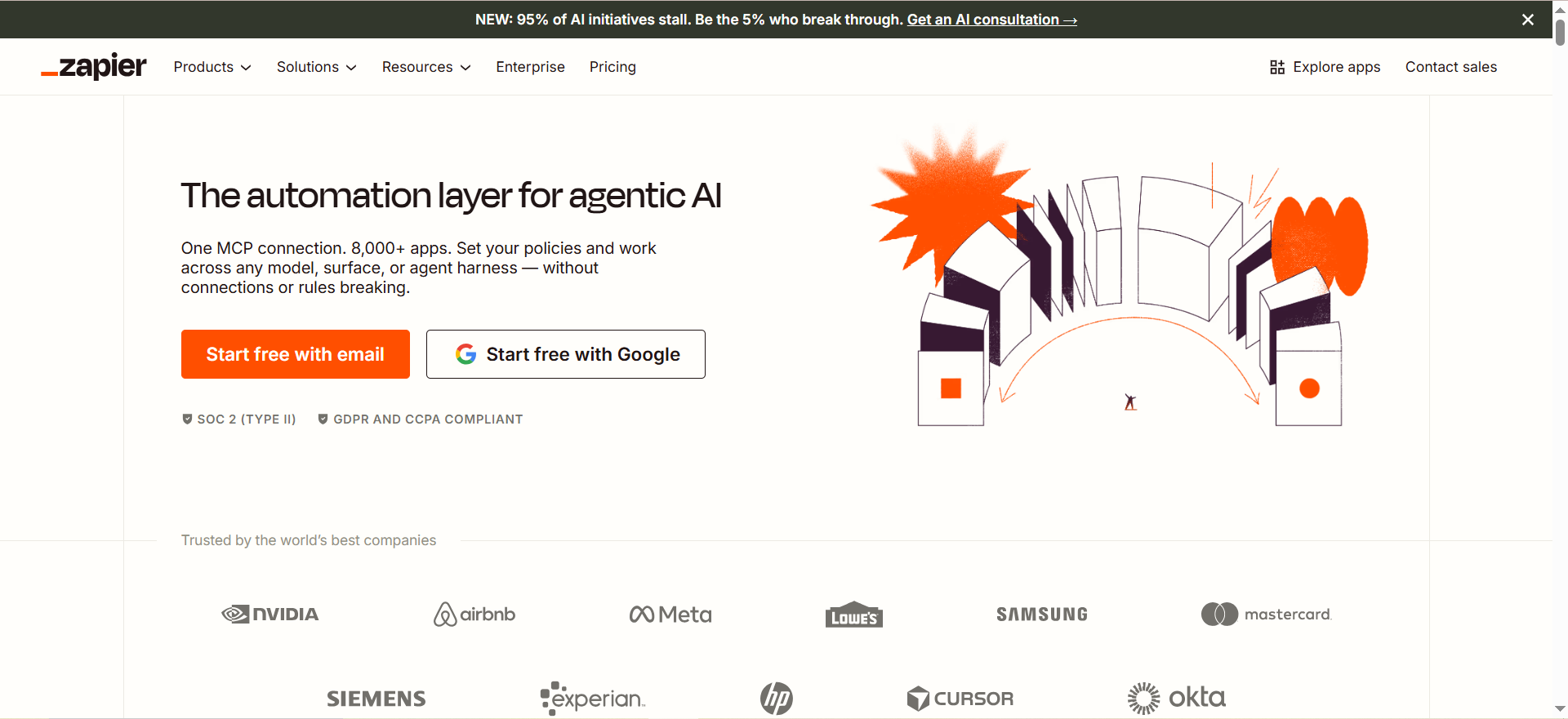
Zapier connects over 7,000 apps to automate repetitive tasks without code. It triggers actions based on events—when a lead fills a form, Zapier automatically adds them to your CRM, sends a welcome email, and creates a calendar reminder. In 2026, Zapier launched AI Agents, conversational AI assistants that can autonomously handle multi-step workflows like lead scoring and follow-up outreach.
Why teams use it
Zapier requires zero coding skills. Sales teams can build automations in minutes using a visual editor: pick a trigger app, choose an action, connect data fields. The platform's breadth is unmatched—7,000 integrations mean you're unlikely to encounter an unsupported app. Non-technical marketers, ops managers, and sales reps all use Zapier independently without relying on engineers.
What it's good for
Fast setup for small-to-medium automation workflows. Connecting your landing page form to your CRM and email tool. Syncing data between Salesforce, HubSpot, Slack, and custom webhooks. Multi-step Zaps (up to 100 steps per workflow) let you chain complex logic together. Zapier Tables and Forms add spreadsheet-like storage and data collection without leaving the platform. The AI Copilot builder suggests automation workflows based on your description.
When it's a good fit
Your team has no coding experience but needs to move fast. You use a mix of SaaS tools (CRM, email, scheduling, support) and want them talking to each other. You want a low-risk, month-to-month solution. You need AI-powered assistants that can autonomously execute sales tasks. You're operating at startup or SMB scale where simplicity beats advanced customization.
When it's not a good fit
You need self-hosted or air-gapped infrastructure (Zapier is cloud-only). Your workflows involve complex branching logic, loops, or custom database queries. You want execution-level pricing transparency (Zapier's task pricing can scale quickly with high-volume workflows). You require on-premise integration due to regulatory or data residency requirements. You're an enterprise with thousands of daily workflow executions (costs balloon with scale).
How to use it
Sign up, choose your trigger app (e.g., Salesforce new lead), select the action app (e.g., Gmail), map the data fields (contact name, email), and activate. For multi-step workflows, add intermediate steps (conditional logic, delays, data transformations). Use Zapier's AI Copilot by describing your workflow in plain English—it builds a preliminary automation you refine. Test the workflow with sample data before going live.
Key capabilities
AI Agents for autonomous sales task executionMulti-step Zaps with conditional branchingTables (spreadsheet storage with formula support)Forms (low-code data collection)Zapier MCP (integrates with Claude and other AI models)Built-in data transformation and formattingDelay, split, and loop steps for workflow controlAPI calls to custom endpointsWebhook triggering from any app
Pricing
Free: 100 tasks/month, limited to simple Zaps. Starter: $19.99/month (billed yearly) for 750 tasks/month. Professional: $73.50/month (billed annually) for 2,000 tasks/month, adds custom logic paths and webhooks. Team: $103.50/month (billed annually) for 2,000 tasks/month, adds team collaboration. Enterprise: custom pricing for unlimited tasks, priority support, and advanced SLA requirements.
Free tier?
Yes. The free tier includes 100 tasks per month, two-step Zaps only, and access to most integrations. Enough to test if Zapier fits your workflow, but scaling requires a paid plan.
Downsides / limitations
Task pricing scales quickly—high-volume automation can become expensive. Multi-step workflows are limited by task complexity (simple data transformations included, heavy computation requires workarounds). No self-hosted option means your data flows through Zapier's servers (compliance concern for some enterprises). Conditional logic, while available, becomes cumbersome in deeply nested scenarios. Execution delays (Zaps check for triggers every few minutes, not real-time). Limited ability to build custom integrations beyond API calls.
2. Make
What it does
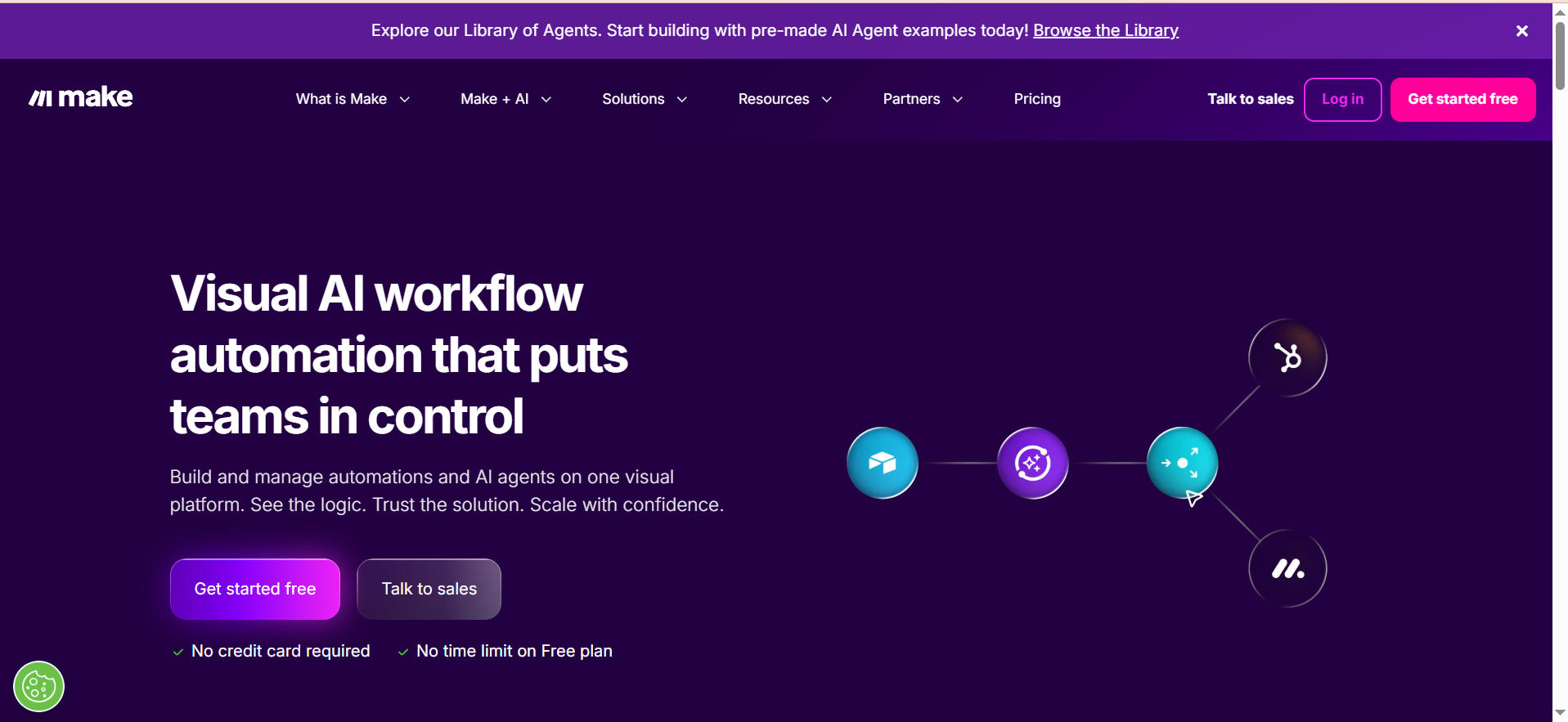
Make (formerly Integromat) is a visual workflow automation platform with 3,000+ app integrations and native support for OpenAI, Claude, and Gemini AI models. You build scenarios—directed graphs of modules connected by data flows—without touching code. Maia, Make's AI assistant, generates scenarios from natural language descriptions. The platform uses a credit system where each module execution costs credits based on complexity.
Why teams use it
Make balances power and accessibility. It's more visually intuitive than code-heavy platforms but more capable than simple task-linking tools. The credit-based pricing is transparent and predictable compared to per-task models. Native AI module support means you can integrate ChatGPT, Claude, or Gemini directly into workflows for tasks like lead scoring, email drafting, and objection handling. Maia lets non-technical users describe what they want and get a working scenario.
What it's good for
Building multi-step sales workflows with visual logic. Routing leads based on scoring criteria, enriching contact data via external APIs, generating personalized outreach emails using AI, and logging interactions back to your CRM. Parallel module execution (multiple paths running simultaneously) works well for scenarios like "score the lead in one branch, send email in another, log in a third." Data mapping is explicit, making it clear which fields flow where.
When it's a good fit
You want visual workflow design without coding. Your team has moderate technical comfort (non-developers can build, developers can extend). You heavily use AI models and want native integration. You operate at SMB-to-mid-market scale and need predictable, transparent pricing. You want better performance than simple task-linking but don't need full programming language support.
When it's not a good fit
You need self-hosted deployment (Make is cloud-only). Your workflows require custom code execution beyond API calls. You operate at enterprise scale with thousands of concurrent executions. You demand real-time triggering (Make checks every few minutes like Zapier). You need complex database operations or heavy computation within the workflow.
How to use it
Create a new scenario, add your trigger module (e.g., webhook from your form), add action modules (e.g., OpenAI module to score the lead, Gmail to send email, Salesforce to log the contact), map the data between modules, and activate. Use Maia to generate the scenario from a description like "score leads from my form using AI, send them an email, and add to Salesforce." Test the scenario with sample data and monitor execution logs.
Key capabilities
Native OpenAI, Claude, and Gemini AI modulesMaia AI assistant for scenario generation3,000+ app integrationsVisual flow editor with parallel execution pathsData transformation and aggregation modulesWebhook triggering and HTTP requestsSchedule-based triggers (daily, weekly, hourly)Conditional branching and loopsRate limiting and error handlingDetailed execution logs and debugging
Pricing
Free: 1,000 credits/month, perfect for testing. Core: $9/month (annual billing) for 10,000 credits. Pro: $16/month (annual billing) for 10,000 credits with priority execution and custom variables. Teams: $29/month for shared workspace and team collaboration. Enterprise: custom pricing for unlimited credits and dedicated support.
Free tier?
Yes. The free tier includes 1,000 credits/month (roughly 10-20 executions of a multi-module scenario). Enough to prototype and validate ideas, but production use requires a paid plan.
Downsides / limitations
Credit system requires calculating costs upfront (a 10-module scenario might consume 100 credits per execution). Less mature than Zapier in terms of global user base and community support. No self-hosted option. Limited custom code support (you can call APIs but can't embed arbitrary Python or JavaScript in the workflow). Maia's generated scenarios require review and refinement. Reporting and analytics are basic compared to enterprise platforms.
3. n8n
What it does
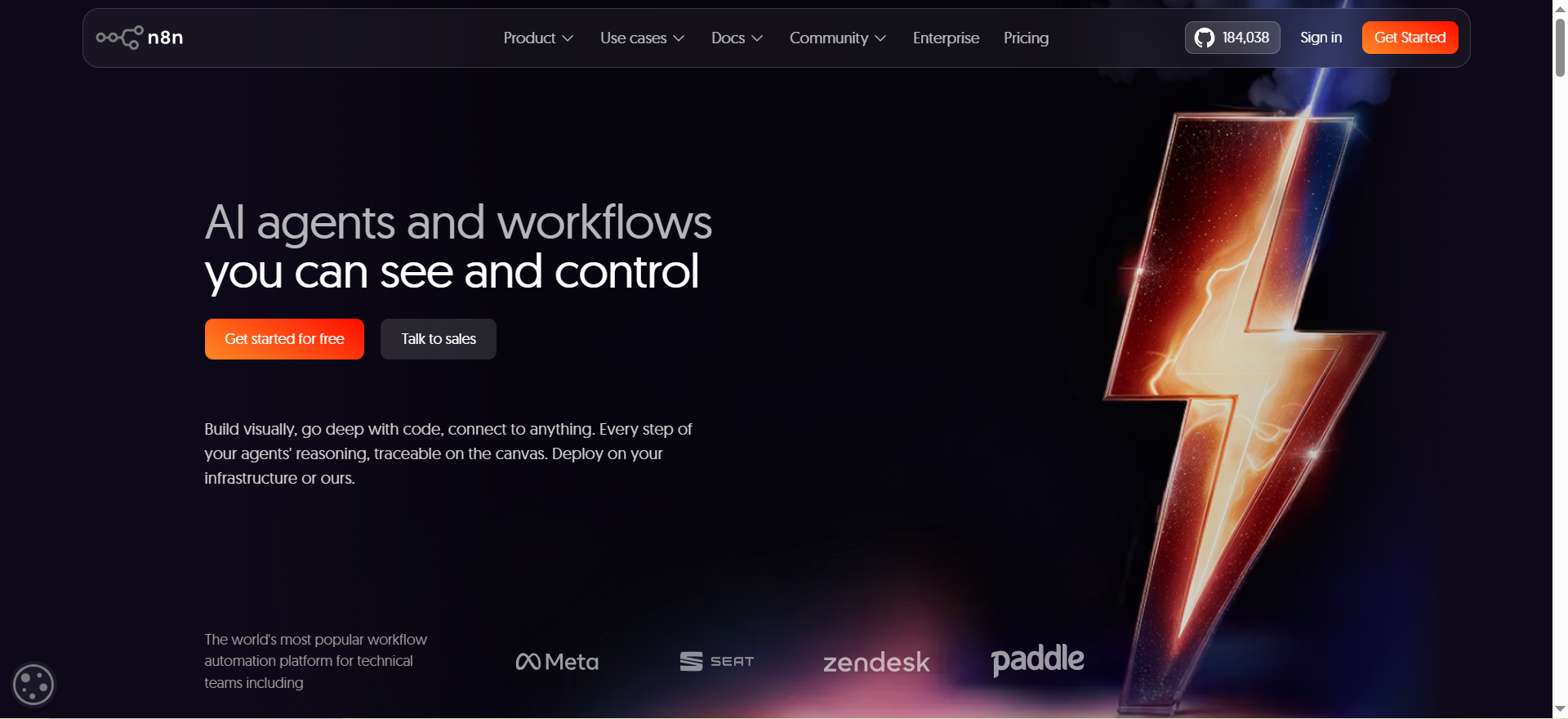
n8n is an open-source workflow automation platform designed for developers and technical teams. You can self-host it (on your own servers) or use n8n Cloud. With 400+ integrations, custom JavaScript and Python code steps, and 70+ AI-dedicated nodes, n8n bridges low-code simplicity and full programming flexibility. Execution-based pricing (per workflow run, not per step) makes it 80-90% cheaper than competitors at scale.
Why teams use it
Developers love n8n because it doesn't force you into a visual-only box. You can drop Python or JavaScript code directly into a workflow, call libraries, and compute complex logic without leaving the platform. The open-source nature means no vendor lock-in—if you stop paying, your workflows still run on your servers. Pricing-wise, a 10-step workflow costs the same as a 1-step workflow (per execution), making it predictable and cheap at volume.
What it's good for
Sophisticated automation for regulated industries (healthcare, finance) where self-hosting is mandatory. Teams evaluating enterprise AI automation tools often land on n8n for this reason. Complex sales workflows with custom logic: scoring leads via machine learning models, data enrichment from multiple sources, and conditional multi-branch routing. Integrating legacy systems and APIs that other platforms struggle with. Building AI workflows using LangChain integration and language model nodes. Any scenario where execution volume is high (hundreds or thousands of runs per day) because per-execution pricing scales better than per-step or per-task pricing.
When it's a good fit
Your team includes engineers or technical ops staff. You need self-hosted infrastructure for compliance or data residency. Your workflows are complex and benefit from custom code. You run high-volume automation (1,000+ executions daily) and need transparent, scalable pricing. You want open-source software to avoid vendor lock-in. You're building AI workflows and need native LangChain support.
When it's not a good fit
Your team has zero technical experience (n8n requires some coding or willingness to learn). You need a fully managed SaaS with minimal operational burden (self-hosting requires database setup, server maintenance). You want the absolute broadest app library (400 integrations is large but less than Zapier's 7,000). You operate in a non-technical role and need drag-and-drop simplicity.
How to use it
For n8n Cloud, sign up and create a workflow. Add trigger nodes (webhook, schedule, or polling), action nodes (HTTP requests, database queries, API calls), and optionally code nodes for custom logic. Write JavaScript or Python directly in the code node. Map data between nodes using n8n's expression editor. Deploy the workflow and monitor executions. For self-hosted, download the Docker image or source code, set up your database (PostgreSQL or SQLite), configure environment variables, and run locally or on your infrastructure.
Key capabilities
Self-hosted and cloud deployment options400+ integrations (REST APIs, GraphQL, databases)JavaScript and Python code nodes70+ AI nodes (LLMs, embeddings, RAG)LangChain integrationSub-workflow execution (modular workflow reuse)Conditional branching and error handlingBuilt-in database support (query relational or NoSQL databases)Webhook triggeringSchedule-based triggersDetailed execution history and debugging
Pricing
Self-hosted: Free (unlimited workflows, users, executions on your infrastructure). n8n Cloud Starter: €24/month (2,500 executions, 5 GB storage). Pro: €60/month (10,000 executions, 50 GB storage). Business: €800/month (40,000 executions, 200 GB storage). Enterprise: custom pricing for dedicated infrastructure and SLA.
Free tier?
Yes. Self-hosted n8n is perpetually free with unlimited workflows and users. n8n Cloud's free tier is generous by industry standards—you can run test workflows for free before upgrading to a paid plan.
Downsides / limitations
Self-hosting requires technical infrastructure knowledge (Docker, databases, networking). Smaller integration library than Zapier (but 400+ covers most needs). Less polished UI/UX compared to Make or Zapier. Community support is strong but smaller than larger platforms. Monitoring and alerting require external tools at enterprise scale. Learning curve for non-developers, even though n8n markets itself as low-code.
4. Workato
What it does
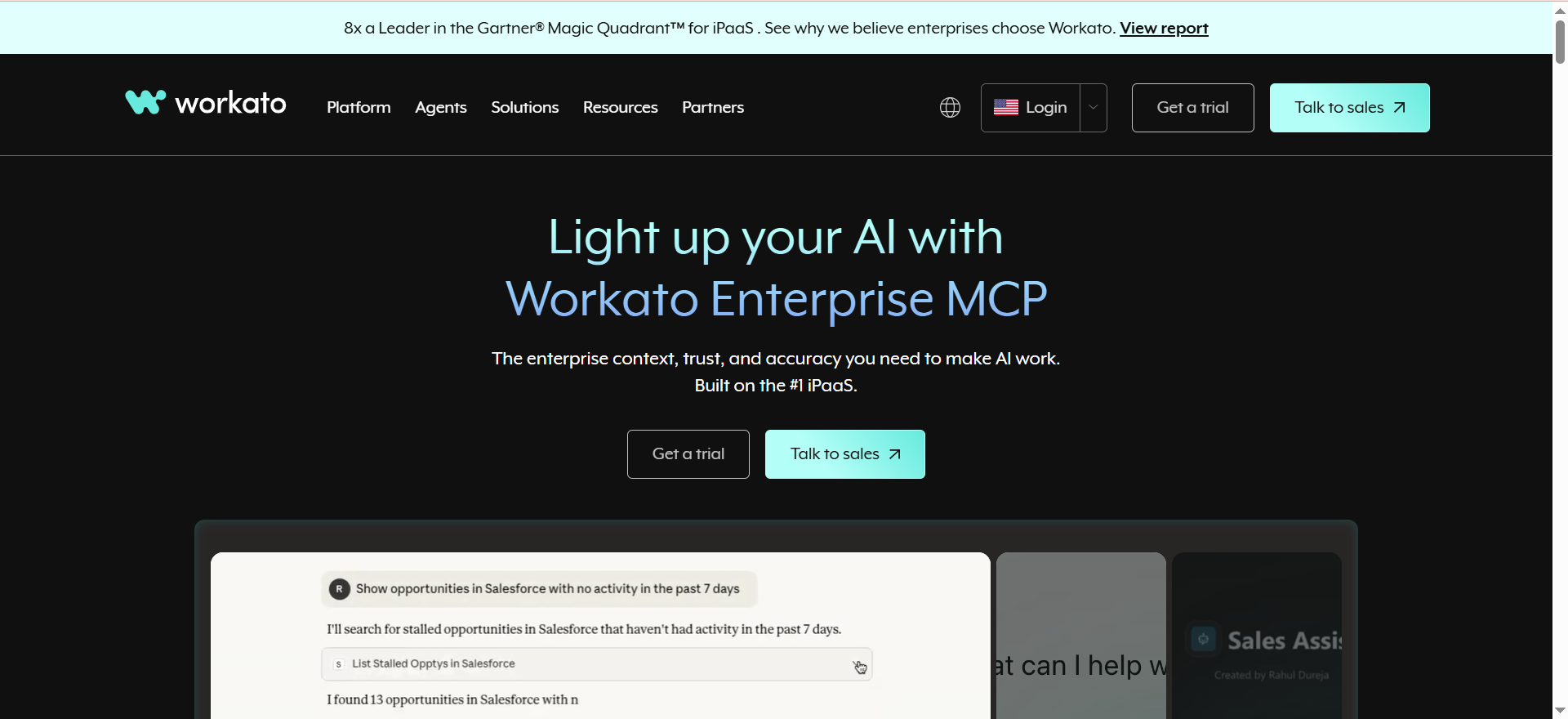
Workato is an enterprise-grade integration and automation platform built for large organizations. With 1,200+ app integrations, unlimited connections and workflows, and advanced features like agentic capabilities (in Workato One edition), it handles complex multi-system orchestration. SOC 2 Type II compliance, MCP functionality, and an Agent Library make it suitable for regulated industries and enterprises managing thousands of workflows.
Why teams use it
Large enterprises with complex integration requirements choose Workato because it scales without breaking. You can build once and deploy across departments without fear of hitting execution limits. The platform offers dedicated support, SLA guarantees, and the security posture required by Fortune 500 companies. Workato One adds autonomous agents that can handle multi-step sales tasks without human intervention, blending RPA, workflow automation, and AI into a single platform.
What it's good for
Enterprise-wide sales workflow orchestration: syncing data across Salesforce, NetSuite, HubSpot, Marketo, and custom systems. Multi-tenant architectures where you need to isolate workflows by customer or region. Regulated industries (finance, healthcare, legal) requiring SOC 2 Type II compliance and audit trails. Building sales operations infrastructure at scale: lead distribution, complex pipeline management, and real-time CRM synchronization. Autonomous agents that can qualify leads, schedule meetings, and nurture deals without human action.
When it's a good fit
You're an enterprise with annual revenue >$100M. You operate in a regulated industry requiring compliance documentation. You manage workflows across multiple departments or business units. You need dedicated support and SLA guarantees. You want agentic automation that can autonomously execute complex sales tasks. You're integrating 5+ critical systems and need a stable, battle-tested platform.
When it's not a good fit
You're a startup or SMB operating on a limited budget (minimum entry is $10K-$15K annually). You need quick time-to-value (Workato implementations often take weeks or months). Your technical team is small and you can't dedicate resources to platform configuration. You want open-source flexibility or self-hosted control (Workato is managed SaaS only). You have simple, linear workflows that don't justify the platform's complexity and cost.
How to use it
Work with Workato's professional services or a certified partner to assess your requirements. Map your integration points (which systems need to talk, how often, what data flows). Build connectors for each system using Workato's connector framework. Design workflows in the IDE, test in a sandbox environment, and promote to production. Configure security, audit logging, and compliance controls. Monitor execution dashboards and set up alerting for failures. Use the Agent Library to deploy pre-built agentic templates for common sales tasks.
Key capabilities
- 1,200+ app integrations
- Unlimited connections, workflows, and collaborators
- Agentic automation (Workato One edition)
- SOC 2 Type II compliance
- MCP functionality for LLM integration
- Dedicated connectors for Salesforce, SAP, Oracle, and major ERPs
- Audit trails and data residency controls
- Sub-workflow and webhook-based architecture
- Real-time data sync and batch processing
- Advanced error handling and retry logic
- Agent Library with pre-built templates
Pricing
Custom and enterprise-only. Rough estimates: SMB-tier starts ~$10K-$15K annually. Mid-market ~$62K-$78K annually. Enterprise $84K-$128K+ annually. Pricing scales with execution volume, integrations, and support level. Workato One (with agentic capabilities) adds premium pricing.
Free tier?
No. Workato is enterprise-focused with no free tier. You must talk to sales to understand your organization's pricing.
Downsides / limitations
Expensive—smallest footprint is still 5+ figures annually, out of reach for early-stage companies. Long sales and implementation cycles (weeks to months before automation runs). Requires dedicated resources for configuration and maintenance. Less community-driven than open-source or SMB platforms. Vendor lock-in—no self-hosted or open-source option. Steep learning curve for the platform's advanced features.
5. UiPath
What it does
UiPath is an enterprise robotic process automation (RPA) platform with AI and machine learning capabilities built in. Unlike workflow automation platforms that connect apps via APIs, RPA automates by controlling the UI itself—mimicking human actions like clicking buttons, filling forms, and reading screens. UiPath combines RPA with AI/ML, OCR (optical character recognition), and image recognition to automate complex, legacy-system-heavy workflows.
Why teams use it
Sales operations teams handling legacy systems (legacy CRMs, ERP systems without APIs) need RPA because those systems were never built for integration. UiPath's OCR and image recognition handle scanning invoices, extracting data from unstructured documents, and recognizing screen changes. Self-healing automation detects UI changes and adapts, reducing maintenance overhead. Enterprises already invested in UiPath for back-office RPA can extend it to sales workflows without introducing new platforms.
What it's good for
Automating sales workflows on legacy or non-API-friendly systems. Extracting data from complex documents (contracts, invoices) and populating CRM systems. Processing high-volume, repetitive sales tasks: data entry, form filling, and report generation. Building intelligent automation that combines RPA with AI: document understanding using OCR, sentiment analysis on customer emails, and predictive lead scoring. Enterprises that already have UiPath deployed and want to expand use cases.
When it's a good fit
You operate at enterprise scale with legacy system integration challenges. Your workflows involve substantial manual data entry or screen interaction. You need OCR and document intelligence for sales or contract processing. You're already using UiPath for other business processes and want to extend it. You can afford the licensing costs and have the infrastructure to support enterprise RPA.
When it's not a good fit
You have a modern SaaS stack with good APIs (Salesforce, HubSpot, Outreach)—RPA is overkill. You're budget-constrained and need affordable automation (UiPath is expensive). You need quick deployment (RPA projects require detailed process analysis and UI/OCR training). Your workflows are simple and don't justify the complexity of RPA. You want open-source or self-hosted flexibility with minimal cost.
How to use it
Use UiPath Studio (the visual editor) to design workflows: record screen actions (click, type, extract), add logic and decision trees, and integrate data from APIs or databases. Train OCR models on document types if handling unstructured data. Package the automation as a reusable component. Deploy to UiPath robots (Attended or Unattended) that execute on-schedule or on-demand. Monitor execution in UiPath Insights, and iterate based on failures or process changes.
Key capabilities
- RPA automation (UI-based process execution)
- OCR and document intelligence
- AI/ML for predictive automation and anomaly detection
- Self-healing automation (detects UI changes and adapts)
- Low-code visual designer with full code support (C#, Java, Python)
- Attended and Unattended robot types
- Process mining
- Bring-your-own AI models (Enterprise tier)
- Scalable robot infrastructure
- Detailed execution logs and audit trails
Pricing
Free: $0/month for individual use with basic attended automation (available on account downgrade). Basic: $25/month for testing and light production use. Standard: custom pricing for mid-market production deployments. Enterprise: custom pricing, typically $50K-$1M+ annually depending on robots, features, and support.
Free tier?
Yes. UiPath offers a free plan with basic attended automation capabilities for individual use. The Basic plan starts at $25/month for testing and light production. Production use at scale requires Standard or Enterprise licensing.
Downsides / limitations
Expensive—licensing costs scale quickly with robots and concurrent executions. Slower than API-based automation (UiPath controls UI, which is inherently slower than direct API calls). Fragile to UI changes (robots record pixel coordinates and element selectors; if the application redesigns, automations break). Long implementation timeline. Requires infrastructure planning. Overkill for simple integrations that could be solved with API-based tools. Learning curve for non-developers.
How Do AI Sales Automation Tools Actually Work?
AI sales automation tools operate on a trigger-action-response model. A trigger (a new lead form submission, a CRM stage change, an incoming email) initiates a workflow. The system then executes a series of actions: extracting data, enriching it via external APIs, running through AI models for scoring or sentiment analysis, and finally taking action (creating CRM records, sending personalized emails, routing to sales reps). At the core, most AI automation tools connect your apps via APIs or webhooks, map data fields between systems, and execute logic on a schedule or event-based trigger. AI components enhance this by automating judgment calls—which leads are sales-qualified, what tone should a follow-up email adopt, which rep should own the deal—that previously required human review.
What Should You Look for in an AI Sales Automation Platform?
When evaluating AI sales automation software, consider four dimensions: ease of use (how quickly non-technical users can build workflows), integration breadth (does it connect to your core tools: CRM, email, forms, scheduling?), AI capability (native support for language models, scoring, enrichment), and cost structure (how pricing scales with your usage). Ask whether the platform offers self-hosted options if you operate in a regulated industry. Test the free tier with a real workflow—don't rely on marketing materials alone. Check user reviews on independent sites (G2, Capterra) to understand real-world pain points. Finally, assess support: startups can survive with community forums, but enterprises need dedicated account management and SLAs.
How Much Do AI Sales Automation Tools Cost?
Pricing varies wildly. Zapier's free tier (100 tasks/month) suits testing; scaling to 2,000 tasks/month costs $73.50/month (billed annually). Make's free tier includes 1,000 credits; mid-market usage runs $30-$100/month. n8n is free self-hosted or €24-€60/month for cloud. UiPath starts at $25/month free tier but scales to hundreds of thousands annually at enterprise. Workato is enterprise-only at $10K-$15K minimum. For SMBs, budget $50-$300/month. For enterprises, expect $50K-$500K+ annually. A key consideration: execution-based pricing (n8n) is cheaper at volume than task-based (Zapier) or credit-based (Make) systems. Do the math with your expected workflow volume before committing.
Can Small Businesses Use AI Sales Automation?
Absolutely. Zapier and Make are purpose-built for SMBs and startups. Both offer free tiers and affordable entry prices ($10-$30/month). n8n's free self-hosted option is also viable if you have technical resources. Most SMBs start with simple workflows (form-to-CRM, email on signup) and graduate to more complex multi-step automation. Our guide to AI SDR tools for sales automation covers what that graduation path looks like. The challenge isn't capability—modern platforms are powerful—but resource allocation. Small teams often lack dedicated ops staff to build and maintain automation, so choosing a user-friendly platform matters more than raw power.
What's the Difference Between RPA and AI Sales Automation?
RPA (robotic process automation) automates by mimicking human UI interaction—clicking buttons, filling forms, reading screen text. It works on legacy systems without APIs and is slower but handles any workflow. AI sales automation focuses on decision-making: scoring leads, drafting emails, routing opportunities. It integrates via APIs and is faster but requires API support. In practice, most modern AI sales automation platforms for B2B teams use API-based workflows (Zapier, Make, n8n) with AI decision-making layers. UiPath stands apart as a true RPA platform, useful when your sales tech stack includes non-integrable legacy systems.
How to Integrate AI Sales Automation With Your CRM?
Most platforms offer native CRM connectors. In Zapier, create a Zap with your CRM as the trigger (new lead) and your action app (email, scoring service) as the response. In Make, add Salesforce or HubSpot modules and map fields. n8n supports custom REST API calls if native connectors are missing. The key step is field mapping: ensuring that data from your form (email, company, budget) correctly maps to CRM fields. Use webhook triggers from your CRM to initiate workflows in real time. Test with sample data in a non-production environment before going live.
What Are the Risks of AI Sales Automation?
Automation quality depends on input data quality. If your lead form captures garbage data, automation will propagate garbage to your CRM. Over-automation can hurt relationships—a prospect wants to hear from a human, not auto-generated emails. Email deliverability suffers if you send too many automated messages too quickly (ISPs flag bulk mail as spam). AI models can perpetuate bias: if your training data is skewed, scoring models will be skewed. Privacy and compliance matter; GDPR and CCPA regulate automated outreach and data handling. Mitigate by regularly auditing automation quality, combining automation with human judgment, and ensuring compliance from day one.
How to Measure ROI From AI Sales Automation Tools?
Track three metrics: time saved (hours per week freed up, multiplied by fully-loaded team cost), conversion improvement (did automation increase lead-to-customer conversion?), and revenue impact (did pipeline coverage increase?). A sales rep that spends 10 hours/week on manual data entry could free up time for relationship-building—assign a dollar value based on rep salary. If automation enables your team to handle 50% more leads with the same headcount, that's ROI. Measure before and after: run a control group against your automated group. Most companies see payback within 3-6 months if implementation is solid.
Are No-Code Automation Tools Good Enough for Sales Teams?
Yes, for most workflows. No-code platforms like Zapier and Make handle 80% of sales automation use cases: lead capture and routing, email sequences, CRM syncing, and basic scoring. They're fast to deploy and require no engineering resources. The 20% of complex workflows—multi-system orchestration, custom ML models, legacy system integration—benefit from applied generative AI process automation tools or hiring engineers. For startups and SMBs without engineering teams, no-code is the right starting point.
Which AI Sales Automation Tool Is Best for Startups?
Zapier wins for bootstrapped startups: free tier handles testing, pricing scales with usage, and no code required. Make is the runner-up—also affordable, slightly more powerful for multi-step workflows. n8n's self-hosted free option appeals to technical founders who can manage infrastructure. Avoid Workato and UiPath—too expensive and complex for early-stage. Start with a single workflow (lead form to CRM), validate the value, then expand. As you scale and revenue grows, you can graduate to more powerful platforms — see our comparison of AI sales automation tools for mid-market companies.
FAQs
Use Zapier or Make. Both offer free tiers, visual builders, and pre-built templates. You can have a lead-to-CRM workflow live in under an hour. Avoid platforms requiring dedicated implementation (Workato, UiPath) unless you have budget and timeline.
Mostly yes. Most platforms can export workflows or data via APIs. However, switching takes work—you'll need to rebuild workflows, retrain team members, and validate new logic. Design with portability in mind: document your workflows and keep integrations loosely coupled.
For simple automation (Zapier, 5-10 workflows), non-technical marketers or sales ops coordinators handle it. For complex automation (Make, n8n, 50+ workflows), a dedicated person or engineer is helpful. For enterprise (Workato, UiPath), you'll need a team: architects, developers, and analysts.
Document your workflows (who is contacted, when, why). Ensure opt-in compliance (only contact leads who consented). Use authenticated APIs where possible. Audit automation decisions regularly for bias. Store PII securely (use encrypted fields, limit access). For GDPR/CCPA, provide data deletion capabilities and audit trails.
Most platforms offer error handling: retry logic (automatically retry a failed step), dead-letter queues (failed executions stored for manual review), and alerting (Slack or email notification on failure). Set up monitoring dashboards to track execution health. Test workflows in non-production before promoting.